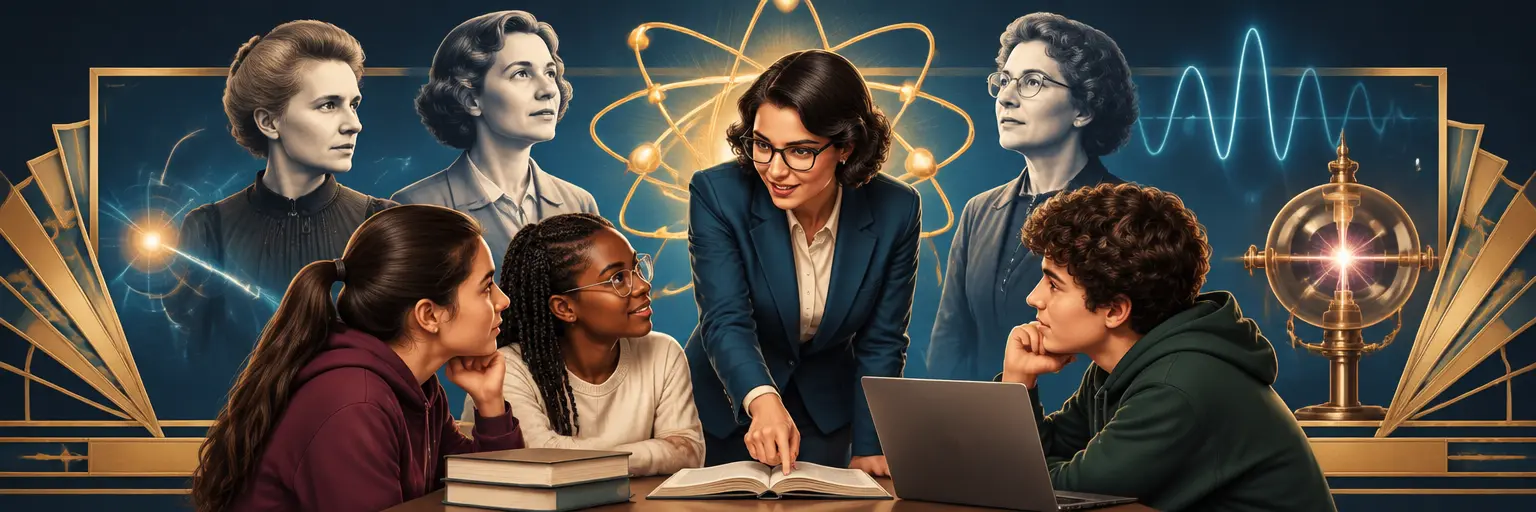
Empower Your Classroom with Women in Physics Lesson Plans
Dive into our curated collection of high school lesson plans centered on the remarkable women who shaped physics. Designed for educators, these resources turn inspiring biographies into actionable, standards-aligned activities. From Marie Curie’s radioactivity research to modern astrophysicists, each plan integrates history, critical thinking, and hands-on problem solving. Perfect for physics, physical science, or history of science courses, these plans help you highlight diverse role models while meeting curriculum goals. Explore engaging experiments, discussion prompts, and assessment tools that make female scientists' contributions tangible for students.
🔬 Biographical Deep Dives & Timeline Projects
These lesson plans transform biographical data into interactive timelines and narrative projects. Students explore the lives of pioneers like Lise Meitner, Chien-Shiung Wu, and Emmy Noether, mapping their discoveries against historical and social contexts. Each plan includes curated primary source excerpts, video links, and guided research questions that encourage students to analyze obstacles these women overcame—from institutional sexism to wartime displacement—while evaluating their scientific methodology.
Expect ready-to-use worksheets for timeline creation, peer-presentation rubrics, and reflection journals. Teachers can adapt activities for single 50-minute classes or multi-day projects. The focus is on connecting personal perseverance with scientific breakthroughs, giving students a holistic view of how gender shaped physics history. These lessons align with Common Core literacy standards and NGSS practices like obtaining, evaluating, and communicating information.
⚛️ Hands-On Experiments Inspired by Their Work
Bring theory to life with labs that replicate or simulate experiments by female physicists. For example, recreate aspects of Marie Curie’s radiation detection using simple cloud chambers, or model Wu’s parity violation experiments with polarized light and mirrors. Each lesson provides clear material lists, safety guidelines, and step-by-step procedures that make abstract concepts accessible. We emphasize low-cost, classroom-friendly setups that spark curiosity and foster collaborative inquiry.
These activities are designed to deepen understanding of core physics principles—radioactivity, weak nuclear force, symmetry, and electromagnetic radiation—while crediting the female scientists behind them. Included are pre-lab discussion prompts, data collection sheets, and post-lab analysis questions that tie results back to historical context. Ideal for honors or AP Physics classes, these experiments also serve as engaging demonstrations for standard tracks.
📝 Critical Thinking & Ethics in Science Debates
Stimulate rigorous discussion with structured debate modules focused on ethical dilemmas and recognition disputes in physics history. Lessons tackle topics like Jocelyn Bell Burnell’s overlooked Nobel Prize, Rosalind Franklin’s uncredited DNA work, and the politics of discovery attribution. Students examine primary documents, editorial cartoons, and scientific papers to form evidence-based arguments in mini-tribunals or Socratic seminars. Each plan includes role cards, debate rubrics, and scaffolding for shy students.
The goal is to hone argumentation, source analysis, and historical empathy. By comparing how male colleagues received credit, students confront systemic bias while celebrating the science itself. These sessions work well in interdisciplinary units with history or social studies departments and are adaptable for virtual or hybrid learning. Post-debate reflection prompts encourage personal connections to modern STEM equity issues.
📊 Data Analysis & Mathematical Modeling Challenges
Empower students to engage with original graphs, spectral data, and lab notebooks from women physicists. Lesson plans feature real datasets—such as Vera Rubin’s galaxy rotation curves for dark matter or Henrietta Leavitt’s period-luminosity relation for Cepheid variables—presented in student-friendly spreadsheets. Learners practice curve fitting, error analysis, and deriving empirical laws, replicating the very reasoning that led to landmark discoveries. No prior coding required; Excel or graphing calculators suffice.
These hands-on analytics build quantitative literacy and show that physics isn’t just memorization—it’s interpretive storytelling with numbers. Each set includes teacher solution guides, differentiated levels of complexity, and extension ideas for science fair projects. By working with authentic data, students appreciate the meticulous care behind breakthrough findings, inspiring respect for the female scientists’ exacting methods.
🧪 Multimedia & Project-Based Learning Toolkits
For longer units, these comprehensive kits combine video interviews, podcast episodes, and archival photos into inquiry-driven PBL tasks. Students produce mini-documentaries, digital exhibits, or podcast episodes profiling a chosen physicist. Lesson plans provide storyboarding templates, research checklists, and peer-review criteria. The kits also integrate digital tools like Canva for infographics and WeVideo for editing, making final projects polished and shareable for school showcases or online portfolios.
Each toolkit aligns with ISTE technology standards and encourages student choice, boosting engagement and ownership. Teachers receive pacing guides for 2–3 week modules, formative assessment checkpoints, and rubrics for grading diverse outputs. These projects foster research skills, creative communication, and deep content knowledge—all while showcasing women’s legacies in physics. Perfect for STEM electives or annual heritage months like Women’s History Month.
Frequently Asked Questions
Do these lesson plans align with Next Generation Science Standards (NGSS)?
Yes, every plan explicitly lists relevant NGSS performance expectations, particularly in physical science (PS1, PS2, PS4) and earth/space (ESS1). We also map to Common Core math and literacy standards, making integration into existing curricula seamless for all 50 states.
Are materials adaptable for online or hybrid learning?
Absolutely. Most lessons include digital versions of handouts, virtual lab simulations, and breakout discussion guides. For laboratory experiments, we offer video demonstrations and data sets for students without physical access, ensuring equity in any learning environment.
What grade range within high school is most suitable?
The plans are primarily designed for grades 9–12, with differentiation options for lower and upper levels. Honors and AP Physics classes can tackle advanced mathematical modeling, while standard courses focus on conceptual understanding and historical context.
Do I need advanced physics knowledge to teach these lessons?
No. Each plan includes background primers, teacher notes with simplified explanations, and answer keys. Even non-physics specialists can lead engaging sessions, as the emphasis is on historical narrative and inquiry, not complex derivations.
Can these lesson plans support a school-wide Women in Science celebration?
Definitely. The multimedia and PBL kits include event planning guides, display templates, and cross-curricular tie-ins with English and art. They’re perfect for creating school assemblies, science fair booths, or permanent hallway exhibits on women physicists.