Beyond Academia: The Impact of Women Scientists in Industry and Government
🌟 Explore how women scientists in industry and government have profoundly shaped innovation and policy, demonstrating their vital impact beyond academia. Their…
Read article
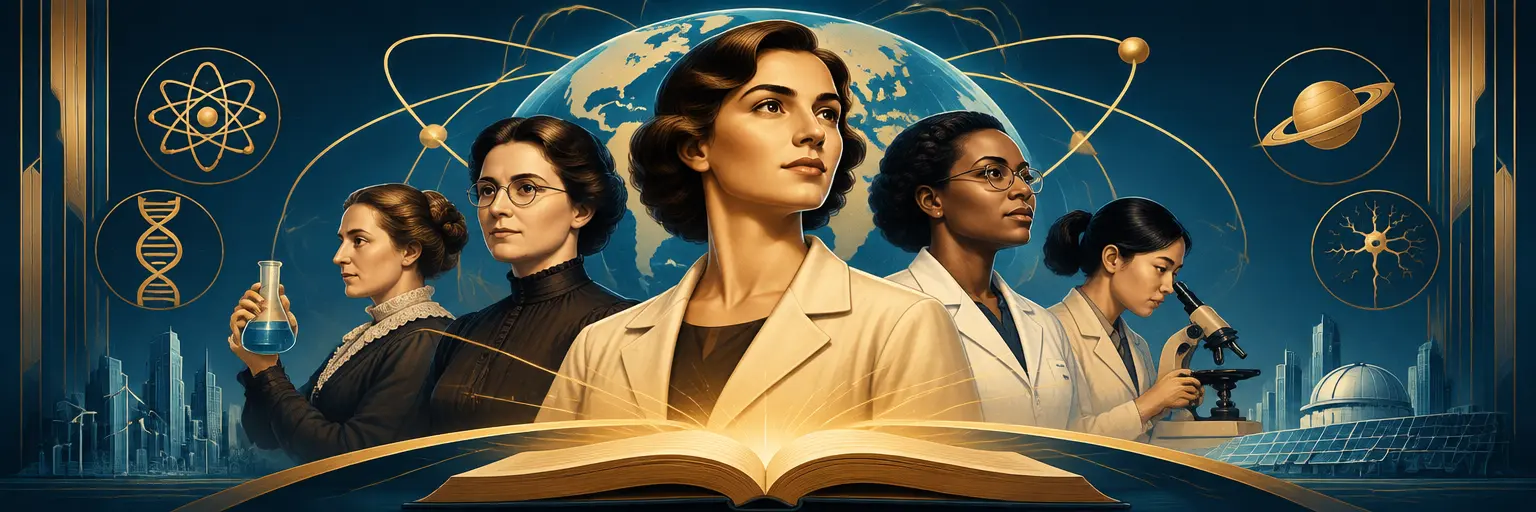
Discover how women’s scientific breakthroughs have reshaped our world, from life-saving medical advances to revolutionary physics, yet remain undervalued or erased in mainstream history. Impact & Legacy isn’t just about past achievements—it’s about the ripple effects on modern research, education, and policy. By tracing the untold influence of female pioneers, we uncover how their work accelerated innovation, mentored future generations, and challenged institutional biases that still echo today. Explore the long-term societal shifts sparked by their discoveries, the systemic barriers they dismantled, and why recognizing their legacy is crucial for inspiring the next wave of STEM leaders. Uncover the often-hidden threads connecting their contributions to current technologies, medical treatments, and environmental solutions—and see how honoring these narratives isn’t just about the past, but about shaping a more inclusive and innovative scientific future.
🌟 Explore how women scientists in industry and government have profoundly shaped innovation and policy, demonstrating their vital impact beyond academia. Their…
Read article
🌟 Celebrating women in science exclusion, this article highlights trailblazing female scientists who challenged gender barriers, transforming their fields and inspiring future…
Read article
🌟 Women scientists animal welfare have revolutionized veterinary science, demonstrating groundbreaking compassion and innovation. Their pioneering work continues to inspire future generations,…
Read article
🌟 Discover how pioneering women scientists overlooked in history challenged norms, transformed fields, and left a lasting legacy—proving that their visionary ideas…
Read article
🌟 Celebrating WomenInScienceHistory.com, this article highlights how women’s contributions to mathematics have profoundly shaped modern science, showcasing pioneering female mathematicians whose insights…
Read article
🌿 Women scientists' biodiversity conservation efforts have transformed environmental protection, showcasing how their pioneering work and dedication are essential for safeguarding our…
Read article
🌟 Women’s contributions to science have profoundly shaped industry, demonstrating that women’s science industry economic impact drives innovation and growth. Celebrating these…
Read article
🌟 Celebrating women scientists' historical recognition legacy, this article honors the unsung victories of pioneering women who overcame barriers, transforming science and…
Read article
🌟 Celebrating the transformative impact of women scientists in inclusive community building, this article highlights how collaboration over competition has fostered diverse,…
Read article
🌟 Celebrating women in computer science history, this article highlights pioneering female scientists who revolutionized technology, overcame significant challenges, and continue to…
Read article
🌟 Women's persistence has shaped scientific history, proving that unwavering dedication can lead to delayed but transformative impacts. Celebrating these stories inspires…
Read articleWelcome to our dedicated exploration of how women scientists have shaped the world far beyond their own discoveries. This subcategory delves into the ripple effects of their work—from shifting research paradigms to inspiring entire generations of female researchers. Here, we examine not just the "what" they achieved, but the enduring "why" it matters today, connecting historical breakthroughs to modern STEM culture, educational policy, and global innovation. Expect a rich tapestry of analytical insights, historical context, and forward-looking perspectives that position these contributions as foundational pillars of the scientific enterprise.
Women scientists often brought unique perspectives and interdisciplinary approaches that challenged established norms. For example, Barbara McClintock's meticulous genetic work on maize led to the concept of transposable elements, a paradigm shift that was initially dismissed but later earned a Nobel Prize. Similarly, primatologist Jane Goodall's immersive, empathetic observation methods revolutionized animal behavior studies. Their legacies are not just discoveries but methodological blueprints that emphasized patience, context, and holistic thinking, which are now integral to fields like ecology, genetics, and social sciences. This section underscores how their innovative approaches have become standard practice in modern laboratories and research institutions.
The impact extends to collaborative science, where women like Chien-Shiung Wu demonstrated the power of experimental rigor in overthrowing theoretical assumptions—her Wu experiment disproved the law of conservation of parity. Their work proved that challenging dogmatic frameworks yields better science. By examining these methodological contributions, we see a clear lineage from their pioneering efforts to today's emphasis on reproducible, transparent, and ethically grounded research. Their legacies remind us that science advances not only by new data but by new ways of seeing and asking questions, a lesson that continues to inform doctoral training and peer review worldwide.
The legacy of women in science transcends laboratory walls; it has reshaped societal attitudes and educational pathways. When figures like Marie Curie or Katherine Johnson are taught in classrooms, they serve as powerful role models that challenge gender stereotypes in STEM. Educational programs worldwide now actively integrate these narratives to counteract implicit bias and encourage young girls to pursue physics, engineering, or mathematics. The visibility of these women has also influenced curriculum design, with textbooks increasingly highlighting their contributions, thereby normalizing female excellence in science. This shift is measurable: increased enrollment of women in STEM majors correlates with the popularity of such historical narratives in school systems.
Beyond education, their stories have fueled grassroots movements and public science communication. Documentaries, podcasts, and social media campaigns often cite these pioneers to advocate for equal funding and representation in research institutions. For instance, the #DistractinglyHonest movement, sparked by a photo of Tim Hunt, drew heavily on historical precedents of discrimination to push for policy changes. Thus, the impact is cyclical—historical accomplishments provide the ammunition for contemporary advocacy, ensuring that the struggle for equity in science remains a visible and active struggle, with these women serving as enduring cultural icons of resilience and brilliance.
The contributions of women scientists have also forced a critical re-evaluation of how recognition is distributed. Historically, female scientists like Rosalind Franklin saw their work credited to male peers, leading to systematic under-recognition. However, their legacy has spurred institutional reforms, including the establishment of gender-balanced award committees and dedicated prizes for women in science, such as the L'Oréal-UNESCO For Women in Science Awards. This reform extends to mentorship pipelines, where successful female scientists now actively sponsor junior researchers, creating networks that mitigate the "leaky pipeline" phenomenon. Their persistent influence has made scientific institutions more transparent about promotion criteria and bias training.
Moreover, the documentation of their struggles has led to historical corrections and apologies. For example, the Royal Society posthumously recognized Franklin's role in DNA discovery, and several institutions have renamed buildings or fellowships in honor of women pioneers. This recognition is not merely symbolic; it shifts institutional culture by creating visible touchstones of female achievement. The legacy here is a scientific community that is more self-reflective and accountable for its historical biases, actively working to ensure that future contributions are evaluated on merit alone. This section highlights how paleontologists, chemists, and astronomers have been posthumously inducted into academies, correcting historical oversights.
Women's scientific legacies are uniquely pervasive because their foundational work frequently underpins multiple industries. Katherine Johnson's orbital mechanics calculations were critical to NASA’s space missions, but the same mathematical principles are used in modern satellite communication and GPS technology. Similarly, Hedy Lamarr's frequency-hopping technology, initially developed for torpedo guidance, is a precursor to Wi-Fi and Bluetooth. The cross-disciplinary nature of their contributions means their impact multiplies over time, from medical imaging (based on pioneering work by female physicists) to artificial intelligence algorithms that draw on early female mathematicians' logic. This section explores case studies where a single contribution has spawned entire technological ecosystems.
In health sciences, the legacy of women like Alice Ball, who developed the first effective leprosy treatment, or Virginia Apgar, whose scoring system saves countless newborns, demonstrates how their work directly influences clinical practice and public health policy. Their interdisciplinary vision often connected chemistry, biology, and ethics in ways that modern research teams now emulate. By tracing these threads, we understand that female innovation is not fringe but central to technological progress, influencing sectors as diverse as renewable energy (from early solar cell work) and oceanography. Their legacy is a call for integrated, problem-solving approaches that transcend narrow specialization.
Women scientists have historically used their platforms to advocate for responsible research, often connecting scientific advancement with social justice. Rachel Carson’s "Silent Spring" launched the environmental movement by courageously challenging chemical corporations, establishing a legacy of scientists as public watchdogs. Similarly, physicist Dorothy Hodgkin used her influence to campaign for nuclear disarmament, while geneticist Barbara McClintock’s dedication to accurate science resisted commercial pressures. These women demonstrated that scientific excellence demands ethical vigilance, not just technical skill. Their legacy informs contemporary debates on climate change, genetic editing, and AI ethics, where women scientists are prominent voices for precautionary principles and equitable deployment.
Furthermore, their experiences of marginalization have made them acutely aware of power imbalances within science, leading to advocacy for open data, peer review integrity, and the protection of junior researchers from harassment. The legacy of women like Henrietta Lacks (whose cells were used without consent) has catalysed patient rights movements and ethical consent protocols. Their impact is thus a moral compass for the scientific community, pushing for practices that respect human dignity and environmental sustainability. This section highlights how their advocacy has shaped policy frameworks, from the Belmont Report to current institutional review boards, ensuring that future scientific achievements are ethically grounded and socially responsible.
Studying their legacy breaks gender stereotypes and provides role models that encourage girls to pursue STEM. It also corrects historical inaccuracies, showing that scientific progress is a collective effort. This enriched curriculum fosters critical thinking about bias and promotes a more inclusive scientific culture, which has been shown to improve innovation and problem-solving in diverse teams.
Common barriers included exclusion from universities and professional societies, limited access to funding and laboratory space, and the routine denial of credit for their work. They also faced social disapproval for pursuing careers, which often forced them to work as unpaid assistants to male relatives. These systemic obstacles required extraordinary persistence, as seen in the lives of pioneers like Maria Mitchell and Émilie du Châtelet.
While many early awards excluded women, institutions have recently expanded eligibility criteria and posthumous recognition. For example, the Nobel Prize now actively reviews nomination data for gender bias. Additionally, new prizes specifically for women in science, like the Nature Research Awards, were created, and many universities have renamed positions or honors after female pioneers to institutionalize their recognition.
Absolutely. Their methodological rigor, interdisciplinary curiosity, and resilience in the face of adversity are timeless qualities. Their willingness to challenge consensus and communicate science to the public offers a blueprint for impactful research. Moreover, their advocacy for ethical practice and mentorship remains directly applicable to navigating today’s competitive, high-stakes research environment.
The "leaky pipeline" refers to the disproportionate loss of women from STEM at each career stage, from undergraduate to senior faculty. The legacy of female scientists helps by providing visible proof that women can succeed, which boosts retention. Their stories also spur institutional changes like flexible work policies, bias training, and targeted mentorship programs that actively plug the leaks by supporting women through critical transitions.