Welcome to Women in Science & Philosophy: Where Inquiry Meets Insight
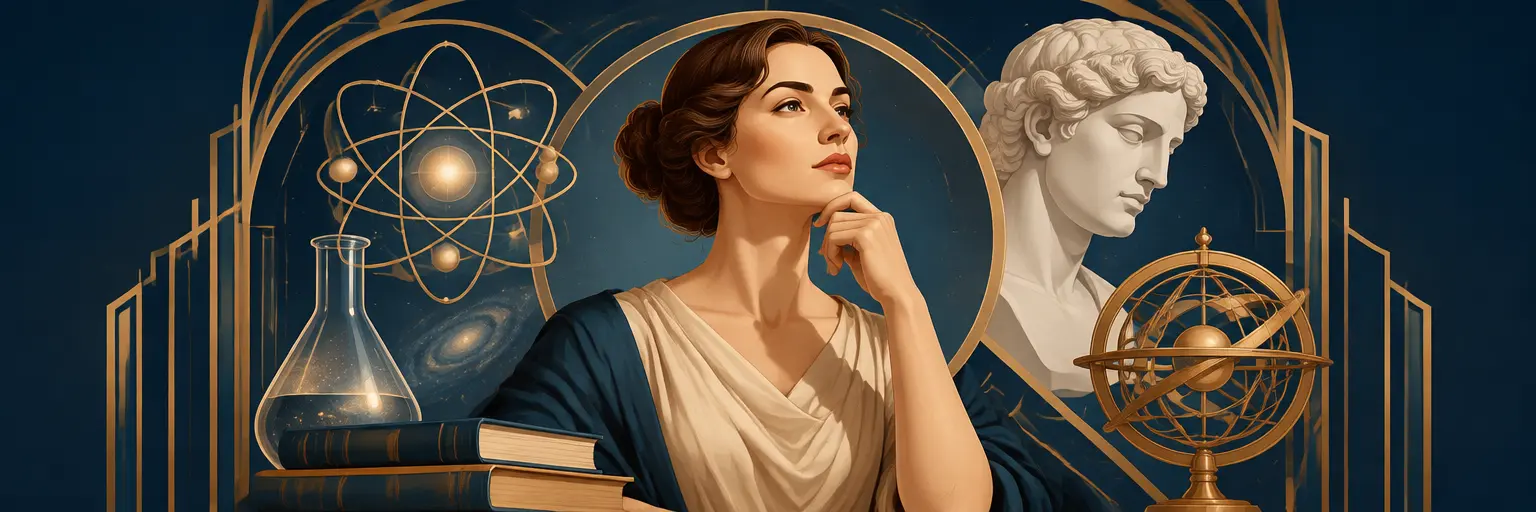
This subcategory explores the profound intersection of scientific discovery and philosophical thought, spotlighting women who bridged both worlds. From ancient natural philosophers to modern theoretical physicists with keen metaphysical interests, these pioneers challenged not only the laws of nature but also the boundaries of human understanding. Here, you'll uncover how female thinkers used logic, ethics, and epistemology to shape scientific methods, and how their philosophical frameworks influenced discoveries in biology, physics, mathematics, and cosmology. Dive into narratives that connect empirical evidence with existential questions, emphasizing that scientific progress is deeply enriched by philosophical rigor.
🔬 Pioneering Female Natural Philosophers & Polymaths
Before the terms "science" and "philosophy" split, women like Hypatia of Alexandria and Hildegard of Bingen embodied unified inquiry. This section profiles figures who mastered mathematics, astronomy, medicine, and dialectics simultaneously. Expect detailed accounts of how their cosmological models, botanical classifications, and ethical treatises were inseparable from their metaphysical beliefs. You'll learn how their holistic approaches—viewing nature as an interconnected system—prefigured modern systems thinking and ecological philosophy, offering lessons rarely found in conventional STEM biographies.
These polymaths often faced exclusion from formal academies, yet they built alternative networks of knowledge. Their surviving texts reveal a sophisticated blend of observation and introspection. By studying their works, readers gain insight into how gendered barriers forced creative intellectual adaptations, such as writing dialogues, using allegory, or embedding scientific ideas within mystical or ethical frameworks. This grounded perspective enriches your understanding of pre-Enlightenment knowledge production.
🧠 The Logic of Discovery: Women in Epistemology & Methodology
This facet zeroes in on female thinkers who formalized how we know what we claim to know. Explore the influential work of figures like Émilie du Châtelet, who translated Newton’s Principia and added her critical commentary on vis viva (living force), blending empirical physics with Leibnizian metaphysics. Also examine contemporary philosophers of science, such as Nancy Cartwright and Sandra Harding, whose critiques of objectivity and value-neutrality have reshaped scientific practice. Expect rigorous yet accessible discussions on falsifiability, underdetermination, and standpoint theory.
Understanding these methodologies helps modern scientists and enthusiasts appreciate the philosophical scaffolding of experiments, models, and hypotheses. Women in this area have persistently argued that observation is theory-laden and that social context inevitably influences research questions. You'll find case studies of how these epistemologists changed fields as diverse as economics and particle physics, proving that asking "What counts as evidence?" is as vital as collecting it.
🌌 Cosmology & Ethics: Women Contemplating the Universe & Humanity
Meet the female astronomers, physicists, and environmental philosophers who paired cosmic studies with profound ethical questions. Figures like Margaret Cavendish, who speculated on atomic matter and plurality of worlds, and modern astrophysicist Jocelyn Bell Burnell, whose discovery of pulsars prompted her to reflect on the nature of unintentional bias and attribution, feature prominently. This section investigates how their scientific insights led to deeper philosophical queries about human significance, free will, and our responsibility toward the planet and extraterrestrial life.
Expect explorations of astroethics, including debates on planetary protection and the moral implications of space colonization, as articulated by women like Lucianne Walkowicz. Additionally, discover how ecofeminist philosophers, such as Vandana Shiva, link scientific paradigms with social justice, arguing that reductionist science often disregards indigenous and feminine perspectives. This content is perfect for readers interested in the humanistic dimensions of science, offering frameworks for responsible innovation and sustainable exploration.
📜 Biography & Context: The Personal as Philosophical
This area focuses on the lived experiences and personal writings (letters, diaries, memoirs) of women in science, using them as philosophical texts. Examine how figures like Ada Lovelace, Carl Sagan’s collaborator Ann Druyan, or primatologist Jane Goodall articulated their own intellectual journeys, grappling with determinism, consciousness, and the moral status of non-human animals. These biographical sources provide raw material for understanding how personal adversity (exclusion, lack of mentorship) informed their philosophical outlooks on collaboration, mentorship, and the social structure of science.
By analyzing the narrative arcs of these scientists, you'll see that science is not an emotionless endeavor. These women’s reflections on their own biases, failures, and moments of inspiration reveal the philosophical principles that guided them, such as humility before data, skepticism of authority, and patience with uncertainty. This section undertakes a hermeneutic approach—interpreting their actions through their own words—enabling a more authentic appreciation of their contributions beyond dry lists of achievements.
🔥 Contemporary Debates & Intersectional Voices
Here, the focus shifts to current controversies where science and philosophy collide, led by women of diverse backgrounds. Explore topics like the neurophilosophy of cognition (with figures like Patricia Churchland), the nature of mathematical reality (following Mary Leng), and the philosophy of medicine regarding gender bias in clinical trials. This section highlights the work of scholars who use qualitative and phenomenological methods to critique overquantified approaches in psychology and sociology, advocating for richer, more nuance-driven models of human behavior.
You’ll also encounter discussions on decolonizing science, emphasizing how women philosophers from the Global South challenge Western-centric epistemologies. Expect interviews, op-eds, and critical summaries of recent books that bridge laboratory findings with ethical frameworks concerning AI, genetic engineering, and climate justice. This dynamic subcategory ensures the historical context connects to the urgent conversations of today, empowering you to see philosophy not as an ivory tower discipline but as a necessary toolkit for solving modern global challenges.
Frequently Asked Questions
Who are some key women that combined science and philosophy historically?
Notable examples include Hypatia (mathematics and Neoplatonism), Émilie du Châtelet (physics and metaphysics), Margaret Cavendish (natural philosophy and atomism), and Ada Lovelace (analytical engines and conceptual abstraction). These women merged empirical investigation with philosophical reasoning, often challenging Aristotle’s frameworks and mentoring students across disciplines.
Why is the intersection of science and philosophy important for understanding women’s contributions?
Because many women were excluded from formal scientific roles, they often articulated their ideas within philosophical treatises, ethical essays, or speculative dialogues. Viewing their work through this interdisciplinary lens reveals the full scope of their intellect, showing that their contributions were not just "minor discoveries" but foundational to how we reason about nature, proof, and meaning.
How did gender bias influence the philosophical ideas of these women?
Gender bias often forced women to adopt rhetorical strategies like humility, using male pseudonyms, or framing originality as commentary on male work. Ironically, this fostered critical perspectives on authority, empathy, and the social construction of knowledge. Their philosophical writings frequently emphasized collaboration, perspectival diversity, and the limits of detached objectivity.
Can I find resources about contemporary women in the philosophy of science?
Yes, explore journals like Philosophy of Science or Hypatia, and follow scholars such as Nancy Cartwright, Sandra Harding, or Helen Longino. Academic platforms like PhilPapers and university departmental websites list their publications. Many also maintain blogs or participate in public podcasts discussing epistemological and ethical questions in modern research.
Are there any open-access archives of writings by women in science and philosophy?
Yes, collections like Project Gutenberg (for Hypatia’s era texts), the Women Writers Project at Northeastern University, and the Internet Encyclopedia of Philosophy offer free content. For modern works, check institutional repositories like PhilSci-Archive, and databases like the Stanford Encyclopedia of Philosophy, which frequently feature entries on female philosophers of science.