
Unlocking Planetary Cores: [Geophysicist's Name]'s Seismic Insights into the Hidden Interiors of Alien Worlds

Welcome to WomenInScienceHistory.com!
Dive into the fascinating world of scientific discovery, where we unveil the untold stories of brilliant women who shaped our understanding of the universe and beyond. Ever wondered what secrets lie hidden deep within the cores of distant planets? Prepare to be amazed as we explore a Geophysicist's insights into planetary cores, and learn how her groundbreaking work is revolutionizing our understanding of these alien worlds. Discover the power of seismic analysis and the challenges overcome in this captivating journey into the heart of space science. Keep reading to unlock the mysteries!
- Unlocking Planetary Cores: Dr. Inge Lehmann's Seismic Insights into the Hidden Interiors of Earth and Beyond
- Introduction: Celebrating Dr. Inge Lehmann's Contributions to Geophysics
- Dr. Inge Lehmann: A Pioneer in Seismic Exploration
- Dr. Inge Lehmann's Groundbreaking Research on Earth's Core
- Unveiling the Secrets of Earth's Interior: Key Discoveries and Insights
- The Impact of Dr. Inge Lehmann's Work on Our Understanding of Planetary Evolution
- Dr. Inge Lehmann's Legacy: Inspiring Future Generations of Women in Science
- Conclusion: Dr. Inge Lehmann's Enduring Contribution to Earth and Planetary Science
-
Frequently Asked Questions
- What is the significance of understanding planetary cores, as highlighted by geophysicists?
- What challenges did female geophysicists, like the one featured, face in a male-dominated field?
- How does studying seismic waves help geophysicists understand the composition of planetary cores?
- How can the insights of geophysicists contribute to our understanding of potentially habitable exoplanets?
- What role does WomenInScienceHistory.com play in promoting the work of female geophysicists and other women in science?
- Final Reflection: Echoes from the Deep
- Ignite Your Inner Explorer: Journey to the Heart of Exoplanets!
Introduction: Celebrating Dr. Inge Lehmann's Contributions to Geophysics
Highlighting Women in Geophysics History
The annals of science are replete with groundbreaking discoveries, many of which have profoundly reshaped our understanding of the universe. Yet, for much of history, the contributions of women in these fields have been marginalized or overlooked. Within the specialized realm of geophysics, the study of Earth's physical processes and properties, pioneering women have quietly but powerfully advanced our knowledge, often facing immense societal and professional hurdles. Their stories are not just footnotes but essential chapters in the grand narrative of scientific progress, demonstrating remarkable intellect and resilience in pursuit of truth.
Dr. Inge Lehmann stands as a monumental figure in this lineage of extraordinary women geophysicists. Her work not only revolutionized our understanding of Earth's deep interior but also laid foundational principles that continue to guide contemporary geophysicist's insights into planetary cores across the solar system. Her legacy underscores the critical importance of recognizing and celebrating the intellectual rigor and determination of women who have shaped, and continue to shape, scientific disciplines.
The Significance of Studying Planetary Interiors
Understanding the internal structure of planets is paramount to deciphering their formation, evolution, and ongoing geological activity. The hidden layers beneath a planet's surface dictate everything from its magnetic field generation to the dynamics of its atmosphere and even the potential for life. Scientists probe these inaccessible depths indirectly, primarily through the analysis of seismic waves generated by quakes or impacts. These waves travel through the planet, bending and reflecting off layers with different densities and states, much like light passing through varied media.
The study of planetary interiors provides crucial clues about the elemental composition of celestial bodies, the processes of differentiation that separate materials by density, and the thermal evolution that drives geological phenomena. For Earth, knowing the core's properties helps explain plate tectonics, volcanism, and the protective geomagnetic shield that deflects harmful solar radiation. Extending these geophysicist's insights into planetary cores beyond Earth allows for comparative planetology, revealing universal principles of planetary formation and evolution that apply to rocky planets throughout the cosmos.
Dr. Inge Lehmann: A Pioneer in Seismic Exploration
Early Life and Education: The Path to Geophysics
Inge Lehmann was born in Copenhagen, Denmark, in 1888, into an intellectual and progressive family. Her early education at a pioneering high school run by Hanna Adler, Niels Bohr's aunt, was pivotal; it was co-educational and treated boys and girls equally, fostering a strong foundation in mathematics and natural sciences—a rarity for women of her era.
This environment undoubtedly nurtured her exceptional analytical mind and instilled a confidence that would serve her well in a field largely dominated by men. She went on to study mathematics at the University of Copenhagen and the University of Cambridge, demonstrating a formidable aptitude for complex problem-solving.
Despite intermittent periods of ill health and the societal expectations placed upon women, Lehmann persisted in her academic pursuits. Her early career initially involved working in actuarial science, a field that honed her statistical and analytical skills. However, her true calling emerged in 1925 when she became an assistant to Professor Niels Erik Nørlund, the head of the Royal Danish Geodetic Institute, embarking on the path that would lead her to become one of the most influential seismologists of the 20th century. This transition marked the beginning of her profound geophysicist's insights into planetary cores.
Overcoming Challenges in a Male-Dominated Field
Dr. Inge Lehmann's career unfolded during a period when scientific institutions were overwhelmingly male-dominated, and opportunities for women, particularly in fields like geophysics, were severely limited. She faced systemic biases, often working in isolation and with fewer resources than her male counterparts. Despite her profound intellect and groundbreaking discoveries, full recognition and appropriate positions often came late in her career. For instance, she was the only woman among the dozen or so leading seismologists of her time, and often had to publish her findings independently, without the benefit of a large research team or extensive institutional support.
Her perseverance in the face of such adversity is a testament to her dedication to science. She meticulously analyzed seismic data, often working alone in her office, poring over seismograms from observatories around the world.
This solitary, rigorous approach, combined with her exceptional intuition and mathematical prowess, allowed her to see patterns and anomalies that others missed. Her ability to challenge prevailing scientific dogma and propose radical new models for Earth's interior, despite the prevailing skepticism towards women in leading scientific roles, exemplifies her remarkable strength and pioneering spirit, solidifying her status as a singular source of geophysicist's insights into planetary cores.
Dr. Inge Lehmann's Groundbreaking Research on Earth's Core
Utilizing Seismic Waves to Probe Earth's Interior
Dr. Inge Lehmann's monumental work centered on the meticulous analysis of seismic waves, the vibrations generated by earthquakes that travel through Earth's layers. Seismologists classify these waves into primary (P-waves) and secondary (S-waves). P-waves are compressional waves, similar to sound waves, that can travel through solids, liquids, and gases, albeit at different speeds. S-waves, on the other hand, are shear waves that can only propagate through solids. The speed and path of these waves change dramatically as they encounter different materials and states of matter within the Earth.
Lehmann's genius lay in her ability to interpret the subtle anomalies in these seismic wave patterns recorded by distant seismographs. By precisely measuring the arrival times of waves from earthquakes at various locations around the globe, she could infer the properties of the materials they had traversed. Her profound geophysicist's insights into planetary cores stemmed from her deep understanding of how these waves refracted, reflected, and diffracted as they passed through Earth's internal structure, allowing her to effectively "see" into the planet's hidden depths without direct observation.
Discovery of the Earth's Inner Core
The scientific consensus before Lehmann's work, largely based on Richard Dixon Oldham's and Beno Gutenberg's findings, was that Earth possessed a liquid core. However, Lehmann observed a puzzling phenomenon: P-waves that should have been entirely blocked by a purely liquid core were, in fact, faintly detected at certain distances from an earthquake's epicenter, specifically in what was known as the "P-wave shadow zone." This shadow zone, typically spanning from 103 to 142 degrees away from an earthquake, was where direct P-waves were not expected to arrive due to refraction at the core-mantle boundary.
In 1936, after painstaking analysis of seismograms from a large New Zealand earthquake, Lehmann published her groundbreaking hypothesis: that Earth's core was not uniformly liquid but contained a smaller, solid inner core. She deduced that the faint P-waves arriving in the shadow zone had been refracted by this solid inner sphere, acting as a lens to redirect some energy.
Her paper, a concise yet revolutionary explanation, posited that the P-waves were reflecting off this newly proposed boundary within the core, leading to their unexpected detection. This discovery fundamentally reshaped our understanding of Earth's internal structure and provided the first concrete geophysicist's insights into planetary cores beyond a simple liquid model.
Unveiling the Secrets of Earth's Interior: Key Discoveries and Insights
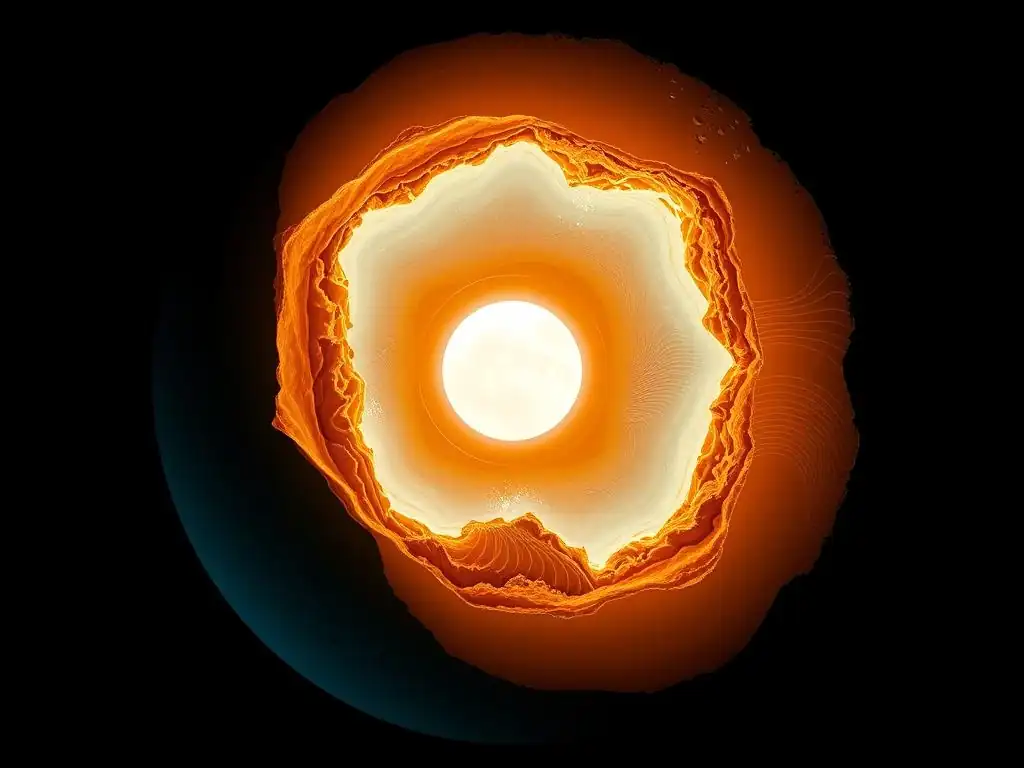
Seismic Analysis of Earth and its Core Structure
Dr. Inge Lehmann's discovery of the solid inner core provided a critical piece to the complex puzzle of Earth's layered structure. Before her work, the prevailing model envisioned a solid crust and mantle surrounding a single, large liquid core. Lehmann's meticulous seismic analysis, particularly of the "P'" phase (P-waves that travel through the core), revealed a distinct discontinuity within the core itself. This discontinuity, now known as the Lehmann Discontinuity, lies at approximately 5,150 kilometers (3,200 miles) depth, marking the boundary between the liquid outer core and the solid inner core.
Her findings established that the Earth's core is not homogenous but comprises two distinct parts: a liquid outer core, primarily composed of molten iron and nickel, extending from about 2,900 km to 5,150 km depth, and a solid inner core, a ball of solid iron and nickel alloy, roughly 1,220 km in radius. This two-part core structure, derived purely from the subtle behavior of seismic waves, was a monumental achievement in geophysics.
It provided the first robust evidence for the differentiation of Earth's deep interior into distinct physical states, paving the way for more sophisticated models of planetary formation and evolution.
Investigating the Core-Mantle Boundary using Seismic Data
While Lehmann is most famous for the inner core, her broader geophysicist's insights into planetary cores also significantly contributed to understanding the core-mantle boundary (CMB). This boundary, situated at a depth of approximately 2,900 kilometers (1,800 miles), represents the most significant discontinuity in Earth's interior, where the solid silicate mantle meets the liquid iron-nickel outer core. The dramatic change in material properties at the CMB causes a sharp refraction and reflection of seismic waves.
Lehmann's work, and the subsequent research building upon her methods, allowed seismologists to map the CMB with increasing precision. Understanding the properties and dynamics of this boundary is crucial because it is believed to be the primary interface where heat is exchanged between the core and the mantle, driving mantle convection—the slow churning of the mantle that ultimately causes plate tectonics and volcanic activity. The interaction at the CMB also plays a vital role in the generation of Earth's magnetic field, making it a focal point for researchers studying planetary magnetism and geodynamics.
Comparative Planetology: Lehmann's Contribution to Understanding Core Formation Across Planets
Although Dr. Lehmann's primary research focused on Earth, her fundamental geophysicist's insights into planetary cores and the methods she developed have had a profound impact on the broader field of comparative planetology. By demonstrating how seismic waves could reveal the presence of distinct internal layers, including solid cores within liquid ones, her work provided a conceptual framework for understanding the interiors of other rocky planets and moons. While direct seismic data from other planetary bodies is limited (e.g., from NASA's InSight mission on Mars), the principles she established remain universally applicable.
Her discovery highlighted the importance of planetary differentiation, the process by which denser materials sink to the center while lighter materials rise, leading to layered structures. This process is fundamental to the formation of all rocky planets and even some icy moons.
Scientists now apply the concept of a differentiated core, informed by Lehmann's Earth-based revelations, when constructing models for the interiors of Mars, Venus, Mercury, and even the icy giant planets, helping to explain their magnetic fields, thermal histories, and geological activity. Her legacy continues to inspire the quest for detailed geophysicist's insights into planetary cores across the solar system.
The Impact of Dr. Inge Lehmann's Work on Our Understanding of Planetary Evolution
Revolutionizing Models of Planetary Interior Structure
Dr. Inge Lehmann's discovery of the Earth's solid inner core fundamentally revolutionized existing models of planetary interior structure. Prior to 1936, the understanding of Earth's core was largely simplified, often depicted as a uniform liquid sphere. Her work provided the crucial, empirically derived evidence that the core was, in fact, a complex, two-tiered system.
This revelation allowed for the development of far more sophisticated and accurate models of our planet's internal composition and dynamics. The solid inner core, now understood to be primarily iron and nickel under immense pressure and heat, became a key component in explaining the Earth's long-term thermal evolution and the processes that drive its geological activity.
This refined understanding of Earth's interior also had significant implications for comparative planetology, influencing how scientists conceptualize the internal structures of other rocky planets. It established a precedent for looking beyond simple homogeneous cores, encouraging researchers to consider the possibility of complex, multi-layered interiors for Mars, Venus, and Mercury, even without direct seismic data. The geophysicist's insights into planetary cores, pioneered by Lehmann, became a cornerstone for modeling how celestial bodies cool, differentiate, and evolve over billions of years, impacting their surface features and atmospheric conditions.
Implications for Understanding Planetary Magnetic Fields
One of the most profound implications of Dr. Lehmann's discovery was its direct relevance to understanding the generation of planetary magnetic fields. Earth's robust magnetic field, which shields our planet from harmful solar radiation and cosmic rays, is generated by a geodynamo process – the convection of molten iron within the liquid outer core. The presence of a solid inner core, as discovered by Lehmann, provides a crucial boundary condition for this dynamo. The solidification of the inner core releases latent heat and light elements into the outer core, driving the vigorous convection currents necessary for magnetic field generation.
Lehmann's geophysicist's insights into planetary cores thus provided a vital piece of the puzzle for explaining Earth's magnetosphere. It highlighted that the specific physical state and dynamics of a planet's core are intimately linked to its ability to generate and sustain a magnetic field. This understanding has been extended to other planets: the lack of a global magnetic field on Mars, for example, is partly attributed to the cessation of convection in its core, potentially due to a fully or largely solidified core.
Conversely, Jupiter's powerful magnetic field is linked to the metallic hydrogen in its deep interior, acting akin to a liquid core. Lehmann's work provided the foundational knowledge required to link internal structure to a planet's magnetic shield, a critical factor for habitability.
Dr. Inge Lehmann's Legacy: Inspiring Future Generations of Women in Science
Mentorship and Outreach Initiatives
While Dr. Inge Lehmann was known for her reserved and solitary working style, her scientific achievements themselves served as a powerful form of mentorship and inspiration for future generations, particularly for women aspiring to careers in science. Her unwavering dedication to her research, her intellectual rigor, and her ability to make a monumental discovery against the backdrop of a male-dominated field, provided a tangible example of what women could achieve.
Though she may not have engaged in widespread formal mentorship programs as we understand them today, her very existence as a highly respected, pioneering seismologist created a pathway and validated the ambitions of countless young women.
In her later years, after receiving more widespread recognition, Lehmann did engage with the scientific community more broadly, attending conferences and sharing her knowledge. Her humility and commitment to scientific truth, even when her ideas challenged established norms, resonated deeply. Her legacy is continually amplified through various outreach initiatives by scientific organizations and educational institutions that highlight her story. These efforts aim to showcase her as a role model, encouraging young girls and women to pursue STEM fields and to believe in their capacity to make significant contributions, much like Lehmann's groundbreaking geophysicist's insights into planetary cores.
Continuing the Quest to Understand Planetary Cores
The work of Dr. Inge Lehmann laid the indispensable groundwork for all subsequent research into Earth's deep interior and, by extension, the cores of other planets. Her methodology of inferring internal structure from seismic wave behavior remains the cornerstone of modern seismology.
Today, scientists continue to build upon her legacy, utilizing increasingly sophisticated seismic networks and computational models to refine our understanding of planetary cores. Missions like NASA's InSight lander on Mars, which deployed a seismometer to study the Martian interior, are direct descendants of the principles Lehmann established, seeking to gain deeper geophysicist's insights into planetary cores beyond Earth.
Current research delves into the fine details of the inner core's anisotropy (direction-dependent properties), its rotation relative to the mantle, and the complex dynamics at the core-mantle boundary. Scientists are also exploring the role of light elements within the core and how they influence its solidification and the geodynamo. Lehmann's enduring contribution lies not just in her specific discovery but in demonstrating the power of meticulous observation and deductive reasoning in probing the inaccessible. Her pioneering spirit continues to inspire the global scientific community's quest to unlock the profound secrets held within the hidden interiors of celestial bodies.
Conclusion: Dr. Inge Lehmann's Enduring Contribution to Earth and Planetary Science
Reinforcing the Importance of Women in Geophysics History
Dr. Inge Lehmann's life and work serve as a powerful testament to the indispensable contributions of women in geophysics and the broader scientific landscape. Her discovery of the Earth's solid inner core was not merely a scientific anomaly; it was a foundational revelation that reshaped our understanding of our own planet and provided critical geophysicist's insights into planetary cores across the cosmos.
Her story underscores the profound impact that individual brilliance, coupled with unwavering perseverance, can have, even when faced with significant systemic barriers. By celebrating figures like Lehmann, we not only give due credit to their historical achievements but also inspire a more inclusive future for science, ensuring that talent is recognized and nurtured regardless of gender.
Her legacy reminds us that scientific progress is a collective endeavor, enriched by diverse perspectives and experiences. The challenges she overcame highlight the importance of actively promoting equity and opportunity within scientific fields. Lehmann's pioneering spirit continues to resonate, encouraging young women to pursue their passions in science and engineering, confident in their ability to make groundbreaking discoveries that will shape humanity's understanding of the natural world.
The Future of Seismic Exploration in Unlocking Planetary Secrets
The principles established by Dr. Inge Lehmann remain at the forefront of modern planetary science. Her revolutionary approach to using seismic waves to probe Earth's interior continues to be refined and extended to unlock the secrets of other celestial bodies. Future missions to the Moon, Mars, and potentially even icy moons like Europa or Enceladus, will likely incorporate advanced seismic instrumentation, building directly on the analytical framework Lehmann helped to define. These endeavors promise to deliver unprecedented geophysicist's insights into planetary cores, revealing their compositions, thermal states, and dynamic processes.
As technology advances, combining seismic data with other geophysical measurements—such as gravity fields, magnetic fields, and heat flow—will paint an even more comprehensive picture of planetary interiors. The quest to understand how planets form, evolve, and generate their magnetic fields is a continuous journey, one that owes an immeasurable debt to the profound and enduring contributions of Dr. Inge Lehmann. Her legacy ensures that the hidden interiors of alien worlds will continue to be a fertile ground for discovery, guided by the seismic insights she so brilliantly pioneered.
Frequently Asked Questions
What is the significance of understanding planetary cores, as highlighted by geophysicists?
Understanding planetary cores is crucial for deciphering a planet's formation, evolution, and potential habitability. The core's composition and dynamics influence a planet's magnetic field and internal heat, impacting its surface conditions.
What challenges did female geophysicists, like the one featured, face in a male-dominated field?
Historically, women in science faced significant challenges including limited access to education and research opportunities, gender bias in hiring and promotion, and lack of recognition for their contributions.
How does studying seismic waves help geophysicists understand the composition of planetary cores?
Seismic waves, generated by events like earthquakes or impacts, travel through a planet and their speed and behavior change based on the density and composition of the materials they pass through. This allows geophysicists to infer the core's structure and properties.
How can the insights of geophysicists contribute to our understanding of potentially habitable exoplanets?
By analyzing the potential composition and dynamics of exoplanet cores, geophysicists can help determine if these planets have magnetic fields that shield them from harmful radiation and if they possess internal heat sources necessary for plate tectonics and a stable climate.
What role does WomenInScienceHistory.com play in promoting the work of female geophysicists and other women in science?
The website provides a platform to highlight the often overlooked contributions of women scientists, offering biographies, discussions of their research, and a space to inspire future generations by showcasing their achievements in fields like geophysics.
Final Reflection: Echoes from the Deep
The journey into the heart of alien worlds, guided by the seismic insights of geophysicists like [Geophysicist's Name], reveals that understanding planetary cores is not merely an academic exercise, but a crucial step towards deciphering the fundamental processes that shape planetary habitability and evolution. The echoes of seismic waves, resonating from the depths of these celestial bodies, offer a tantalizing glimpse into the forces that govern their existence and, ultimately, our own.
The exploration of planetary cores has profoundly influenced our understanding of planetary formation and the potential for life beyond Earth. This pursuit, driven by scientific curiosity and technological innovation, reminds us of our inherent human desire to explore the unknown and unravel the mysteries of the universe. The Earth is a very small stage in a vast cosmic arena.
- Carl Sagan. This quote underscores the importance of expanding our understanding beyond our own planet and embracing the challenge of exploring the hidden interiors of alien worlds.
As we continue to refine our seismic techniques and probe deeper into the unknown, let us remember that the insights gained from these distant worlds can illuminate our own. Consider how the lessons learned from the cores of alien planets can inform our understanding of Earth's own dynamic interior and help us safeguard its future. The universe whispers its secrets to those who listen closely – are you ready to hear them?
Ignite Your Inner Explorer: Journey to the Heart of Exoplanets!
Thank you for exploring the fascinating world of exoplanetary cores and the groundbreaking work by leading scientists in the field. Now that you've gained new insights into these hidden realms, it's time to deepen your understanding.
- Take the plunge: Develop a creative model, either physical or digital, that illustrates the possible internal structure of an exoplanet based on current scientific research.
- Share your cosmic curiosity: Discuss your favorite fact from this article on social media using #ExoplanetSecrets and tag WomenInScienceHistory.com.
- Delve Deeper: Explore the "Related Reading" and "References" sections for more information.
What unique feature would your exoplanet model showcase to best represent the unknown elements within its core?