Masterclasses: Women Mathematicians & Legacies
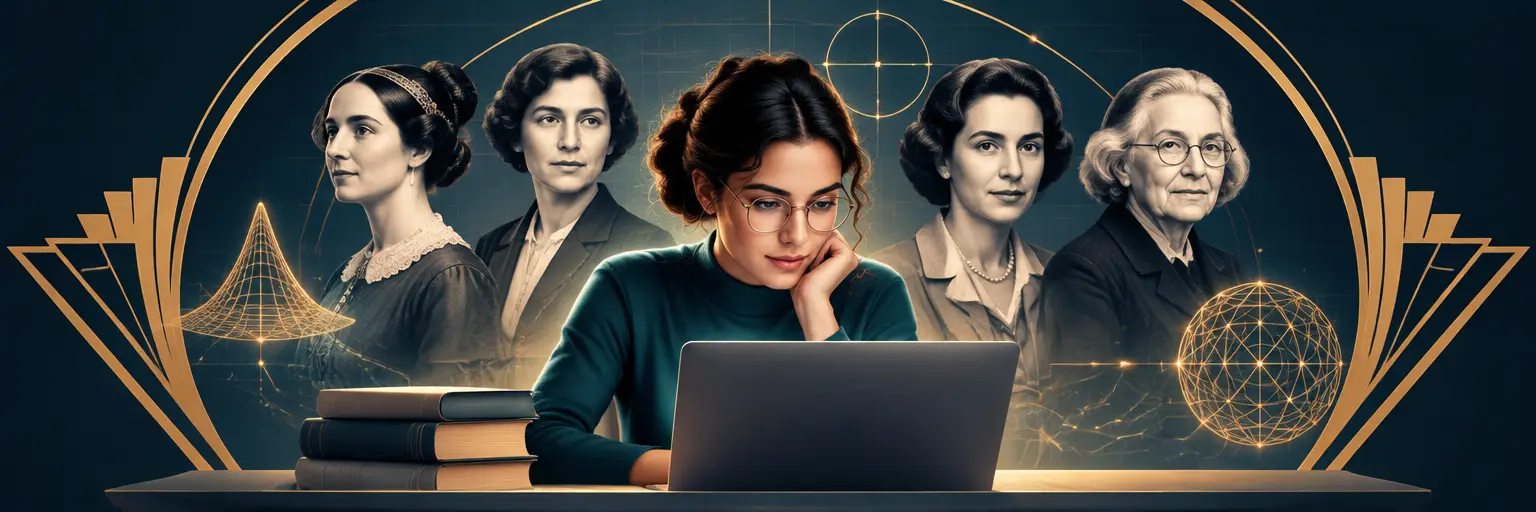
Dive into the fascinating world of mathematical pioneers through our curated masterclasses on WomenInScienceHistory.com. These courses illuminate the lives, breakthroughs, and enduring influence of women who shaped mathematics despite formidable barriers. Each masterclass blends rigorous historical context with accessible explanations of complex concepts, making advanced mathematics engaging for learners of all levels. Whether you are a student, educator, or lifelong enthusiast, these classes reveal how female mathematicians transformed the field and left legacies that continue to inspire modern problem-solving. Explore hidden narratives, interactive lessons, and expert insights designed to empower and educate.
🔍 Uncovering the Pioneers of Abstract Thought
Our masterclasses begin with foundational figures like Hypatia of Alexandria, considered the first notable female mathematician, and Émilie du Châtelet, who advanced Newtonian physics. You will delve into their original manuscripts and philosophical debates, understanding how they navigated societies that denied women formal education. These sessions emphasize critical thinking and historical analysis, showing how their abstract ideas—ranging from geometry to calculus—underpinned later scientific revolutions. Expect primary source readings and guided discussions that connect their struggles to contemporary issues in STEM gender equity.
Each pioneer’s story is framed within a broader cultural context, revealing patronage networks, religious constraints, and intellectual rivalries. You will learn how Hypatia’s teaching methods in Alexandria influenced Neo-Platonism, while du Châtelet’s translation of Newton’s Principia remains the standard French version today. The masterclass uses interactive timelines and archival imagery to bring these figures to life. By the end, you will appreciate not just their mathematical outputs, but their roles as educators and public intellectuals who defied expectations.
📐 The Rise of Modern Mathematical Giants
Transition to the 19th and 20th centuries, focusing on Sofia Kovalevskaya, Emmy Noether, and Maryam Mirzakhani. Kovalevskaya became the first woman in Northern Europe to earn a doctorate in mathematics, while Noether revolutionized abstract algebra and theoretical physics with her theorems on symmetry and conservation. Mirzakhani, the first woman to win the Fields Medal, reshaped hyperbolic geometry and moduli spaces. Masterclasses here include video lectures from current mathematicians explaining these advanced concepts in intuitive ways, alongside case studies of their Nobel-worthy contributions.
You will also explore their professional networks, such as Noether’s collaboration with Albert Einstein and David Hilbert at Göttingen, and Mirzakhani’s work with the International Mathematics Union. The courses break down complex ideas like Noether’s theorem into visual simulations and practical examples, ensuring conceptual clarity. Interactive problem sets allow you to engage with their methodologies directly. Additionally, discussions address systemic barriers—from university hiring bans to field-specific biases—that these women overcame, offering lessons in resilience and institutional change.
🌐 Global Legacies and Modern Influence
This section maps how the legacies of historical female mathematicians influence current research and pedagogy worldwide. We examine initiatives like the Association for Women in Mathematics (AWM) and the Emmy Noether Program, which fund early-career researchers. You will see direct lineage from Hypatia’s commentary to contemporary data science algorithms and from Noether’s algebra to string theory. Masterclasses feature interviews with active female professors, industry leaders, and policy makers who discuss how these historical figures shaped their career paths and mentoring styles.
Furthermore, we analyze how mathematical curricula are being reformed to include these stories, fostering inclusivity in classrooms from primary to postgraduate levels. The course provides downloadable resources, including lesson plan templates and controversy discussion guides, to help educators integrate this history into their own teaching. You will also explore digital humanities projects that map the geographic and temporal spread of these women’s influence, showing how an idea born in ancient Alexandria can be traced through modern algorithmic design and cryptography. This holistic view underscores that legacies are not static but evolving.
🎓 Practical Learning and Certification Paths
Each masterclass is structured as a self-paced online module with weekly live Q&A sessions. You will gain access to a private community forum, where participants discuss readings and solve collaborative challenges. Assessments include reflective essays, conceptual quizzes, and a final project—such as creating a digital biography or a lesson plan about a chosen mathematician. Successful completion awards a certificate from WomenInScienceHistory.com, recognized by partner educational institutions. The curriculum is designed to be flexible, with lifetime access to all materials and updates.
Our instructional design uses scaffolding techniques to gradually increase mathematical complexity, ensuring that even those with basic numeracy can follow. For advanced learners, we offer supplementary materials such as original papers, historical correspondence, and computational notebooks. The masterclasses also include career guidance, leveraging the stories of these women to discuss persistence, mentorship, and creative problem solving in modern STEM fields. By the end, you will not only possess deep historical knowledge but also practical tools to advocate for diversity in mathematics, whether in academia, industry, or community education.
📚 Curated Resources and Community Engagement
Beyond video content, the masterclass offers a rich digital library featuring rare scanned books, annotated bibliographies, and interactive maps. We partner with archives such as the Sophia Kovalevsky Museum and the Emmy Noether Archives at Bryn Mawr College to provide authentic primary sources. You can join virtual book clubs, attend guest lectures by historians of mathematics, and participate in annual symposia. These resources are optimized for search engines, ensuring that your learning journey is both deep and discoverable.
Community engagement is central to our approach. As a learner, you can contribute to our ongoing oral history project by interviewing local women mathematicians or adding new archival findings. This crowdsourced model enhances the masterclass experience and builds a living archive. We also organize regional meetups and online hackathons where participants apply mathematical concepts from historical contexts to modern problems, such as algorithmic bias or climate modeling. These activities foster a supportive network of like-minded individuals, turning passive learning into active advocacy and peer-to-peer mentorship.
Frequently Asked Questions
Do I need advanced math skills to join these masterclasses?
No, absolutely not. Our courses are designed for all levels, using visual analogies and step-by-step explanations. We start from the historical context and gradually introduce mathematical concepts, ensuring that beginners feel comfortable while advanced learners gain depth. Each module includes optional advanced readings for those seeking extra challenge.
Will I receive a certificate upon completion?
Yes, you will receive a durable digital certificate from WomenInScienceHistory.com, which you can display on LinkedIn or your resume. The certificate includes detailed learning outcomes and is endorsed by our partner institutions. This credential demonstrates your commitment to historical and mathematical literacy.
Are the masterclasses available for group or institutional enrollment?
Certainly. We offer discounted group rates for schools, universities, and professional organizations. Institutional packages include administrators’ dashboards, progress tracking, and custom curriculum alignment. For bulk orders, contact our team for a tailored proposal that meets your educational or corporate training needs.
Can I access course materials after the masterclass ends?
Yes, once enrolled, you have lifetime access to all videos, readings, and future updates. We regularly add new content, such as interviews with current mathematicians or newly digitized archives, at no additional cost. This ensures your learning continues to evolve with new discoveries.
How do these masterclasses differ from standard math history courses?
Our focus is uniquely on women mathematicians and their often-overlooked legacies, blending historical scholarship with interactive learning. Unlike generic courses, we emphasize applied insights for modern STEM careers and include community-driven projects. Additionally, our instructors are both historians and practicing mathematicians, offering dual expertise rarely found elsewhere.