
Hypatia's Wisdom: A Masterclass in Ancient Mathematical Thought & Pedagogy

Welcome to WomenInScienceHistory.com!
Delve into the fascinating world of women who shaped science, often against incredible odds. This website celebrates their enduring legacies, and today, we invite you to explore the brilliance of a truly remarkable figure. Are you ready to unravel the secrets of Hypatia’s ancient mathematical pedagogy? Discover how this pioneering woman's approach to teaching revolutionized mathematical thought and continues to inspire educators today. Prepare to be captivated by her wisdom and the lessons she imparted – a masterclass that transcends time. Read on to unlock the secrets of Hypatia's enduring impact!
- Unveiling Hypatia's Legacy: A Journey into Ancient Mathematical Pedagogy
- Reconstructing Hypatia's Mathematical Curriculum: A Step-by-Step Guide
- Modern Applications of Hypatia's Pedagogical Methods: Inspiring Future Mathematicians
- Mastering Ancient Mathematical Pedagogy: Further Resources and Continued Learning
- The Enduring Influence of Hypatia’s Teaching Methods: Shaping Mathematical Thought for Centuries
- Frequently Asked Questions
- Final Reflection: Echoes of Hypatia's Legacy
- Unleash Your Inner Scholar: Rediscover Hypatia's Genius!
Unveiling Hypatia's Legacy: A Journey into Ancient Mathematical Pedagogy
WomenInScienceHistory.com Honors Hypatia: A Pioneer of Mathematical Education
Hypatia of Alexandria, living from approximately 350-370 AD to 415 AD, stands as a monumental figure in the annals of ancient mathematics and philosophy. As a prominent scholar and teacher at the Neoplatonic school in Alexandria, she navigated a world predominantly dominated by men, carving out an unparalleled reputation for her intellectual prowess and profound knowledge.
Her lectures attracted students from across the Roman Empire, including notable figures like Synesius of Cyrene, who later became a bishop and remained a devoted correspondent. Hypatia's contributions extended beyond mere instruction; she is believed to have edited and commented on crucial mathematical and astronomical texts, thereby preserving and clarifying ancient knowledge for future generations.
WomenInScienceHistory.com proudly highlights Hypatia's extraordinary life and work, celebrating her as a beacon of intellectual independence and a trailblazer in mathematical education. Her story is a powerful testament to the often-overlooked intellectual contributions of women throughout history. By showcasing figures like Hypatia, the website aims to inspire contemporary and future generations of female scientists and mathematicians, demonstrating that the pursuit of knowledge and intellectual leadership transcends gender and time. Her pioneering efforts in Hypatia's ancient mathematical pedagogy laid foundational stones for how complex subjects could be effectively taught and understood.
Why Study Hypatia's Ancient Mathematical Pedagogy Today? Relevance and Inspiration
Studying Hypatia's ancient mathematical pedagogy offers far more than a historical curiosity; it provides timeless insights into effective learning and critical thinking that remain profoundly relevant in modern education. Her approach was not about rote memorization but about fostering a deep, conceptual understanding of mathematical principles. She encouraged her students to question, analyze, and derive conclusions independently, emphasizing the why behind mathematical operations rather than just the how. This method cultivated genuine intellectual curiosity and problem-solving skills, qualities that are paramount in today's rapidly evolving scientific and technological landscape.
Furthermore, Hypatia's life serves as a powerful source of inspiration. In an era where women's intellectual contributions were largely marginalized, she achieved prominence as a philosopher, mathematician, and astronomer. Her resilience in the face of societal challenges and her unwavering dedication to knowledge embody the spirit of perseverance crucial for anyone embarking on a demanding academic or professional path. Her story reminds us that intellectual brilliance knows no gender boundaries and that the pursuit of knowledge, even amidst adversity, can leave an indelible mark on history, making Hypatia's ancient mathematical pedagogy a model for enduring intellectual leadership.
Reconstructing Hypatia's Mathematical Curriculum: A Step-by-Step Guide
Step 1: Grasping the Foundations - Euclid's Elements through Hypatia's Lens
At the core of ancient mathematical education, and certainly Hypatia's curriculum, lay Euclid's Elements. This monumental treatise, comprising thirteen books, systematically laid out the principles of geometry and number theory, serving as the definitive textbook for centuries. Hypatia, like other leading scholars of her time, would have meticulously taught Elements, but her approach was distinguished by an emphasis on profound comprehension rather than mere memorization of theorems. Historical accounts suggest she undertook significant editorial work on existing versions, aiming to clarify intricate proofs and make the foundational concepts more accessible to her diverse student body.
While Hypatia's direct commentaries on Euclid's Elements are unfortunately lost to history, her reputation as a meticulous and insightful teacher implies a focus on logical rigor and conceptual clarity. Her pedagogical methods likely involved guiding students through the axioms, postulates, and propositions, ensuring they grasped the underlying deductive reasoning. This focus on the logical architecture of mathematics, rather than just its results, was a hallmark of her Hypatia's ancient mathematical pedagogy, designed to build a robust intellectual foundation for her students' further studies in advanced mathematics and astronomy.
Recommended Resource: Euclid's Elements (Green Lion Press Edition) - A Clear and Accessible Translation for Modern Learners
For modern learners seeking to understand the foundational texts that shaped Hypatia's educational environment, the Green Lion Press edition of Euclid's Elements offers an exceptionally clear and faithful translation. This edition is praised for its commitment to presenting Euclid's work in a manner that honors the original text's structure and logical flow, making it an excellent resource for those wishing to reconstruct the intellectual journey of Hypatia's students. It provides the clarity necessary to appreciate the beauty and rigor of ancient Greek geometry.
Understanding Hypatia's Commentary on Euclid and its Impact
Although Hypatia's specific commentaries on Euclid's Elements have not survived, their existence is inferred from historical references, particularly from her student Synesius of Cyrene. These commentaries were likely not original mathematical discoveries but rather pedagogical enhancements – clarifications, alternative proofs, or simplified explanations designed to improve the understanding and accessibility of Euclid's complex arguments. Her work in this area underscores her commitment to effective teaching and her role in consolidating and disseminating mathematical knowledge, making the profound insights of Euclid more digestible for her students and solidifying a key component of her Hypatia's ancient mathematical pedagogy.
Step 2: Exploring Conic Sections - Apollonius of Perga and Hypatia's Contributions
Beyond the foundational Elements, Hypatia's curriculum delved into more advanced geometric concepts, notably Apollonius' Conics. This eight-book treatise on conic sections (parabola, ellipse, and hyperbola) represented the pinnacle of ancient Greek geometry. Hypatia was renowned for her editorial work on Apollonius's challenging text, which was notoriously complex. Her efforts in clarifying and simplifying Conics were crucial for its study and application, particularly in the fields of optics and astronomy, where these curves had significant practical relevance.
Hypatia's engagement with Apollonius' Conics highlights her expertise not just in comprehending advanced mathematical theory but also in effectively transmitting it. Her revisions or commentaries likely streamlined Apollonius's dense proofs, making the sophisticated properties of conic sections more comprehensible to her students. This pedagogical refinement was essential for enabling a broader understanding of these concepts, which were vital for understanding planetary motion and the design of optical instruments. Her unique ability to distill complex ideas into teachable formats was a defining characteristic of her ancient mathematical pedagogy.
Resource: Apollonius' Conics (Translated and Explained) - Delve Deeper into Hypatia's Area of Expertise
To truly appreciate the depth of Hypatia's work and the challenges she addressed, engaging with a well-translated and explained edition of Apollonius' Conics is invaluable. Such resources often provide modern annotations and diagrams that help unpack the intricate geometric arguments. By studying Apollonius, one can gain insight into the sophisticated mathematical landscape that Hypatia navigated and enhanced, understanding the specific areas where her pedagogical genius would have been applied.
Hypatia's Innovative Approaches to Teaching Conic Sections
While specific details of Hypatia's classroom methods are scarce, it can be inferred that her innovative approaches to teaching conic sections would have involved more than just lecturing. Given the visual nature of geometry, she likely employed extensive use of diagrams, perhaps drawn on sand or slate, and encouraged interactive discussions.
Her aim would have been to bridge the gap between abstract theory and practical application, possibly by linking conic sections to real-world phenomena such as the paths of celestial bodies or the focusing properties of lenses. This practical, application-oriented aspect was a crucial element of Hypatia's ancient mathematical pedagogy.
Step 3: Astronomical Calculations and the Almagest - Applying Mathematical Principles to the Cosmos
The study of astronomy was deeply intertwined with mathematics in the ancient world, and Hypatia's curriculum prominently featured Ptolemy's Almagest. This comprehensive astronomical treatise, compiled in the 2nd century AD, served as the standard model of the universe for over a thousand years. Hypatia taught The Almagest not merely as a descriptive text but as a practical application of the geometry, trigonometry, and arithmetic her students had mastered, emphasizing the computational aspects required for celestial observation and prediction.
Hypatia's role in astronomical studies also extended to the practical realm. She is credited with improving and teaching the use of astronomical instruments such as the astrolabe, used for calculating time and the positions of celestial bodies, and the hydroscope, an instrument for measuring specific gravity. Her instruction would have focused on the precise mathematical calculations necessary for operating these tools and for interpreting their readings. This blend of theoretical mathematical principles with hands-on, observational astronomy was a cornerstone of Hypatia's ancient mathematical pedagogy, demonstrating how abstract concepts could be applied to understand the cosmos.
Recommended: The Almagest by Ptolemy (Translated Edition) - Understanding Hypatia's Astronomical Context
For those seeking to fully grasp the astronomical context within which Hypatia operated, a translated edition of The Almagest by Ptolemy is an indispensable resource. This text provides a detailed account of the geocentric model of the universe, along with the sophisticated mathematical methods used to describe planetary motion. Studying The Almagest allows one to appreciate the immense mathematical challenge that Hypatia and her students undertook in trying to chart the heavens, showcasing the rigorous application of Hypatia's ancient mathematical pedagogy to real-world problems.
Hypatia's Role in Astronomical Studies and its Educational Implications
Hypatia's involvement in astronomical studies was not merely theoretical; it was deeply practical. Her students, like Synesius, specifically sought her guidance on the construction and use of scientific instruments. This indicates a pedagogical approach that emphasized the tangible application of mathematical knowledge. By integrating the theoretical study of The Almagest with the practical manipulation of tools like the astrolabe, Hypatia provided a holistic education that trained her students not just to understand mathematical principles but to apply them to solve real-world problems, a powerful example of her ancient mathematical pedagogy.
Modern Applications of Hypatia's Pedagogical Methods: Inspiring Future Mathematicians
Fostering Critical Thinking: Hypatia's Emphasis on Understanding Why
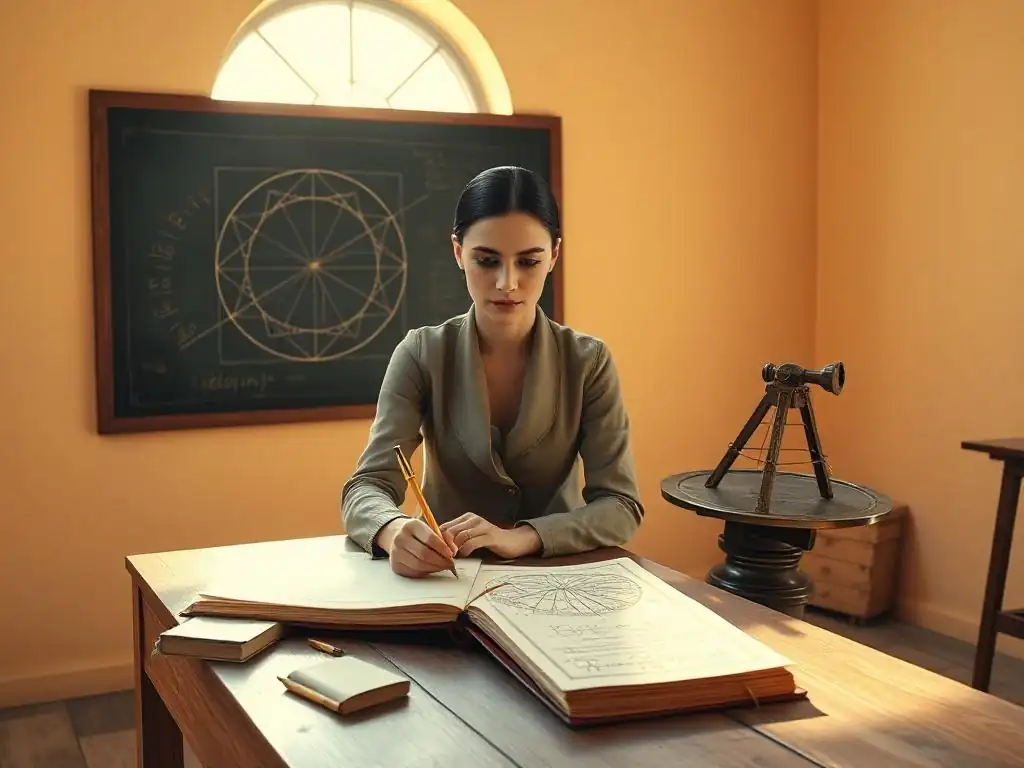
Hypatia's pedagogical philosophy was deeply rooted in the Socratic method, encouraging her students to question, analyze, and logically derive conclusions rather than simply accepting information. Her emphasis was on understanding the underlying principles and the logical validity of mathematical arguments, rather than just memorizing formulas or proofs. This approach cultivated true critical thinking skills, empowering her students to not only solve problems but to understand the fundamental reasons behind their solutions.
This commitment to understanding the "why" remains a gold standard for effective education today, particularly in STEM fields. In an era of abundant information, the ability to critically evaluate, synthesize, and apply knowledge is far more valuable than mere recall. Hypatia's method prepared her students for intellectual leadership and innovation by fostering intellectual autonomy, a crucial skill that continues to define successful mathematicians and scientists, demonstrating the enduring relevance of Hypatia's ancient mathematical pedagogy.
Online Course: "Critical Thinking Through Ancient Mathematics" - Learn to Think Like Hypatia
An online course titled "Critical Thinking Through Ancient Mathematics" could be designed to immerse learners in the problem-solving approaches of Hypatia's era. Such a course would present ancient mathematical challenges from texts like Euclid's Elements or Apollonius' Conics, guiding students to derive solutions through logical deduction and conceptual understanding, rather than relying on modern formulas. This would mirror Hypatia's emphasis on the process of mathematical thought, allowing participants to experience firsthand the intellectual rigor of Hypatia's ancient mathematical pedagogy.
Promoting Collaborative Learning: Recreating Hypatia's Salon Environment in the Digital Age
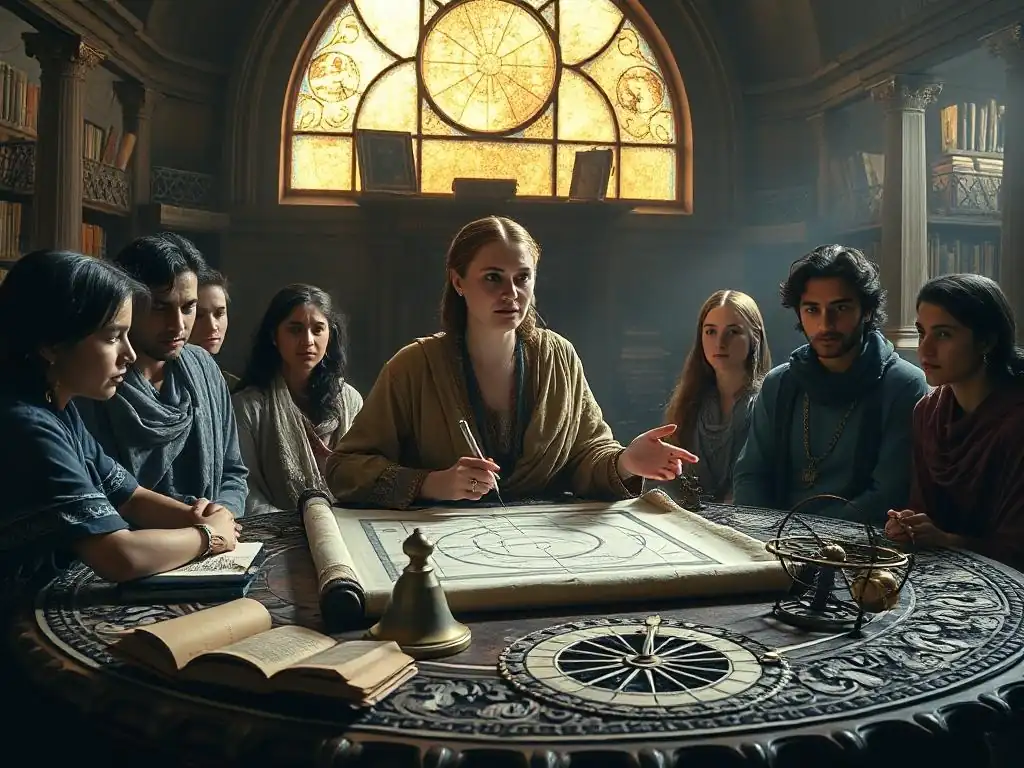
Hypatia's school was less a formal classroom and more an intellectual salon, a vibrant hub where students, scholars, and philosophers engaged in lively discussions, debates, and collaborative inquiry. This environment fostered mutual learning, the exchange of diverse perspectives, and the collective pursuit of knowledge, breaking down traditional hierarchies between teacher and student. The emphasis was on shared intellectual exploration, where ideas were tested, refined, and built upon collectively.
This model of collaborative learning is highly adaptable to the digital age. Modern educational platforms can effectively recreate the intellectual dynamism of Hypatia's salon through features like asynchronous discussion forums, virtual whiteboards for collaborative problem-solving, and shared document editors for group projects. These tools facilitate peer-to-peer learning and the co-creation of knowledge, extending the reach and impact of Hypatia's ancient mathematical pedagogy to a global audience, proving that collaborative learning is a timeless approach.
Building a Virtual Math Community: Platforms and Tools for Collaborative Learning
To build a virtual math community inspired by Hypatia's salon, various digital platforms can be leveraged. Discussion forums or dedicated social learning networks allow participants to pose questions, share insights, and engage in in-depth mathematical discourse. Collaborative whiteboards and shared document tools enable students to work together on problems in real-time or asynchronously, mimicking the shared problem-solving sessions that likely occurred in Hypatia's academy. These tools foster a sense of collective intellectual endeavor, embodying the spirit of Hypatia's ancient mathematical pedagogy.
Integrating Geometry and Astronomy: Hypatia's Holistic Approach to STEM Education
A defining characteristic of Hypatia's curriculum was her holistic approach to knowledge, particularly the seamless integration of geometry and astronomy. She taught mathematics not as an isolated abstract discipline but as an essential tool for understanding the cosmos and the physical world. Her instruction on The Almagest was a prime example, where the geometric principles of circles, spheres, and conic sections were directly applied to model planetary motions and celestial phenomena.
This interdisciplinary approach is highly relevant to contemporary STEM education, which increasingly emphasizes real-world applications and the breaking down of disciplinary silos. Hypatia's model demonstrates the power of a curriculum that connects theoretical knowledge to practical observation and problem-solving, fostering a deeper appreciation for the interconnectedness of scientific disciplines. Her foresight in integrating these fields underscores the enduring value of Hypatia's ancient mathematical pedagogy for inspiring curiosity and innovation in future generations of scientists.
Tool: Geogebra - A Modern Tool to Visualize and Explore Geometric and Astronomical Concepts
Geogebra is an excellent modern tool that aligns with Hypatia's integrated approach to teaching geometry and astronomy. This dynamic mathematics software allows users to create interactive geometric constructions, graph functions, and explore concepts like conic sections visually. For instance, one can model the orbits of planets as ellipses or visualize the geometric properties of an astrolabe. By providing a tangible, interactive way to explore complex mathematical and astronomical concepts, Geogebra acts as a modern bridge to the visual and applied aspects of Hypatia's ancient mathematical pedagogy.
Mastering Ancient Mathematical Pedagogy: Further Resources and Continued Learning
Recommended Books and Articles on Hypatia and Ancient Mathematics
For those wishing to delve deeper into Hypatia's life and the rich intellectual landscape of ancient Alexandria, numerous scholarly books and articles offer invaluable insights. Biographies like Hypatia of Alexandria by Maria Dzielska provide comprehensive accounts of her life, work, and the historical context of her era. Academic texts focusing on the history of Greek mathematics and philosophy, such as A History of Greek Mathematics by Sir Thomas Heath, offer detailed analyses of the mathematical foundations Hypatia taught and elaborated upon. These resources are essential for understanding the intellectual environment that shaped Hypatia's ancient mathematical pedagogy.
Beyond comprehensive histories, specialized articles in academic journals often explore specific aspects of Hypatia's contributions, her philosophical school, or the influence of her teaching methods. Searching reputable academic databases for keywords like "Hypatia mathematics," "Alexandrian Neoplatonism," or "ancient mathematical education" can yield a wealth of detailed research. These scholarly works provide the depth necessary to truly appreciate the sophistication and enduring impact of Hypatia's ancient mathematical pedagogy.
Online Forums and Communities Dedicated to the Study of Ancient Mathematics
Engaging with online forums and communities dedicated to the study of ancient mathematics can significantly enhance one's understanding of Hypatia's legacy. These platforms provide a space for enthusiasts, students, and scholars to discuss challenging concepts, share interpretations of ancient texts, and explore the historical context of mathematical discoveries. Such communities foster a collaborative learning environment, reminiscent of Hypatia's own salon, where collective inquiry deepens individual comprehension.
These digital spaces also offer opportunities to connect with individuals who share a passion for the history of science, allowing for the exchange of ideas and resources related to Hypatia's ancient mathematical pedagogy. Whether through structured discussions or informal chats, participating in these communities can provide fresh perspectives and reinforce learning, keeping the spirit of intellectual exploration alive and accessible to a global audience.
University of Oxford Online Course: "History of Mathematics: From Hypatia to the Present"
For a structured and comprehensive exploration of the evolution of mathematical thought, an online course such as "History of Mathematics: From Hypatia to the Present," potentially offered by a prestigious institution like the University of Oxford, would be highly beneficial. Such a course would typically cover key mathematical developments from antiquity through to modern times, placing Hypatia's contributions within a broader historical narrative. It would analyze her work in the context of ancient Greek mathematics and its subsequent influence.
A course of this nature would not only provide a deep dive into the mathematical content but also examine the philosophical and societal contexts that shaped mathematical inquiry. By tracing the lineage of mathematical ideas from Hypatia's era to contemporary breakthroughs, participants would gain a nuanced understanding of how Hypatia's ancient mathematical pedagogy contributed to the enduring edifice of mathematical knowledge, highlighting its foundational importance and continued relevance.
The Enduring Influence of Hypatia’s Teaching Methods: Shaping Mathematical Thought for Centuries
Hypatia's Legacy: Inspiring Women in STEM and Beyond
Hypatia's enduring legacy extends far beyond her specific mathematical and astronomical contributions; she remains a powerful symbol of intellectual independence, resilience, and the profound impact of women in science. Her story inspires countless women to pursue careers in STEM fields, demonstrating that intellectual leadership and groundbreaking work are achievable despite historical and societal barriers. She serves as a historical blueprint for intellectual excellence, proving that Hypatia's ancient mathematical pedagogy was a testament to her profound intellect and dedication.
Beyond the realm of science and mathematics, Hypatia's life inspires anyone committed to the pursuit of knowledge, critical thinking, and intellectual freedom. Her unwavering dedication to scholarship in a tumultuous era makes her a universal figure for intellectual courage. Her story reminds us that the pursuit of truth and understanding, irrespective of societal constraints, leaves an indelible mark on human history, continuing to resonate and motivate individuals to challenge norms and excel.
Continuing the Conversation: Sharing Your Insights on Hypatia's Mathematical Pedagogy
The exploration of Hypatia's ancient mathematical pedagogy is an ongoing journey, inviting continuous reflection and discussion. Her innovative teaching methods, emphasis on critical thinking, and holistic approach to integrating disciplines offer valuable lessons for contemporary educators and learners alike. Understanding how she fostered deep comprehension and intellectual autonomy in her students can inform modern educational practices, encouraging a more engaged and meaningful learning experience.
We encourage you to share your insights, interpretations, and reflections on Hypatia's profound influence and her pedagogical genius. How do you see her methods reflected in modern education? What lessons can today's mathematicians and educators draw from her approach? By continuing this conversation, we honor Hypatia's legacy and ensure that her wisdom, particularly her groundbreaking ancient mathematical pedagogy, continues to inspire and shape the future of scientific and mathematical thought.
Frequently Asked Questions
What is Hypatia best known for?
Hypatia is primarily known as a philosopher, astronomer, and mathematician who lived in Alexandria during the late Roman Empire. She was renowned for her intellectual prowess and her ability to teach and advance mathematical thought.
What is "Hypatia's ancient mathematical pedagogy" referring to?
This phrase refers to Hypatia's unique and effective teaching methods in mathematics. She focused on logical reasoning and helped her students develop a deep understanding of mathematical principles rather than rote memorization.
What challenges did Hypatia face as a woman in science?
Hypatia lived in a male-dominated society and faced considerable prejudice and discrimination due to her gender. Her intellectual pursuits were often met with skepticism and even hostility.
What subjects did Hypatia teach beyond mathematics?
While her mathematical expertise is well-documented, Hypatia also taught philosophy and astronomy. Her teachings encompassed a broad range of intellectual disciplines, reflecting her comprehensive knowledge.
Why is it important to study the contributions of women like Hypatia in science history?
Studying women like Hypatia helps to correct historical biases and provides a more complete understanding of scientific advancements. It also inspires future generations by showcasing the significant contributions women have made despite facing numerous obstacles.
Final Reflection: Echoes of Hypatia's Legacy
The exploration of Hypatia's mathematical pedagogy reveals more than just historical insights; it unveils a timeless approach to learning that resonates profoundly today. The pursuit of knowledge, driven by curiosity and nurtured through collaborative discourse, remains the cornerstone of effective education. Hypatia's dedication to fostering critical thinking and independent exploration serves as a powerful reminder of what truly matters in the pursuit of understanding, a lesson desperately needed in our increasingly standardized and often rote-learning focused educational systems.
The influence of Hypatia extends beyond the realm of mathematics and philosophy; she embodies the spirit of intellectual freedom and the courage to challenge conventional wisdom. Her story, tragically cut short, continues to inspire generations to question, to explore, and to advocate for the pursuit of truth. Reserve your right to think, for even to think wrongly is better than not to think at all.
This quote, often attributed to Hypatia (though its exact origin is debated), encapsulates the essence of her pedagogical philosophy: empowering individuals to engage actively with knowledge and to form their own informed opinions.
As we reflect on Hypatia's life and work, let us consider how we can integrate her principles into our own lives and educational practices. Embrace curiosity, encourage critical thinking, and foster a spirit of collaboration in all that you do. Let Hypatia's legacy be a beacon, guiding us towards a future where knowledge is not simply memorized, but actively constructed and passionately pursued.
Unleash Your Inner Scholar: Rediscover Hypatia's Genius!
Thank you for diving deep into the world of Hypatia and her lasting contributions to mathematics and education. You've now gained a glimpse into her brilliance and the challenges she faced. Ready to carry her torch forward?
- Embrace Hypatia's teaching methods by seeking out diverse perspectives in your own learning or teaching, focusing on collaborative problem-solving. This is the cornerstone of her legacy!
- Explore primary sources related to ancient mathematics and philosophy. Unearth the original texts and delve deeper into Hypatia's intellectual environment.
- Share this article with friends and colleagues to inspire them with Hypatia's story. Help spread awareness of her achievements and the importance of women in STEM.
What small step will you take today to channel Hypatia's wisdom and passion for knowledge?