
Jocelyn Bell Burnell: More Than a Discovery – The Theoretical Implications of Pulsars

Welcome to WomenInScienceHistory.com, a place dedicated to illuminating the remarkable achievements of women in science! Dive into the captivating story of Jocelyn Bell Burnell and discover how her groundbreaking observations led to the pulsar theory, revolutionizing our understanding of the universe. What unexpected theoretical implications emerged from her work, and why is it so crucial to acknowledge her contributions? Explore the article below to uncover the full story and delve into the world of physics!
- Introduction: Unveiling Jocelyn Bell Burnell's Groundbreaking Discovery of Pulsars
- The Initial Discovery: How Jocelyn Bell Burnell Found the First Pulsar
- Understanding Pulsars: What Are These Rotating Neutron Stars?
- Theoretical Implications of Pulsars: Revolutionizing Astrophysics
- The Controversy: Nobel Prize Recognition and Overlooked Contributions
- Bell Burnell's Legacy: Inspiring Future Generations in Physics
- Conclusion: Jocelyn Bell Burnell and the Enduring Legacy of Pulsar Research
-
Frequently Asked Questions
- What is Jocelyn Bell Burnell best known for?
- Why is Jocelyn Bell Burnell's work considered significant despite her supervisor receiving the Nobel Prize?
- What exactly are pulsars, and how did Bell Burnell's discovery contribute to their understanding?
- What challenges did Jocelyn Bell Burnell face as a woman in science during her time?
- How does "WomenInScienceHistory.com" aim to highlight the contributions of women scientists like Jocelyn Bell Burnell?
- Final Reflection: Echoes of Discovery, Waves of Inspiration
- Unveil the Universe: Your Next Steps in Pulsar Discovery
Introduction: Unveiling Jocelyn Bell Burnell's Groundbreaking Discovery of Pulsars
Women in Physics History: Recognizing Bell Burnell's Contribution
Jocelyn Bell Burnell stands as a monumental figure in the annals of astrophysics, a pioneering woman whose sharp observational skills as a graduate student led to one of the 20th century's most significant astronomical discoveries. At a time when women were often relegated to supportive roles or their contributions overlooked in male-dominated scientific fields, Bell Burnell's meticulous work and persistence shattered expectations, fundamentally altering our understanding of the cosmos. Her story is a powerful testament to the critical role of individual brilliance and dedication, even within the confines of established academic hierarchies.
Her groundbreaking find, while initially overshadowed in terms of formal recognition, undeniably laid the groundwork for an entirely new branch of astrophysical inquiry. It highlighted the importance of keen observation and the courage to pursue anomalous data, qualities that are central to scientific progress. The subsequent development of Jocelyn Bell Burnell pulsar theory and its applications continues to be a cornerstone of modern high-energy astrophysics, underscoring the enduring impact of her initial contribution.
The Significance of Bell Burnell's Pulsar Discovery: A Paradigm Shift in Astrophysics
The detection of pulsars was far more than the identification of a new celestial object; it represented a profound paradigm shift in astrophysics, fundamentally transforming theoretical frameworks and opening up previously unimaginable avenues for research. Before Bell Burnell's discovery, neutron stars were largely theoretical constructs, hypothesized but unproven remnants of supernovae. The direct observation of pulsars provided the first concrete evidence of these incredibly dense, rapidly rotating objects, validating long-standing predictions about stellar evolution and the ultimate fate of massive stars.
This discovery ignited a new era in high-energy astrophysics, providing natural laboratories for testing the most extreme predictions of physics. The unique properties of pulsars, from their precise timing to their powerful magnetic fields, allowed scientists to explore phenomena that were previously inaccessible, leading to the refinement and expansion of pulsar theory and its applications in probing fundamental physics, from general relativity to the nature of spacetime itself.
The Initial Discovery: How Jocelyn Bell Burnell Found the First Pulsar
The Cambridge Radio Telescope and the Search for Quasars
Jocelyn Bell Burnell's monumental discovery began during her PhD studies at the University of Cambridge, where she worked under the supervision of Antony Hewish. Her primary task was to build and operate a new radio telescope, the Interplanetary Scintillation Array, designed to study quasars.
These incredibly distant and luminous active galactic nuclei exhibit "scintillation," or twinkling, in their radio signals due to the solar wind, similar to how stars twinkle in Earth's atmosphere. The telescope, spanning an area of 4.5 acres with 2,048 dipole antennas, was specifically designed to detect rapid variations in radio signals, a feature that would prove unexpectedly crucial.
Bell Burnell spent two years constructing this massive instrument, a significant undertaking that required meticulous attention to detail and hands-on engineering. Once operational, her daily routine involved analyzing miles of paper chart recordings, searching for the subtle patterns indicative of quasar scintillation. This painstaking and often tedious work cultivated her exceptional observational acuity, preparing her for the unprecedented signals she would soon encounter.
Anomalous Signals: Identifying the First Pulsar (PSR B1919+21)
In November 1967, amidst the expected quasar data, Bell Burnell noticed a peculiar, faint signal that she affectionately dubbed "scruff." This anomalous signal, appearing as a series of incredibly precise, regularly spaced pulses, was unlike anything previously observed. The pulses repeated with astonishing regularity, precisely every 1.3373 seconds, a periodicity far too stable for terrestrial interference and too rapid for any known astronomical source.
Initially, the signal was dismissed as interference, possibly from terrestrial radio transmissions or even satellite reflections. However, Bell Burnell's unwavering persistence led her to meticulously track the "scruff" across the sky, observing that it moved with the stars, confirming its extraterrestrial origin. Her detailed analysis and refusal to disregard the anomaly were critical in distinguishing this faint, rapid signal from the multitude of noise and expected astronomical phenomena.
From "Little Green Men" to a New Class of Celestial Objects
The unprecedented nature of the regular, precise pulses initially led to a humorous, yet serious, internal consideration that the signals might be artificial, originating from extraterrestrial intelligence. The research team playfully labeled the first source "LGM-1," short for "Little Green Men 1," reflecting the truly baffling character of the discovery. This initial speculation highlights the complete novelty of the phenomenon and the lack of any existing pulsar theory to explain it.
However, the "LGM" hypothesis was quickly discarded when Bell Burnell, through continued diligent observation, detected a second, then a third, and ultimately a fourth similar source from different parts of the sky within a few months. The statistical improbability of multiple independent civilizations broadcasting identical signals firmly pointed to a natural astronomical phenomenon. The scientific community swiftly recognized these objects as a new class of celestial bodies: rapidly rotating, highly magnetized neutron stars, thereby laying the empirical foundation for what would become sophisticated pulsar theory.
Understanding Pulsars: What Are These Rotating Neutron Stars?
Neutron Stars: The Remnants of Supernova Explosions
Pulsars are fundamentally neutron stars, which are among the most exotic and dense objects in the universe. They are formed from the cataclysmic gravitational collapse of the core of a massive star, typically one with an initial mass between 8 and 20 times that of our Sun, after it exhausts its nuclear fuel and undergoes a Type II supernova explosion. If the remaining core mass falls within a specific range, approximately 1.4 to 3 solar masses (bounded by the Chandrasekhar and Tolman-Oppenheimer-Volkoff limits, respectively), it will form a neutron star rather than a black hole.
These remnants are incredibly compact, typically only 10 to 15 kilometers in radius, roughly the size of a city, yet they contain more mass than our Sun. This extreme compression results in extraordinary density; a single teaspoon of neutron star material would weigh billions of tons. Coupled with this immense density are incredibly powerful magnetic fields, often trillions of times stronger than Earth's, and extremely rapid rotation rates, which are key to their observable properties.
The Lighthouse Effect: Explaining Pulsar Radio Emissions
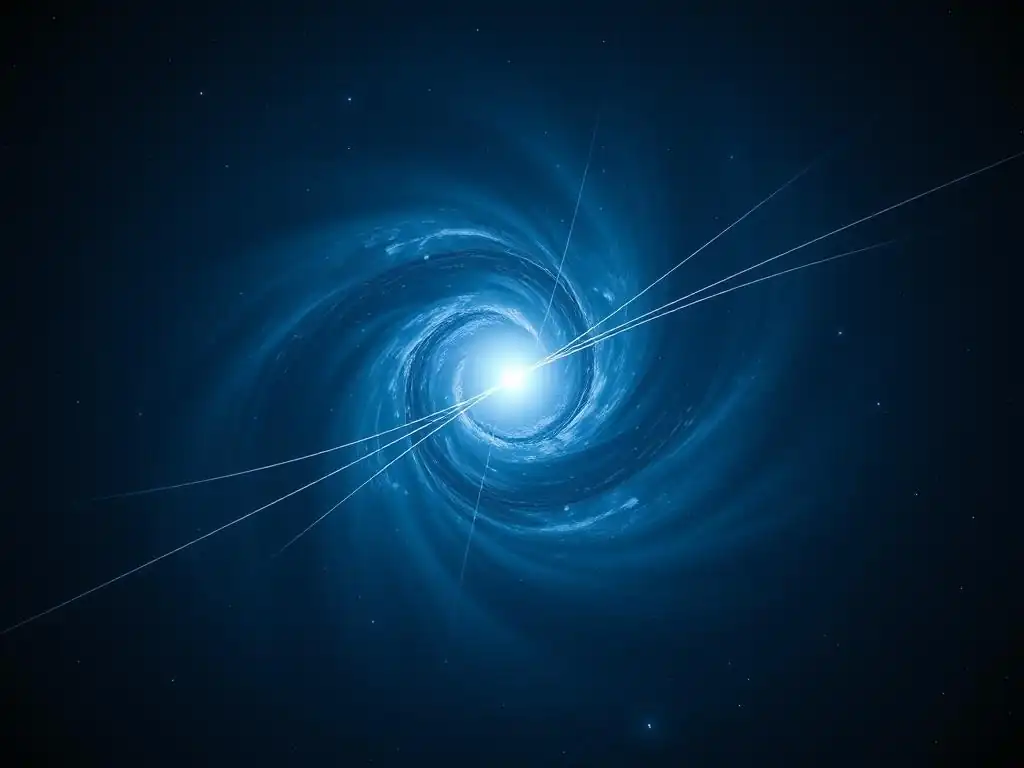
The characteristic pulsing behavior of pulsars, which gave them their name, is explained by what is known as the "lighthouse effect." Neutron stars possess strong magnetic fields, which are not necessarily aligned with their rotation axis. As the neutron star spins, highly energetic particles are accelerated along the magnetic field lines, particularly near the magnetic poles. These accelerated particles emit beams of electromagnetic radiation, often in the radio spectrum, but also in X-rays and gamma rays.
Because the magnetic axis is tilted relative to the rotation axis, these powerful beams sweep across space like the rotating beam from a lighthouse. When one of these beams happens to sweep across Earth's line of sight, we detect a brief, intense pulse of radiation. This precise and regular "flash" is the defining observational characteristic of a pulsar, and its regularity is a direct consequence of the neutron star's stable, rapid rotation, a core concept within pulsar theory.
The Formation and Evolution of Pulsars: Connecting to Stellar Life Cycles
The formation of a neutron star, and thus a pulsar, is an integral part of the stellar life cycle for massive stars. After a massive star exhausts the nuclear fuel in its core, it can no longer support itself against its own gravity. The core rapidly collapses, leading to a spectacular Type II supernova explosion that expels the star's outer layers into space, enriching the interstellar medium with heavy elements. What remains is the super-dense, collapsed core.
Over time, pulsars gradually slow down their rotation as they radiate energy, typically over millions of years. This slowing is often observable as a very gradual increase in their pulse period. However, some pulsars can be "recycled" in binary star systems.
If a neutron star is in a close binary with a companion star, it can accrete matter from its companion. This infalling matter transfers angular momentum to the neutron star, spinning it up to incredibly fast "millisecond pulsar" periods, sometimes hundreds of rotations per second, demonstrating the dynamic and evolving nature of these objects within the framework of pulsar theory.
Theoretical Implications of Pulsars: Revolutionizing Astrophysics
Pulsars and General Relativity: Testing Einstein's Theory in Extreme Environments
Pulsars, particularly those found in binary systems, have proven to be unparalleled cosmic laboratories for rigorously testing Albert Einstein's theory of General Relativity. Their immense gravitational fields and rapid orbital motions create extreme conditions where relativistic effects become pronounced and measurable. The precision with which pulsar pulses can be timed allows astronomers to detect minute changes in their orbits, providing exquisite sensitivity to gravitational phenomena.
A landmark example is the Hulse-Taylor binary pulsar, PSR B1913+16, discovered in 1974. This system consists of two neutron stars orbiting each other every 7.75 hours. Observations over decades have shown that the orbital period of this binary system is steadily decreasing at a rate of about 76 microseconds per year. This orbital decay precisely matches the prediction of General Relativity for the energy lost by the system through the emission of gravitational waves, providing the first indirect evidence of these spacetime ripples and a profound validation of the theoretical framework underpinned by Jocelyn Bell Burnell pulsar theory.
Pulsars as Cosmic Clocks: Precision Timing and Gravitational Wave Detection
Due to their extraordinary rotational stability, pulsars act as incredibly precise "cosmic clocks," rivalling the accuracy of atomic clocks on Earth. This inherent stability makes them invaluable tools for a wide array of astronomical measurements. They are used to map the interstellar medium by measuring the dispersion of radio pulses, to establish a galactic coordinate system, and even to detect minute changes in Earth's rotation.
Beyond these applications, arrays of millisecond pulsars, known as Pulsar Timing Arrays (PTAs) such as NANOGrav in North America, the European Pulsar Timing Array (EPTA), and the Parkes Pulsar Timing Array (PPTA) in Australia, are being used as galactic-scale detectors for ultra-low-frequency gravitational waves. These arrays monitor dozens of the most stable millisecond pulsars, looking for correlated changes in the arrival times of their pulses. Such correlated deviations would indicate the stretching and squeezing of spacetime caused by passing gravitational waves from supermassive black hole binaries or the early universe, pushing the boundaries of pulsar theory into cosmological scales.
Pulsars in Binary Systems: Studying Stellar Evolution and Compact Objects
The discovery and study of pulsars in binary systems have provided unprecedented insights into the complex processes of stellar evolution and the nature of compact objects. When a pulsar is gravitationally bound to a companion star, the interactions between them offer unique opportunities to probe phenomena such as mass transfer, angular momentum exchange, and the eventual fate of binary systems that include neutron stars, white dwarfs, or even black holes.
Observations of these binary pulsars allow astronomers to precisely measure neutron star masses, providing crucial data for testing theories of dense matter physics and the equation of state for matter under extreme conditions. Furthermore, these systems have led to the discovery of exotic binary configurations, such as double neutron star binaries and neutron star-white dwarf binaries, which are key to understanding gravitational wave sources. The study of these intricate dance partners continues to refine our understanding of how stars evolve and interact in the most extreme environments, continuously expanding the scope of pulsar theory.
The Controversy: Nobel Prize Recognition and Overlooked Contributions
The 1974 Nobel Prize in Physics: Acknowledging the Discovery of Pulsars
In 1974, the Nobel Prize in Physics was awarded to Antony Hewish and Martin Ryle "for their pioneering work in radio astrophysics; Ryle for his observations and inventions, in particular of the aperture synthesis technique, and Hewish for his decisive role in the discovery of pulsars." Hewish was Jocelyn Bell Burnell's PhD supervisor at the University of Cambridge. While the Nobel Committee recognized the significance of the pulsar discovery, the exclusion of Bell Burnell from the award sparked immediate and lasting controversy within the scientific community.
The prize announcement acknowledged Hewish's "decisive role," implying his leadership and direction in the research group. However, it was Bell Burnell who meticulously built and maintained the telescope, analyzed the vast amounts of data, and, crucially, identified and persisted in investigating the anomalous signals that turned out to be the first pulsars. Her omission from the 1974 Nobel Prize became a widely cited example of how the contributions of junior researchers, particularly women, have historically been overlooked in favor of their senior male colleagues, despite their foundational role in discoveries like the initial Jocelyn Bell Burnell pulsar theory formulation.
The Exclusion of Jocelyn Bell Burnell: Ethical Considerations and Gender Bias in Science
The decision to exclude Jocelyn Bell Burnell from the 1974 Nobel Prize was met with significant criticism from prominent scientists, including Fred Hoyle, a renowned astrophysicist, who publicly stated that he believed Bell Burnell had been unfairly denied her share of the prize. This incident brought to the forefront ethical considerations surrounding the attribution of credit in collaborative scientific endeavors, particularly concerning the work of graduate students.
More broadly, Bell Burnell's exclusion became a poignant symbol of gender bias prevalent in science during that era, and indeed, one that continues to be discussed today. It highlighted how the systematic undervaluation of women's intellectual contributions and the hierarchical structures of academia could lead to the marginalization of pivotal roles played by female researchers. Her story serves as a powerful case study in the ongoing struggle for equitable recognition and the dismantling of barriers faced by women striving to make their mark in fields like physics and the development of fundamental concepts such as pulsar theory.
Bell Burnell's Perspective: Reflections on the Nobel Prize Controversy
Despite the widespread outcry regarding her omission from the Nobel Prize, Jocelyn Bell Burnell has consistently maintained a remarkably gracious and philosophical perspective on the matter. She has often stated that, at the time, it was conventional for the supervisor to receive credit for discoveries made by their students, reflecting the prevailing academic norms of the era. She has publicly expressed that she was content with the immense satisfaction of having made the discovery itself, a feeling that no prize could diminish.
Her equanimity, however, has not prevented her from becoming a powerful advocate for change. While personally accepting of the past, Bell Burnell has leveraged her platform to champion greater recognition for early-career researchers and to actively promote diversity and inclusion in science. Her reflections on the Nobel controversy serve as a call to action for the scientific community to foster a more equitable environment where contributions, regardless of seniority or gender, are appropriately acknowledged, ensuring that future advancements, including those in pulsar theory, are recognized fairly.
Bell Burnell's Legacy: Inspiring Future Generations in Physics
The Bell Burnell Graduate Scholarship Fund: Supporting Underrepresented Students in Physics
Jocelyn Bell Burnell's legacy extends far beyond her groundbreaking scientific discovery; it is powerfully cemented by her profound commitment to fostering diversity and inclusion in science. In 2018, she was awarded the Special Breakthrough Prize in Fundamental Physics, an honour accompanied by a substantial $3 million prize. In a remarkable act of generosity and foresight, Bell Burnell famously donated the entire prize money to the Institute of Physics (IOP) to establish the Bell Burnell Graduate Scholarship Fund.
The explicit purpose of this fund is to support PhD students from groups that are significantly underrepresented in physics. This includes women, ethnic minorities, and students from socio-economically disadvantaged backgrounds, who often face substantial barriers to pursuing advanced scientific education. This initiative directly addresses systemic inequalities, providing crucial financial support and encouragement to a new generation of physicists, ensuring that talent, not background, determines access to groundbreaking research in fields like pulsar theory.
Promoting Diversity and Inclusion in STEM Fields: Bell Burnell's Advocacy
Beyond her philanthropic endeavors, Jocelyn Bell Burnell has been a tireless and vocal advocate for diversity and inclusion across all STEM fields. Throughout her distinguished career, she has held numerous prestigious leadership positions, including President of the Royal Astronomical Society and President of the Institute of Physics, using these platforms to champion equitable opportunities and break down systemic barriers. Her advocacy extends to mentoring, public speaking, and active participation in initiatives aimed at making science more accessible and welcoming to all.
Her personal story, particularly the Nobel Prize controversy, serves as a powerful narrative that she frequently shares to highlight the challenges faced by women in science and to inspire younger generations. By openly discussing her experiences and promoting a more inclusive scientific culture, Bell Burnell ensures that her influence continues to shape the future of science, encouraging a broader spectrum of voices to contribute to fundamental research, including the ongoing evolution of pulsar theory.
The Enduring Impact of Pulsar Theory: Shaping Modern Astrophysics
The enduring impact of pulsars on modern astrophysics cannot be overstated. From their initial discovery by Jocelyn Bell Burnell, these cosmic objects have become indispensable tools for probing the most extreme conditions in the universe. They have provided the most compelling evidence for Einstein's General Relativity outside of black holes, enabled the indirect detection of gravitational waves decades before direct observation, and are now at the forefront of the search for low-frequency gravitational waves using Pulsar Timing Arrays.
Pulsars continue to serve as unique laboratories for understanding the physics of neutron stars, the interstellar medium, and the dynamics of binary systems. The foundational observations made by Bell Burnell and the subsequent development of Jocelyn Bell Burnell pulsar theory have opened a window into relativistic astrophysics that continues to yield groundbreaking discoveries, shaping our understanding of the universe's most extreme phenomena and its fundamental laws.
Conclusion: Jocelyn Bell Burnell and the Enduring Legacy of Pulsar Research
The Continued Exploration of Pulsars: New Discoveries and Ongoing Research
The field of pulsar astronomy, ignited by Jocelyn Bell Burnell's remarkable discovery, remains one of the most dynamic and fruitful areas of astrophysical research. New types of pulsars continue to be discovered, including highly magnetized magnetars and rapidly spinning millisecond pulsars in binary systems, each offering unique insights into extreme physics. Future observatories, such as the Square Kilometre Array (SKA), promise to uncover thousands more pulsars, pushing the boundaries of our observational capabilities and expanding the scope of pulsar theory.
Ongoing research leverages pulsars to refine our understanding of neutron star interiors, which contain matter at densities unreachable in terrestrial laboratories. They are also being used to precisely map the interstellar medium, test gravitational theories with unprecedented accuracy, and contribute to the grand quest for gravitational wave detection. The journey that began with a faint, regular "scruff" on a chart recorder continues to lead to profound revelations about the cosmos.
Jocelyn Bell Burnell: A Pioneer in Astrophysics and an Advocate for Equality in Science
Jocelyn Bell Burnell's legacy is multifaceted and deeply inspiring. She is celebrated not only as the astute observer who made one of the most significant astronomical discoveries of the 20th century, providing the empirical foundation for Jocelyn Bell Burnell pulsar theory, but also as an unwavering champion for equality and inclusion in science. Her scientific acumen allowed humanity to peer into the extreme physics of neutron stars and the fabric of spacetime itself.
Beyond her scientific contributions, Bell Burnell's resilience in the face of overlooked recognition and her subsequent dedication to supporting underrepresented groups in physics stand as a beacon for ethical scientific practice. Her life's work serves as a powerful reminder that scientific progress is best achieved when all talents are recognized and nurtured, ensuring that the next generation of pioneers, regardless of their background, can contribute fully to the ongoing exploration of the universe.
Frequently Asked Questions
What is Jocelyn Bell Burnell best known for?
Jocelyn Bell Burnell is most famously known for her discovery of pulsars in 1967 while she was a graduate student. This groundbreaking discovery revolutionized astrophysics.
Why is Jocelyn Bell Burnell's work considered significant despite her supervisor receiving the Nobel Prize?
Her work is significant because she made the initial observation and recognized the unusual signal that led to the discovery of pulsars. Many argue she should have been included in the Nobel Prize awarded to her supervisor, Anthony Hewish.
What exactly are pulsars, and how did Bell Burnell's discovery contribute to their understanding?
Pulsars are highly magnetized, rotating neutron stars that emit beams of electromagnetic radiation. Bell Burnell's discovery provided the first observational evidence of these fascinating celestial objects.
What challenges did Jocelyn Bell Burnell face as a woman in science during her time?
Bell Burnell, like many women in science, faced gender bias and discrimination in a male-dominated field. Her contributions were initially overlooked and minimized due to her gender.
How does "WomenInScienceHistory.com" aim to highlight the contributions of women scientists like Jocelyn Bell Burnell?
The site aims to inspire future generations by showcasing the biographies and achievements of female scientists. It also seeks to shed light on the challenges they overcame and the often-overlooked importance of their work.
Final Reflection: Echoes of Discovery, Waves of Inspiration
The story of Jocelyn Bell Burnell and the discovery of pulsars resonates profoundly today, reminding us that scientific breakthroughs often emerge from unexpected places and require unwavering dedication. Her journey, initially overshadowed, now serves as a powerful testament to the importance of recognizing and celebrating the contributions of all scientists, regardless of background or perceived status. The theoretical implications of pulsars continue to shape our understanding of the universe, demonstrating the enduring legacy of this groundbreaking discovery.
The impact of Bell Burnell's work extends far beyond the realm of astrophysics. It has influenced the cultural landscape by highlighting the persistent challenges faced by women in STEM fields. Her story serves as a crucial reminder of the need for greater inclusivity and equity in science, ensuring that future generations of researchers have the opportunity to thrive. It helps if you are a bit oddball, because you tend to look at things differently.
This quote encapsulates the spirit of innovation and the importance of embracing diverse perspectives in the pursuit of knowledge.
Let us all take a moment to reflect on the lessons learned from Jocelyn Bell Burnell's experience. Consider how we can actively contribute to a more equitable and inclusive scientific community. Embrace curiosity, challenge assumptions, and remember that even the smallest observation can lead to extraordinary discoveries. The universe is vast and full of mysteries waiting to be unveiled – are you ready to listen to its whispers and contribute to its understanding?
Unveil the Universe: Your Next Steps in Pulsar Discovery
Thanks for delving into the remarkable story of Jocelyn Bell Burnell and the theoretical implications of pulsars. Now that you've explored this groundbreaking discovery, let's take your understanding further:
- Dedicate time this week to research how pulsars confirm Einstein's theory of general relativity.
- Share this article with your friends and family on social media to inspire a new generation of scientists.
- Explore our website to discover more untold stories of women in science and their contributions to our understanding of the universe.
What aspect of pulsar research most excites you, and how might you use that excitement to further your own learning?