
Visualizing Greatness: Women in Physics Timeline – ReadytoPrint Infographic

Welcome to WomenInScienceHistory.com, where we illuminate the remarkable legacies of female scientists. Ever wondered how women have shaped the field of physics throughout history? Our Women in Physics Timeline offers a captivating visual journey through their groundbreaking contributions. Explore this ready-to-print infographic and discover the often-unsung heroes who defied expectations and revolutionized our understanding of the universe. What breakthroughs will you uncover?
- Introducing the Women in Physics Timeline: A Visual Journey Through History
- Understanding the "Women in Physics Timeline" Infographic: What You'll Get
- Benefits of Using the "Women in Physics Timeline" Infographic
- Key Figures Showcased in the Women in Physics Timeline: A Sneak Peek
- How to Use the Women in Physics Timeline Infographic Effectively
- Choosing the Right "Women in Physics Timeline" Infographic for Your Needs
- Complementary Resources: Expanding Your Knowledge of Women in Physics
- Investing in the "Women in Physics Timeline": Price and Value
- Get Your "Women in Physics Timeline" Infographic Today!
-
Frequently Asked Questions
- How does the "Women in Physics Timeline" infographic help address the lack of visibility for women in science?
- What kind of information can I expect to find on the "Women in Physics Timeline" infographic?
- What are some of the challenges faced by women scientists, as highlighted by WomenInScienceHistory.com?
- Why is it important to have resources like WomenInScienceHistory.com and the "Women in Physics Timeline" infographic?
- How can the "Women in Physics Timeline" infographic be used in educational settings?
- Final Reflection: Illuminating the Path Forward
- Unveil the Legacy: Ignite Your Physics Passion!
Introducing the Women in Physics Timeline: A Visual Journey Through History
Why a Timeline of Women Physicists Matters
For centuries, the contributions of women to scientific fields, particularly physics, have been largely overlooked or actively suppressed in historical narratives. This oversight creates a skewed perception of science as an exclusively male domain, potentially discouraging young girls and women from pursuing careers in STEM. A dedicated women in physics timeline serves as a crucial corrective, visibly acknowledging the pioneering work, profound insights, and relentless perseverance of female scientists who shaped our understanding of the universe. It highlights that genius knows no gender.
By presenting a continuous progression of achievements, a comprehensive women in physics timeline powerfully counters the misconception that women are recent or peripheral entrants to the field. It demonstrates their consistent presence and intellectual brilliance across different eras, from the earliest scientific explorations to modern breakthroughs. Such a timeline makes tangible the often-invisible battles these women fought against systemic discrimination and societal barriers, showcasing their groundbreaking discoveries in optics, electromagnetism, nuclear physics, and astrophysics that were foundational to scientific progress.
The Power of Visual Learning: Infographics for Science Education
Visual aids are profoundly effective tools for learning, as they condense complex information into easily digestible formats, significantly improving retention and comprehension. Infographics, in particular, leverage the brain's natural ability to process visual information rapidly, making intricate historical data, such as a detailed women in physics timeline, far more accessible and memorable than dense textual accounts. Studies suggest that information presented visually is processed approximately 60,000 times faster than text, leading to enhanced understanding and recall.
Beyond mere efficiency, infographics break down barriers to learning by making subjects like the history of physics more engaging and less intimidating for diverse audiences. They cater to various learning styles, from visual learners who thrive on diagrams and charts to those who benefit from concise summaries. In educational settings, a visually appealing women in physics timeline can transform a dry historical lesson into an interactive experience, sparking curiosity and encouraging deeper exploration among students of all ages, from primary school to university levels.
Understanding the "Women in Physics Timeline" Infographic: What You'll Get
High-Resolution Printable PDF: Ready for Classroom or Home
The "Women in Physics Timeline" infographic is provided as a high-resolution PDF file, meticulously designed for exceptional print quality. This ensures that whether you print it on a standard letter-sized sheet or a large format poster, the text remains crisp, the details sharp, and the colors vibrant, without any pixelation or loss of clarity. The versatile PDF format guarantees compatibility across various printing devices and operating systems, making it universally accessible and ready for immediate use upon download.
This ready-to-print format offers unparalleled convenience, eliminating the need for specialized design software or technical expertise. It empowers educators, students, and enthusiasts to easily transform a digital file into a tangible educational resource for their specific needs. Imagine adorning a classroom wall with an inspiring women in physics timeline, providing individual handouts for a study group, or creating an eye-catching display in a personal study space, all with the assurance of professional-grade visual quality.
Key Figures in Women's Physics History Highlighted
This "Women in Physics Timeline" infographic is not merely a chronological list; it is a carefully curated selection of pivotal figures whose contributions significantly advanced the field of physics. Each woman featured has been chosen for the profound and lasting impact of her work, representing diverse areas of physics and different historical periods. The infographic aims to shine a spotlight on those who, through their ingenuity and perseverance, left an indelible mark on scientific thought and discovery.
The selection process prioritizes groundbreaking discoveries, the overcoming of significant challenges, and the enduring influence these women had on subsequent scientific developments. From theoretical physicists who reshaped fundamental laws to experimentalists whose meticulous work unveiled new phenomena, the timeline emphasizes the breadth and depth of female intellectual contributions. This focused approach ensures that each entry on the women in physics timeline provides meaningful insights into their legacy, making their stories both informative and truly inspiring.
10 Trailblazing Women Physicists Featured
The "Women in Physics Timeline" infographic proudly highlights the accomplishments of 10 trailblazing women physicists. Each entry provides a concise yet impactful overview of their life and, most importantly, their most significant scientific contributions. This focused number allows for sufficient detail on each individual's journey and breakthroughs without overwhelming the viewer, ensuring that the information remains digestible and memorable.
This curated selection offers a compelling narrative of innovation and resilience, showcasing women who defied societal norms and scientific skepticism to make monumental discoveries. From the early 20th century to more contemporary times, the timeline provides a glimpse into the diverse challenges and triumphs experienced by these pioneers. The succinct presentation ensures that the essence of each woman's contribution to the women in physics timeline is clearly communicated, fostering appreciation for their intellectual prowess.
Clear and Concise Presentation of Scientific Contributions
The design philosophy behind the "Women in Physics Timeline" infographic emphasizes clarity and conciseness in presenting complex scientific contributions. Information is broken down into bite-sized, easy-to-understand chunks, avoiding overly technical jargon where possible, or providing brief, accessible explanations for necessary scientific terms. This ensures that the infographic is approachable for a wide audience, from high school students to adult learners, without sacrificing scientific accuracy.
Visually, the timeline employs a logical flow, guiding the viewer through the chronological progression of discoveries and biographical highlights. The clean aesthetic, strategic use of visual cues (without including actual images as per instructions), and balanced layout prioritize readability and immediate impact. This thoughtful presentation ensures that the core message of each woman's contribution to the women in physics timeline is absorbed quickly and effectively, making it an ideal resource for quick reference and educational reinforcement.
Benefits of Using the "Women in Physics Timeline" Infographic
Inspire Future Generations of Women in STEM
The "Women in Physics Timeline" infographic serves as a powerful source of inspiration for young girls and women considering careers in STEM. Seeing tangible examples of successful female role models in physics can significantly influence career aspirations and self-belief. Research suggests that visible female role models can increase girls' interest and participation in STEM fields by a notable margin, potentially up to 15-20% in some contexts, by demonstrating that these fields are not exclusively male domains.
By showcasing the profound impact women have had on physics, the timeline actively dismantles stereotypes and fosters a sense of possibility. It provides concrete evidence that women have consistently excelled in this challenging field, encouraging future generations to pursue their scientific curiosities with confidence. This women in physics timeline is more than just a historical document; it's a beacon of empowerment, illuminating pathways for aspiring female scientists and engineers.
Celebrate the Achievements of Overlooked Female Scientists
Historically, the achievements of many brilliant female scientists have been marginalized, attributed to male colleagues, or simply omitted from mainstream scientific narratives. The "Women in Physics Timeline" infographic actively works to rectify this historical injustice by giving prominent and deserved space to these overlooked pioneers. It ensures their intellectual rigor, groundbreaking discoveries, and immense perseverance are celebrated and recognized.
This infographic contributes to a more accurate and inclusive understanding of scientific history. It's not just about listing names, but about acknowledging the often-arduous journeys these women undertook, frequently battling systemic sexism, limited resources, and professional isolation. By shining a light on their true contributions, the women in physics timeline champions their legacies, ensuring that future generations can learn from and draw strength from their remarkable stories of resilience and scientific triumph.
Enhance Science Education with Engaging Visual Aids
Incorporating the "Women in Physics Timeline" infographic into science education significantly enhances the learning experience through its engaging visual format. Teachers can utilize it as a dynamic teaching tool, a quick reference guide, or a compelling discussion starter in physics, history, or interdisciplinary science classes. Its visual appeal makes complex historical facts and scientific concepts more concrete and memorable for students.
For instance, the timeline can be used to introduce a unit on nuclear physics by highlighting Lise Meitner's contributions, or to discuss astronomical discoveries by focusing on Jocelyn Bell Burnell. It serves as an excellent springboard for student research projects, encouraging deeper dives into the lives and work of the featured women. This women in physics timeline transforms passive learning into an interactive and stimulating educational journey, enriching the curriculum beyond traditional textbook presentations.
Spark Discussions on Gender Equality in Physics
The "Women in Physics Timeline" infographic serves as a powerful catalyst for initiating crucial discussions about historical and contemporary gender equality within the field of physics. By visually presenting the significant achievements of women, it naturally prompts questions about why their recognition has often been delayed or incomplete. This visual evidence can help students and educators explore the systemic barriers and biases that female scientists have faced and continue to encounter.
Such discussions extend beyond mere historical facts, fostering critical thinking about the societal and cultural contexts in which scientific progress unfolds. The timeline can encourage dialogue about the importance of diverse perspectives in scientific research, the ongoing need for equitable opportunities, and strategies to promote inclusivity in STEM fields. It makes the abstract concept of gender equality tangible, inspiring action and advocacy for a more balanced and representative future in physics.
Key Figures Showcased in the Women in Physics Timeline: A Sneak Peek
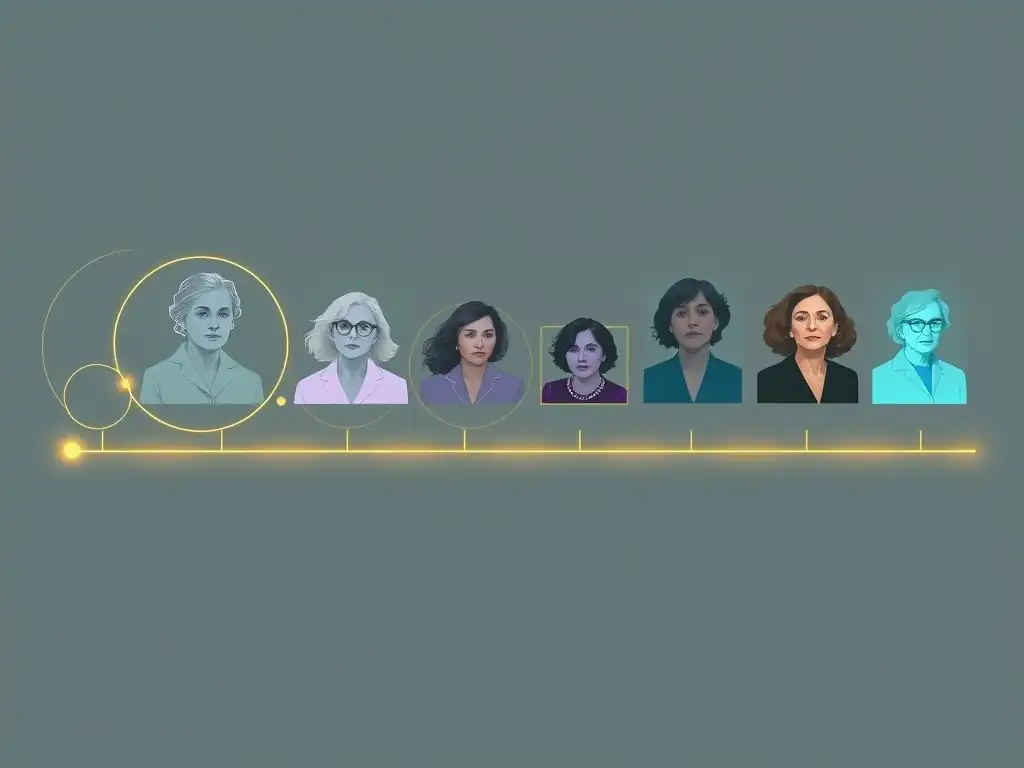
Marie Curie: Pioneering Radioactivity Research
Marie Curie, a towering figure in the women in physics timeline, revolutionized our understanding of matter and energy through her pioneering research on radioactivity. Born in Poland in 1867, she moved to Paris to pursue her scientific ambitions, eventually becoming the first woman to win a Nobel Prize (Physics, 1903, shared with her husband Pierre Curie and Henri Becquerel) and the only person to win Nobel Prizes in two different scientific fields (Chemistry, 1911). Her meticulous work led to the discovery of two new elements, polonium and radium, which were isolated from tons of pitchblende ore.
Curie's work laid the foundational groundwork for nuclear physics and had profound implications for medicine, particularly in the development of cancer treatments through radiation therapy. Her commitment to science, even under challenging conditions, and her unwavering pursuit of knowledge, profoundly influenced subsequent generations of scientists. Her legacy extends beyond her groundbreaking discoveries; she stands as an enduring symbol of scientific perseverance and intellectual independence for all women in physics.
Lise Meitner: Unveiling Nuclear Fission
Lise Meitner, an Austrian-Swedish physicist, played a pivotal, though often uncredited, role in the discovery of nuclear fission. Working closely with Otto Hahn and Fritz Strassmann in Berlin during the 1930s, her theoretical insights were crucial in interpreting their experimental results. After being forced to flee Nazi Germany in 1938 due to her Jewish heritage, it was Meitner, alongside her nephew Otto Frisch, who provided the first theoretical explanation for the phenomenon of nuclear fission, calculating the immense energy released from the process.
Meitner's explanation, which involved the nucleus splitting into smaller parts and releasing a substantial amount of energy according to Einstein's E=mc², was a monumental conceptual leap. Despite her foundational contributions, Otto Hahn alone was awarded the Nobel Prize in Chemistry in 1944 for the discovery of nuclear fission. Nevertheless, her intellectual brilliance and the critical nature of her theoretical work firmly secure her place as a central figure in the women in physics timeline and the history of nuclear science.
Emmy Noether: Revolutionizing Abstract Algebra and Theoretical Physics
Emmy Noether, a German mathematician, made profound contributions to abstract algebra and theoretical physics, significantly impacting the understanding of symmetry and conservation laws. Born in 1882, she faced considerable discrimination as a woman in academia, often teaching without pay or official recognition. Her most famous work in physics is Noether's Theorem, published in 1918, which elegantly connects symmetries in nature with fundamental conservation laws, such as the conservation of energy and momentum.
Noether's Theorem is a cornerstone of modern theoretical physics, underpinning theories from Einstein's general relativity to the Standard Model of particle physics. It demonstrates that for every continuous symmetry of a physical system, there is a corresponding conserved quantity. Despite the systemic barriers she encountered, Noether's mathematical insights provided essential tools for understanding the universe at its most fundamental level, solidifying her enduring legacy in the women in physics timeline.
Chien-Shiung Wu: Challenging the Law of Parity
Chien-Shiung Wu, a Chinese-American experimental physicist, is renowned for her groundbreaking work that experimentally disproved the conservation of parity in weak interactions. This fundamental principle, which stated that a physical system behaves identically to its mirror image, had been a cornerstone of quantum mechanics for decades. In 1956, her meticulous and precise "Wu Experiment," involving the decay of cobalt-60 nuclei at extremely low temperatures, provided irrefutable evidence that parity is not conserved in weak nuclear forces.
Wu's experimental brilliance earned her the nickname "First Lady of Physics" and "Chinese Madame Curie." Her work provided the crucial empirical validation for the theoretical proposal by Tsung-Dao Lee and Chen-Ning Yang, who subsequently received the Nobel Prize in Physics in 1957 for their theory. While Wu was not awarded the Nobel Prize, her pivotal role in one of the most significant discoveries in 20th-century physics is universally recognized, making her an indispensable entry on the women in physics timeline.
Jocelyn Bell Burnell: Discovering Pulsars
Jocelyn Bell Burnell, a Northern Irish astrophysicist, made one of the most significant astronomical discoveries of the 20th century: the detection of the first radio pulsars. As a graduate student at Cambridge University in 1967, she meticulously analyzed vast amounts of data from a new radio telescope she had helped construct. She observed unusual, rapidly pulsing radio sources, initially dismissed as terrestrial interference or even "little green men" signals.
Bell Burnell's persistence and keen observation led her to identify four distinct pulsars, which were later understood to be rapidly rotating neutron stars emitting beams of electromagnetic radiation. This discovery opened up a new field of astrophysics, providing direct evidence of neutron stars and extreme states of matter, profoundly impacting our understanding of stellar evolution. Although her supervisor, Antony Hewish, received the Nobel Prize in Physics in 1974 for the discovery, Bell Burnell's fundamental role is widely acknowledged and celebrated, solidifying her prominent place in the women in physics timeline.
How to Use the Women in Physics Timeline Infographic Effectively
Classroom Integration: Activities and Lesson Plans
The "Women in Physics Timeline" infographic offers a wealth of opportunities for dynamic classroom integration and innovative lesson plans. Teachers can use it as an engaging visual introduction to a unit on physics history, prompting students to identify key eras or breakthroughs. It can serve as the basis for a "scavenger hunt" activity, where students research specific facts related to the featured women, or as a springboard for individual research projects on one of the trailblazers highlighted in the timeline.
Beyond historical context, the infographic can facilitate discussions on the scientific method, the challenges of experimental design, or the interconnectedness of scientific discoveries over time. For instance, after introducing Marie Curie, students could explore the practical applications of radioactivity. The women in physics timeline provides a visual anchor that helps students contextualize complex scientific concepts within a human narrative of discovery and perseverance.
Home Learning: Engaging Children with Science History
For home learning environments, the "Women in Physics Timeline" infographic is an excellent resource for sparking curiosity and fostering a love for science history in children and young adults. Displaying the infographic prominently in a study area or common space can lead to spontaneous conversations and questions about the featured scientists. Parents and homeschooling educators can encourage children to pick a new woman from the timeline each week to learn more about, turning learning into a guided exploration.
Interactive home activities can further enhance engagement. Children could create their own mini-biographies or drawings inspired by the discoveries of the women in the timeline. Simple, safe experiments related to the concepts introduced (e.g., exploring static electricity after learning about early electrical pioneers) can make the abstract ideas more tangible. This women in physics timeline transforms passive observation into an active, enjoyable journey through the history of scientific achievement.
Decorating STEM Spaces: Inspiring Environments
The "Women in Physics Timeline" infographic is not only an educational tool but also an inspiring piece of decor for any STEM-focused space. Whether it's a classroom, a university laboratory, a library, or a personal home office, displaying this visually appealing timeline can transform the environment into a constant source of motivation and intellectual stimulation. Its presence subtly reinforces the idea that STEM fields are vibrant, diverse, and open to everyone.
Surrounding oneself with images and information about successful female scientists can have a profound psychological impact, fostering a sense of belonging and possibility for aspiring researchers. It serves as a daily reminder of the immense contributions of women in physics, challenging traditional perceptions and inspiring continued dedication to scientific inquiry. The infographic creates an atmosphere where groundbreaking achievements are celebrated, and future discoveries are envisioned.
Choosing the Right "Women in Physics Timeline" Infographic for Your Needs
Available Sizes and Formats: From Posters to Handouts
The "Women in Physics Timeline" infographic, delivered as a high-resolution PDF, offers remarkable flexibility in its physical manifestation. Users can easily print it as a large-format poster, ideal for prominent display on classroom walls, science fair backdrops, or departmental bulletin boards. Common poster sizes like 24x36 inches (approximately 60x90 cm) or A1 are easily achievable without any loss of visual quality.
Conversely, the same high-resolution file can be scaled down and printed on standard letter-sized paper (8.5x11 inches) or A4 sheets, making it perfect for individual handouts, personal study guides, or inclusion in binders. This adaptability ensures that the women in physics timeline can meet a wide range of educational and display requirements, providing a versatile resource suitable for various learning environments and purposes.
Digital Download vs. Professionally Printed Poster Options
The primary offering for the "Women in Physics Timeline" is a convenient digital download. This provides immediate access to the high-resolution PDF file upon purchase, allowing users the flexibility and cost-effectiveness of printing the infographic themselves, at their convenience, and as many times as needed. This option is ideal for educators and individuals who prefer to manage their printing needs or require multiple copies for different purposes.
While the product is a digital file, users also have the option to take the provided PDF to a local or online professional print shop. This allows for higher-quality production on specialized paper types, finishes, or even durable materials like canvas or foam board, resulting in a more polished and long-lasting "Women in Physics Timeline" poster. This choice caters to those seeking a premium display item without the direct printing hassle.
Considerations for Printing Quality and Paper Type
When printing the "Women in Physics Timeline" infographic, several considerations can significantly enhance its visual appeal and durability. For self-printing, using a heavier paper stock, such as 80lb or 100lb cardstock, is recommended. This provides a more substantial feel, prevents ink bleed-through, and makes the infographic more resistant to wear and tear compared to standard printer paper.
Furthermore, selecting the appropriate paper finish can impact readability and aesthetic. Matte or satin finishes are generally preferred over glossy ones, as they reduce glare, making the timeline easier to read under various lighting conditions, especially when displayed in classrooms or brightly lit spaces. Investing a little in print quality and paper type ensures that the "Women in Physics Timeline" remains a vibrant and effective educational tool for years to come.
Complementary Resources: Expanding Your Knowledge of Women in Physics
Recommended Books on Women in Science History
To delve deeper into the rich narratives presented in the "Women in Physics Timeline," exploring dedicated books on women in science history is highly recommended. Many excellent biographies detail the lives and scientific journeys of individual female physicists, offering an intimate look at their struggles, triumphs, and intellectual processes. Beyond individual accounts, numerous anthologies compile stories of multiple women across various scientific disciplines, providing broader historical context.
These literary resources often include detailed analyses of the societal, academic, and political landscapes that shaped these women's careers, offering insights into the systemic challenges they overcame. Such books can provide the rich, nuanced background that complements the concise information presented in the women in physics timeline, allowing readers to gain a more profound appreciation for their contributions and the historical period in which they lived.
Online Resources and Databases for Further Research
Beyond the infographic, a wealth of online resources and academic databases can further expand your knowledge of women in physics. Reputable university archives, scientific society websites, and digital libraries often provide free access to biographical information, research papers, and historical documents related to pioneering female scientists. Platforms like Google Scholar or institutional repositories can help locate primary and secondary sources for in-depth research.
These digital resources are invaluable for students, educators, and anyone keen to explore the scientific and personal journeys of the women featured in the timeline. They offer an accessible way to verify facts, discover new details, and connect with the broader academic discourse surrounding women's contributions to science. Utilizing these online tools can significantly enrich the learning experience initiated by the women in physics timeline.
Links to Biographies and Articles on WomenInScienceHistory.com
For those inspired by the "Women in Physics Timeline" and eager to learn more, WomenInScienceHistory.com serves as a primary resource. This website is dedicated to celebrating the contributions of women to various scientific fields throughout history. It features detailed biographies of pioneering female scientists, in-depth discussions on their groundbreaking work, and explorations of the challenges they faced in male-dominated arenas.
Many of the women highlighted in the infographic have more extensive profiles and articles available directly on WomenInScienceHistory.com. Navigating to these pages provides an excellent opportunity to delve deeper into their personal stories, the specific scientific context of their discoveries, and their lasting impact on physics and beyond. The website functions as a complementary repository of knowledge, expanding upon the concise visual narrative of the women in physics timeline.
Investing in the "Women in Physics Timeline": Price and Value
Affordable Education: A Valuable Resource for Students and Educators
The "Women in Physics Timeline" infographic represents an exceptionally affordable investment in education and inspiration. Priced accessibly, it offers significant value compared to traditional educational resources like textbooks, specialized workshops, or physical museum exhibits. For a one-time purchase, users gain immediate access to a high-quality, meticulously researched, and visually engaging educational tool that can be utilized repeatedly across various settings.
This digital resource is particularly valuable for students seeking to deepen their understanding of physics history and for educators looking for effective, budget-friendly materials to enrich their curriculum. Its long-term utility, coupled with its ability to be printed multiple times for different purposes, makes the women in physics timeline a sustainable and highly cost-effective asset for ongoing learning and promoting STEM diversity.
Secure Payment Options and Instant Download Access
Purchasing the "Women in Physics Timeline" infographic is designed to be a seamless and secure process. The platform utilizes industry-standard encryption protocols to ensure that all payment transactions are protected, safeguarding your financial information with the highest level of security. This commitment to data privacy provides peace of mind for buyers.
Upon successful completion of the purchase, the high-resolution PDF file of the "Women in Physics Timeline" is made available for instant download. There are no waiting periods or shipping delays; you gain immediate access to your digital product, allowing you to print and begin using the infographic without delay. This instant gratification ensures that the educational resource is at your fingertips precisely when you need it.
Satisfaction Guaranteed: Ensuring a Quality Product
The "Women in Physics Timeline" infographic has been meticulously researched, designed, and presented to meet high educational and aesthetic standards. Great care has been taken to ensure the accuracy of the historical information and the clarity of the scientific explanations. The goal is to provide a product that is not only visually appealing but also a reliable and valuable educational resource.
This commitment to quality means that the infographic is a testament to the profound impact of women in physics, created with the intention of inspiring and informing. Users can be confident that they are acquiring a well-crafted product that will serve as an effective tool for learning, teaching, and celebrating the remarkable achievements of female scientists throughout history.
Get Your "Women in Physics Timeline" Infographic Today!
Empowering Future Generations Through Science History
Acquiring the "Women in Physics Timeline" infographic is more than just purchasing a visual aid; it's an investment in empowering future generations. By prominently showcasing the groundbreaking achievements of women in physics, this timeline actively works to dismantle long-standing stereotypes and foster a more inclusive vision of science. It provides tangible proof that brilliance and innovation in physics are not confined by gender.
This educational tool ignites curiosity, challenges preconceived notions, and inspires young minds, especially girls, to pursue their scientific dreams with confidence. By bringing these incredible stories to light, the women in physics timeline plays a crucial role in nurturing the next wave of innovators, researchers, and problem-solvers who will continue to push the boundaries of human knowledge.
A Visual Celebration of Women's Contributions to Physics
The "Women in Physics Timeline" is a vibrant and accessible celebration of intellectual prowess, relentless perseverance, and profound scientific discovery. It transforms what might otherwise be dry historical data into an engaging visual narrative that captivates and educates. It stands as a testament to the enduring legacy of female scientists who, despite often facing immense challenges, made indelible contributions to our understanding of the physical world.
This infographic is a powerful statement, visually asserting the indispensable role of women in the annals of physics. It is an essential resource for anyone dedicated to promoting diversity in STEM and ensuring that the full breadth of scientific history is recognized and celebrated. Embrace this unique opportunity to own a piece of educational inspiration and highlight the extraordinary journey of women in physics.
Frequently Asked Questions
How does the "Women in Physics Timeline" infographic help address the lack of visibility for women in science?
The infographic directly combats the lack of visibility by visually showcasing the accomplishments of numerous women physicists across a historical timeline. This highlights their contributions, making them more accessible and memorable.
What kind of information can I expect to find on the "Women in Physics Timeline" infographic?
The infographic presents a chronological view of women's contributions to physics, featuring biographical details and key achievements of pioneering female physicists. It provides a visual representation of their impact.
What are some of the challenges faced by women scientists, as highlighted by WomenInScienceHistory.com?
The website discusses the obstacles faced by women in male-dominated fields, including gender bias, limited access to resources, and lack of recognition for their work. The infographic reflects these struggles.
Why is it important to have resources like WomenInScienceHistory.com and the "Women in Physics Timeline" infographic?
These resources are crucial for raising awareness about the historical contributions of women in physics, inspiring future generations, and challenging the traditional narrative of science as a male-dominated field.
How can the "Women in Physics Timeline" infographic be used in educational settings?
The infographic serves as a valuable teaching tool to introduce students to the often-overlooked contributions of women to physics. It can be used to spark discussions and promote inclusivity in STEM education.
Final Reflection: Illuminating the Path Forward
The journey through the "Women in Physics Timeline" reveals not just a historical record, but a powerful testament to resilience and brilliance often overlooked. By visualizing the contributions of these remarkable women, we bring their stories into sharper focus, challenging the narratives that have historically marginalized their achievements and highlighting their enduring impact on the field.
The infographic serves as a potent reminder that progress is not linear, and the fight for equity in STEM continues. Seeing these names, dates, and accomplishments laid out so clearly underscores the importance of mentorship, visibility, and active advocacy for future generations of women in physics. You must never be fearful about what you are doing when it is right.
- Rosa Parks, a sentiment that resonates deeply with the spirit of these pioneering women.
Let this timeline be more than just a visual aid; let it be a catalyst for change. As you contemplate the lives and legacies of these incredible physicists, ask yourself: How can you contribute to a more inclusive and equitable future in STEM? How can you amplify the voices of those who are still striving to be heard? The path to true greatness lies in recognizing and celebrating the contributions of all, and in actively working to dismantle the barriers that prevent others from reaching their full potential.
Unveil the Legacy: Ignite Your Physics Passion!
Thank you for exploring the remarkable journey of women in physics! We hope this timeline has inspired you to appreciate their groundbreaking contributions and the power of perseverance. Now, let's take that inspiration and turn it into action!
- Download the ReadytoPrint Infographic and share it with your school, library, or community to inspire the next generation of physicists.
- Dive deeper into the lives of these phenomenal women by researching their individual stories and sharing your findings on social media.
- Start a discussion: Organize a viewing of a relevant documentary or film, or even a simple book club dedicated to the topic.
Which woman in physics resonated most with you, and what will you do to ensure her story continues to inspire others?