Reader's Choice: Essential Books on Women in 20th Century Physics
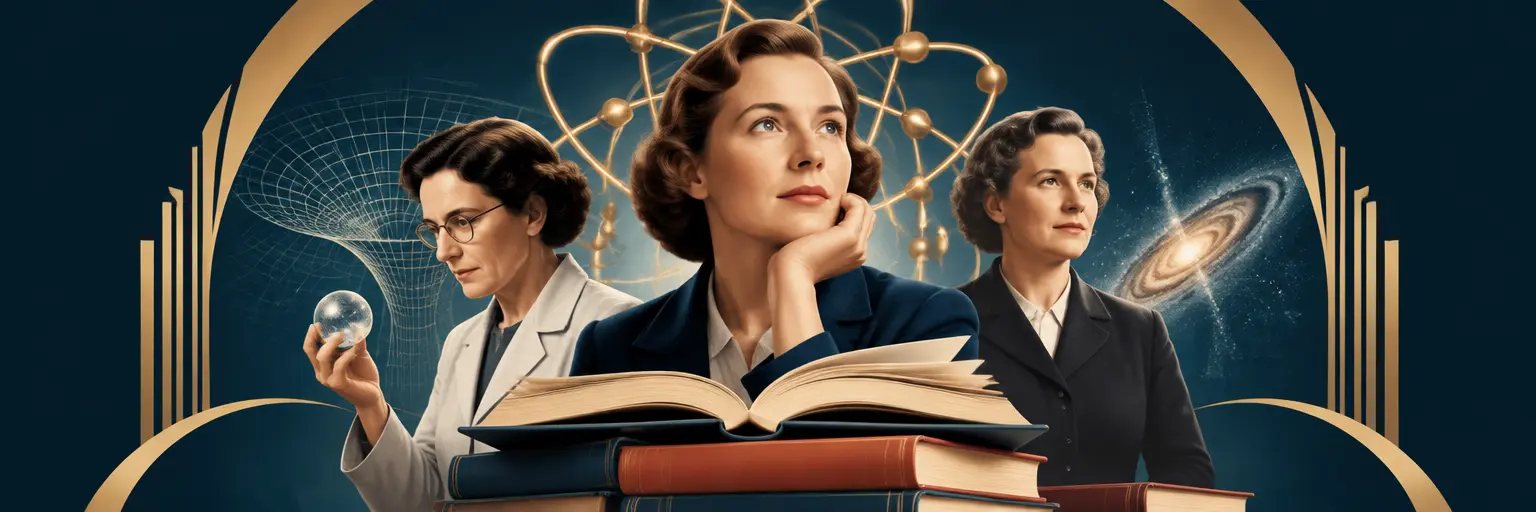
Dive into a curated collection of the most compelling narratives and scholarly works that illuminate the lives and legacies of women who reshaped physics during the 20th century. From Marie Curie's dual Nobel Prizes to Lise Meitner's pivotal role in nuclear fission, these essential books blend rigorous science with personal triumph. Whether you’re a student, educator, or history enthusiast, this selection offers both intellectual depth and emotional resonance, making it a cornerstone for understanding women's indispensable contributions to modern physics.
📘 Biographical Masterpieces: Personal Journeys Through Physics
These biographies go beyond lab notes, revealing the personal sacrifices, societal barriers, and quiet determination of women like Emmy Noether and Chien-Shiung Wu. Expect richly detailed accounts that humanize scientific breakthroughs, drawing from letters, diaries, and interviews. Each book provides a vivid window into how these physicists navigated sexism, war, and academic exile while producing work that underpins today’s quantum and nuclear theories.
For readers seeking narrative-driven science, these titles emphasize resilience and intellectual courage. Key themes include mentorship dynamics, family pressures, and the often-uncredited collaborations with male colleagues. The authors, many of them historians or scientists themselves, apply meticulous archival research to correct historical omissions, turning each page into a revelation about both the woman and her era.
🔬 Scientific Revolutionaries: Groundbreaking Work Explained
Focus on books that delve into the actual physics—quantum mechanics, radioactivity, stellar nucleosynthesis—explained with clarity for non-experts. These works dissect how women like Maria Goeppert-Mayer (nuclear shell model) and Cecilia Payne-Gaposchkin (stellar composition) changed foundational paradigms. Readers will gain a solid grasp of the science without needing a physics degree, as authors use analogies, historical context, and step-by-step logic.
This subcategory is ideal for science communicators and curious minds. Expect detailed explanations of experiments, equations, and theoretical leaps, paired with social commentary on why these contributions were marginalized. The books also highlight collaborative networks among female physicists, offering a collective portrait of innovation that transcends individual genius.
📚 Anthologies & Essay Collections: A Panoramic View
Anthologies compile multiple voices, chronicling the full spectrum of women in 20th-century physics—from pioneers in crystallography to early quantum theorists. These volumes are perfect for readers who prefer breadth over depth, sampling chapters on different scientists, eras, and subfields. Curated by editors with feminist science studies expertise, they include primary source excerpts, contemporary critiques, and comparative analyses.
Expect thematic organization around topics like “war and displacement” or “institutional barriers,” making it easy to jump between chapters. Notable for classroom use, these books often feature discussion questions and timelines, bridging historical context with modern STEM advocacy. They also reveal transnational connections, showing how women in Europe, America, and Asia shared knowledge and strategies despite geopolitical divides.
🛠️ Technical & Philosophical Explorations: Deep-Dive Analyses
For advanced readers, this tier offers critical examinations of women’s scientific methodologies and the philosophical implications of their work. Books here analyze how gendered perspectives influenced problem-solving approaches, from laboratory techniques to theoretical interpretations. They interrogate why certain discoveries were credited to men, using case studies to expose the social construction of scientific authority.
These works incorporate primary laboratory notebooks, correspondence with leading physicists like Bohr and Heisenberg, and comparative studies with male contemporaries. Ideal for historians and graduate students, they challenge readers to reconsider the epistemology of physics—what counts as “discovery” and who gets to define it. Expect rigorous argumentation, abundant footnotes, and a multidisciplinary lens blending sociology, history, and physics.
🎓 Reader’s Guides & Educational Resources
Specially curated for discussion groups or self-study, these books function as learning companions, pairing biography with explanatory essays, glossaries, and study prompts. They are designed to make complex topics accessible to a broader audience, including high school students and lifelong learners. Each chapter ends with reflective questions, making them excellent for book clubs or women-in-STEM courses.
These resources often include comparative charts of key experiments, annotated bibliographies, and links to original papers (now digitized). Perfect for educators, they also offer adaptable lesson plans and multimedia suggestions, such as documentary pairings. By focusing on active engagement, these books transform passive reading into a participatory experience, encouraging readers to trace the historical threads into contemporary physics debates.
Frequently Asked Questions
What qualifies a book as “essential” for this subcategory?
Essential books are selected based on historical accuracy, narrative quality, and scholarly impact. They must highlight a woman who made a significant, verifiable contribution to 20th-century physics, and the book should offer substantial context about scientific concepts and the era’s social climate. Preference is given to works that have received awards, extensive reviews, or are cited by historians.
Are these books technically challenging for non-physicists?
No, the collection spans accessible to dense. Biographies and anthologies are generally written for a general audience, explaining physics with minimal jargon. Technical and philosophical explorations assume more background but still provide explanatory boxes and appendices. Always check the reading level in the description—most titles offer clear transitions between narrative and technical sections.
Can I find multiple books about the same scientist here?
Yes, particularly for Marie Curie and Lise Meitner, where multiple biographies, letter compilations, and analyses exist. The subcategory highlights different angles—for instance, one book may focus on Curie’s family life, another on her lab methods, and a third on her institutional legacy. This allows readers to compare interpretations and deepen their understanding.
How do these books address the “20th century” timeframe specifically?
Each book situates the physicist’s work within decades of defining events: pre-war radioactivity, interwar quantum mechanics, wartime research, and postwar particle physics. Authors explicitly connect scientific advancements to political and social shifts, such as the rise of fascism, immigration policies, and the Cold War, showing how global events shaped research opportunities and recognition.
Do any of these books include primary sources or original data?
Many do, especially the technical and philosophical tiers. You’ll find reprinted correspondence between women physicists and their mentors, excerpts from lab notebooks, and archival photographs of equipment. Anthologies often reproduce original papers with modern annotations, helping readers parse historical notation while comparing it to modern formulations.