
Sophie Germain: Her Mathematical Insights That Aided Celestial Mechanics

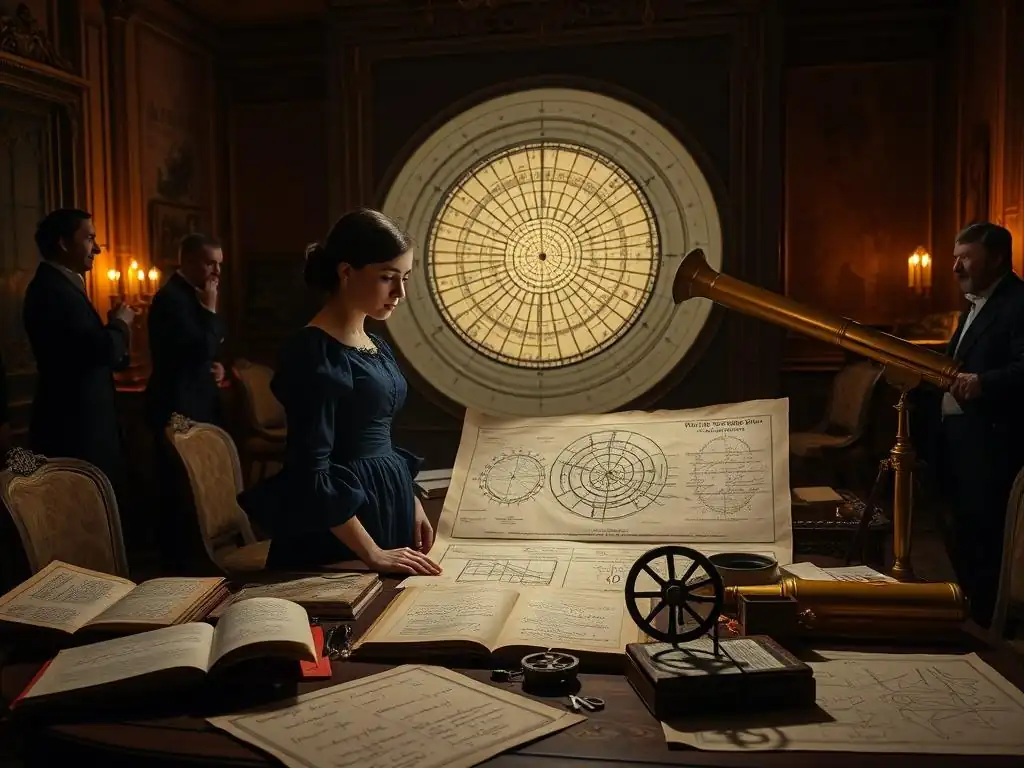
Welcome to WomenInScienceHistory.com! Prepare to be inspired by the untold stories of brilliant women who shaped the scientific landscape. This month, we delve into the extraordinary life and work of Sophie Germain, a mathematical genius whose groundbreaking insights were crucial for understanding celestial mechanics. How did a woman, facing societal barriers, contribute so significantly to this complex field? Read on to uncover her remarkable journey and discover the mathematical brilliance that helped unlock the secrets of the cosmos.
- Introduction: Sophie Germain, a Pioneer in Mathematics and Physics
- Sophie Germain's Contributions to Number Theory and Elasticity
- Sophie Germain's Mathematical Insights and Celestial Mechanics
- Sophie Germain's Mathematical Legacy
- Sophie Germain's Influence on Engineering and Physics
- Conclusion: Celebrating Sophie Germain's Achievements
-
Frequently Asked Questions
- How did Sophie Germain contribute to celestial mechanics?
- What were some of the major challenges Sophie Germain faced as a woman in science?
- What specific area of mathematics did Sophie Germain excel in, besides its application to celestial mechanics?
- Why is it important to highlight the contributions of women like Sophie Germain in the history of science?
- What are "Sophie Germain primes," and why are they named after her?
- Final Reflection: The Enduring Echo of Mathematical Courage
- Unleash Your Inner Math Genius!
Introduction: Sophie Germain, a Pioneer in Mathematics and Physics
Overcoming Obstacles: Sophie Germain's Early Life and Self-Education
Born in Paris in 1776, Marie-Sophie Germain grew up during a tumultuous period marked by the French Revolution. This upheaval, paradoxically, provided her with an unexpected opportunity: confined to her home for safety, she found solace and intellectual stimulation in her father's extensive library. It was there, amidst volumes on history, philosophy, and science, that she discovered her passion for mathematics, particularly after reading about the death of Archimedes during the siege of Syracuse.
Despite her parents' initial disapproval of her intense studies—they even confiscated her candles and warm clothes at night to deter her—Sophie Germain's determination was unwavering. She would secretly study late into the night, wrapped in blankets, teaching herself Latin and Greek to access classic mathematical texts.
Lacking access to formal education due to her gender, Sophie Germain's self-education was remarkably comprehensive. She devoured works by leading mathematicians like Euler and Newton. When the École Polytechnique opened in 1794, admitting only men, Germain cleverly obtained lecture notes and assignments under the pseudonym "Monsieur Le Blanc."
This allowed her to submit her solutions and engage with the material, eventually catching the attention of Joseph-Louis Lagrange, one of the era's most esteemed mathematicians. Impressed by the depth and originality of "Le Blanc's" work, Lagrange sought a meeting, leading to the revelation of Germain's true identity and marking the beginning of her journey into the male-dominated world of professional mathematics.
Sophie Germain's Significance in the History of Women in STEM
Sophie Germain's journey stands as a powerful testament to intellectual perseverance in the face of immense societal barriers. In an era when women were largely excluded from scientific institutions, universities, and professional societies, Germain carved out a unique and respected position for herself through sheer talent and relentless self-study.
Her ability to engage with and contribute to cutting-edge mathematical problems, despite lacking formal academic training, highlights the depth of her innate genius and her unwavering commitment to knowledge. Her story is a crucial narrative in the history of women in STEM, demonstrating that intellectual capability knows no gender, and that significant contributions can emerge from the most unexpected circumstances.
Her recognition by leading figures such as Lagrange, Carl Friedrich Gauss, and Adrien-Marie Legendre, even if initially under a male pseudonym, underscores the undeniable quality of her mathematical insights. Germain's achievements not only advanced specific fields of mathematics and physics but also served as a quiet, yet profound, challenge to the prevailing prejudices of her time.
She became an unofficial, yet highly respected, member of the scientific community, paving the way for future generations of women who would seek to contribute to science and mathematics. Her legacy continues to inspire, reminding us of the importance of recognizing talent wherever it may be found, regardless of gender or societal constraints.
Sophie Germain's Contributions to Number Theory and Elasticity
Germain Primes: A Foundation for Cryptography and Number Theory
Sophie Germain's work in number theory was particularly significant, most notably her contributions to Fermat's Last Theorem. This famously difficult problem posits that no three positive integers a, b, and c can satisfy the equation aⁿ + bⁿ = cⁿ for any integer value of n greater than 2. Germain's approach involved identifying a special class of prime numbers, now known as "Sophie Germain primes."
A prime number p is a Sophie Germain prime if 2p + 1 is also a prime number. Examples include 2 (where 2 2+1=5, which is prime), 3 (where 23+1=7, which is prime), 5 (where 2*5+1=11, which is prime), and so on. Her theorem states that if p is a Sophie Germain prime, then the first case of Fermat's Last Theorem (where p does not divide abc) holds for exponent p. This provided a partial proof and significantly advanced the understanding of the problem.
While Germain's direct work on these primes was rooted in pure mathematics, specifically number theory, the concept of Sophie Germain primes has found surprising relevance in modern applications. For instance, they play a role in the construction of certain large prime numbers used in public-key cryptography, such as RSA.
Although these cryptographic applications emerged long after her time, the fundamental mathematical insights she provided into the properties of primes continue to underpin advanced computational security. Her deep understanding of prime numbers laid a theoretical groundwork that, centuries later, contributes to the secure transmission of information across digital networks, showcasing the enduring power of foundational mathematical discoveries.
Solving the Vibration of Elastic Plates: Chladni's Figures and Germain's Mathematical Model
One of Sophie Germain's most remarkable achievements was her groundbreaking work on the theory of elasticity, specifically addressing the vibration of elastic plates. In 1809, the French Academy of Sciences announced a prestigious prize for a mathematical theory that could explain the patterns observed by Ernst Chladni, who demonstrated that sand sprinkled on a vibrating metal plate would arrange itself into intricate geometric patterns. This challenge, which had baffled leading mathematicians, attracted Germain's attention.
She submitted her first attempt in 1811, but it contained errors. Undeterred, she continued to refine her work, submitting revised versions in 1813 and finally winning the Grand Prix in 1816, becoming the first woman to win a prize from the Academy outright.
Germain's winning essay, "Mémoire sur les vibrations des plaques élastiques," presented a partial differential equation that accurately described the motion of an elastic surface. Her equation, now known as the Germain equation for elastic plates, was a significant step forward in continuum mechanics. While her initial derivation relied on some physical assumptions that were later rigorously justified by Poisson and Navier, her intuitive grasp of the problem and her ability to construct a working mathematical model were profound.
Her work provided the foundational mathematical framework for understanding how materials deform and vibrate, directly influencing the fields of structural engineering and acoustics. The beautiful and complex Chladni figures, once a mystery, now had a mathematical explanation thanks to Sophie Germain's persistent and brilliant mathematical insights.
Sophie Germain's Mathematical Insights and Celestial Mechanics
Fermat's Last Theorem: Germain's Theorem and Partial Proofs
Sophie Germain's most celebrated contribution to number theory is inextricably linked to Fermat's Last Theorem, a problem that captivated mathematicians for centuries. Her specific insight, often referred to as Germain's Theorem, provided a crucial step towards its eventual proof. The theorem states: if p is a Sophie Germain prime (meaning p and 2p + 1 are both prime), then for the first case of Fermat's Last Theorem (where p does not divide any of x, y, z in the equation x^p + y^p = z^p), there are no integer solutions.
This was a significant advance because it provided a partial proof for an infinite class of prime exponents, effectively narrowing the scope of the problem. For instance, she proved that if p is 5, then 2*5+1=11, which is prime, thus the first case holds for the exponent 5.
This rigorous analytical approach to number theory, though seemingly abstract, showcased Germain's profound mathematical insights and her ability to tackle complex problems with innovative strategies. Her work on Fermat's Last Theorem, published in Legendre's "Essai sur la théorie des nombres," cemented her reputation among her peers. While the full proof of Fermat's Last Theorem would not come until Andrew Wiles in 1994, Germain's theorem stood as the most significant general result on the problem for over a century, demonstrating her exceptional analytical prowess and her capacity to contribute meaningfully to the most challenging mathematical questions of her era.
How Germain's Number Theory Influenced Laplace's Work on Celestial Mechanics
While Sophie Germain did not directly publish works on celestial mechanics, her profound mathematical insights and the methods she developed had an indirect, yet significant, influence on the broader scientific landscape, including the work of giants like Pierre-Simon Laplace. Laplace, a towering figure in celestial mechanics, was deeply immersed in applying mathematical analysis to understand planetary orbits, gravitational interactions, and the stability of the solar system.
This field heavily relied on sophisticated differential equations and complex analytical methods. Germain's rigorous work on elasticity, which involved deriving and solving partial differential equations to describe physical phenomena, demonstrated a mastery of the very mathematical tools central to celestial mechanics.
Laplace, recognizing her exceptional talent, personally invited her to attend sessions of the French Academy of Sciences, a rare honor for a woman at the time. He was well aware of her mathematical capabilities, particularly her analytical rigor and her capacity to tackle complex problems. Her approach to solving the elastic plate problem, which required developing a novel mathematical model for a physical system, mirrored the analytical challenges inherent in celestial mechanics.
The transferability of such deep mathematical insights meant that her advancements in applied mathematics, even if in a different domain, strengthened the overall mathematical toolkit available to scientists like Laplace, who were pushing the boundaries of understanding celestial mechanics. Her analytical prowess contributed to the general advancement of mathematical physics, creating a more robust foundation for all areas of scientific inquiry, including the intricate ballet of orbiting planets.
Germain's Theorem and its Impact on Modeling Planetary Orbits
Sophie Germain's theorem, as directly applied to Fermat's Last Theorem, does not have a direct, explicit impact on modeling planetary orbits. However, understanding her broader contribution to mathematics, particularly her mathematical insights and the analytical methods she employed, provides context for how she indirectly supported the advancement of fields like celestial mechanics. The challenges in modeling planetary orbits involve complex systems of differential equations that describe gravitational forces, perturbations, and the long-term stability of orbital paths. These require a deep understanding of calculus, differential equations, and numerical analysis.
Germain's work on the theory of elasticity, where she derived a partial differential equation to describe vibrating surfaces, showcased her mastery of precisely these kinds of analytical tools. Her ability to translate a complex physical phenomenon (vibrating plates) into a solvable mathematical model was a testament to her profound mathematical insights. This general approach—applying sophisticated mathematical models to real-world physical problems—is fundamental to celestial mechanics.
While her direct theorem was in number theory, the intellectual rigor and the development of analytical techniques that characterized all her mathematical work, including her contributions to number theory and elasticity, collectively advanced the state of applied mathematics. This broader advancement provided stronger foundations and more refined tools for all scientific disciplines that relied on mathematical modeling, including the intricate task of accurately predicting and understanding planetary orbits.
Sophie Germain's Mathematical Legacy
Recognition and Acknowledgement: From Gauss to the Scientific Community
Sophie Germain's mathematical brilliance earned her recognition from some of the most eminent mathematicians of her time, despite the significant gender barriers she faced. Her correspondence with Carl Friedrich Gauss, initially under the pseudonym "Monsieur Le Blanc," is particularly notable. Gauss, upon learning her true identity, expressed profound admiration for her work.
In a letter dated April 30, 1807, he wrote, "The enchanting charm of this sublime science revealed itself to me in full light only when I discovered your work." This sentiment from a mathematician of Gauss's stature was an extraordinary testament to her capabilities. Adrien-Marie Legendre also acknowledged her contributions in his treatise on number theory, incorporating her results on Fermat's Last Theorem.
Beyond individual recognition, Germain's persistent efforts led to her winning the prestigious Grand Prix from the French Academy of Sciences in 1816 for her work on elastic plates. This was a monumental achievement, making her the first woman to win the prize outright. Although she was never formally admitted to the Academy or allowed to attend its sessions as a full member, her intellectual contributions were undeniable.
She was also granted an honorary degree from the University of Göttingen, though she passed away before she could receive it. Her posthumous recognition continued to grow, with her work being increasingly cited and appreciated for its originality and depth, cementing her place as a significant figure in the history of mathematics and physics.
The Enduring Impact of Germain's Ideas in Mathematics and Physics
Sophie Germain's mathematical insights continue to resonate across various fields of mathematics and physics, demonstrating the enduring power of foundational theoretical work. In number theory, the "Sophie Germain primes" remain an active area of research, not only for their connection to Fermat's Last Theorem but also for their properties within prime number theory itself. Modern cryptographic algorithms, particularly those relying on the generation of large prime numbers, indirectly benefit from the theoretical understanding that Germain helped to establish. Her work highlighted the intricate relationships between different classes of numbers, contributing to the rich tapestry of number theory.
In physics and engineering, her theory of elasticity laid crucial groundwork for the field of continuum mechanics. The partial differential equation she derived for vibrating plates is a cornerstone in the study of material behavior under stress and vibration. This has direct applications in:
- Structural Engineering: Understanding the load-bearing capacity and vibrational properties of beams, plates, and shells in buildings, bridges, and aircraft.
- Acoustics: Analyzing how sound waves propagate through solid materials and the vibrational characteristics of musical instruments or acoustic panels.
- Material Science: Developing new materials with specific elastic properties.
Her contributions provided essential mathematical tools that continue to be refined and applied in contemporary scientific and engineering challenges, showcasing the profound and lasting impact of Sophie Germain's mathematical insights.
Sophie Germain's Influence on Engineering and Physics
How did Germain's Work influence Structural Engineering and Acoustics?
Sophie Germain's pioneering work on the vibration of elastic plates had a profound and lasting influence on the fields of structural engineering and acoustics. Her mathematical model, represented by a partial differential equation that describes the motion of an elastic surface, provided engineers with a fundamental tool to analyze how materials behave under dynamic loads and vibrations. Before Germain's comprehensive theory, the design of structures like bridges and buildings relied more heavily on empirical methods.
Her work provided a rigorous mathematical framework to predict how different shapes and materials would respond to forces, enabling more precise and safer designs. For instance, understanding the natural frequencies of a structure, a concept directly related to her work, is critical to prevent resonance failures, such as the infamous Tacoma Narrows Bridge collapse decades later.
In acoustics, Germain's theory helped to explain the intricate Chladni figures, which are visual representations of vibrational modes on a surface. This understanding was crucial for the development of musical instruments, where precise control over vibrations is essential for sound quality. Beyond instruments, her insights are applied in modern acoustic design, from concert halls to noise reduction technologies, where predicting and controlling sound propagation through solid materials is paramount. Her mathematical insights into how materials vibrate continue to be foundational for engineers designing everything from high-rise buildings to aircraft components, ensuring their stability and performance under various conditions.
Sophie Germain: Inspiring Future Generations in STEM
Sophie Germain's life and work serve as a powerful source of inspiration for future generations, particularly for women pursuing careers in Science, Technology, Engineering, and Mathematics (STEM). Her extraordinary achievements in a period when women were largely excluded from formal scientific education highlight the immense potential that can be unleashed when talent is recognized and nurtured, regardless of gender. Her story is a compelling narrative of perseverance, intellectual curiosity, and unwavering dedication to knowledge, despite significant societal and personal obstacles. She proved that profound mathematical insights could emerge from unconventional paths, challenging the rigid academic structures of her time.
Her legacy extends beyond her specific theorems and equations. Sophie Germain embodies the spirit of intellectual courage and the pursuit of truth against all odds. For young women today considering a path in STEM, her story offers tangible proof that brilliance and impact are not limited by gender.
She stands as a historical figure who broke barriers through sheer intellectual force, demonstrating that a deep understanding of mathematics and physics can lead to groundbreaking discoveries and influence diverse fields, including the intricate dance of celestial mechanics, even if indirectly through the advancement of fundamental mathematical tools. Her example continues to encourage diverse talent to enter and excel in scientific fields, enriching the global scientific community.
Conclusion: Celebrating Sophie Germain's Achievements
Sophie Germain: A Role Model for Women in Science
Sophie Germain's life story is a compelling testament to intellectual brilliance and unwavering perseverance in the face of daunting societal obstacles. Born in an era when opportunities for women in academia and science were virtually nonexistent, she defied conventions through relentless self-education and an insatiable curiosity for mathematics. Her ability to engage with and contribute to the most challenging mathematical problems of her time, often under a male pseudonym, underscores her exceptional talent and determination.
She stands as a pivotal role model for women in science, demonstrating that passion and intellect can overcome even the most entrenched barriers. Her journey from a self-taught scholar to a respected mathematician, acknowledged by giants like Gauss and Lagrange, serves as an enduring source of inspiration.
Her contributions to number theory, particularly her work on Fermat's Last Theorem and the concept of Sophie Germain primes, laid foundational groundwork that is still relevant today. Even more impactful was her groundbreaking theory of elasticity, which earned her the prestigious Grand Prix from the French Academy of Sciences and provided essential mathematical insights for structural engineering and acoustics.
While her direct work on celestial mechanics was limited, her analytical prowess and the mathematical methods she developed were fundamental to the broader advancements in applied mathematics that underpinned fields like celestial mechanics. Sophie Germain's legacy is a powerful reminder of the importance of fostering diverse talent in STEM, ensuring that future generations of scientists and engineers are empowered to make their own groundbreaking contributions.
Further Research and Resources on Sophie Germain's Work
For those inspired by Sophie Germain's remarkable life and profound mathematical insights, a wealth of resources exists to delve deeper into her contributions. Her correspondence with leading mathematicians like Carl Friedrich Gauss and Adrien-Marie Legendre offers invaluable direct insights into her thinking and the intellectual exchanges of her time.
Biographies dedicated to her life provide detailed accounts of the challenges she faced and the triumphs she achieved, often drawing on historical archives and scholarly interpretations of her work. Key texts, such as her prize-winning "Mémoire sur les vibrations des plaques élastiques," offer direct access to her groundbreaking mathematical formulations in elasticity.
Further exploration can also involve studying the specific mathematical concepts she introduced or advanced, including the properties of Sophie Germain primes in number theory and the differential equations governing elastic surfaces. Understanding the historical context of 18th and 19th-century mathematics and physics provides a richer appreciation for the significance of her work.
Resources from the history of mathematics and women in science organizations often feature comprehensive analyses of her impact. Engaging with these materials allows readers to fully grasp the depth of Sophie Germain's mathematical insights and her lasting influence on fields ranging from pure number theory to the applied physics essential for understanding everything from vibrating structures to the complex dynamics of celestial mechanics.
Frequently Asked Questions
How did Sophie Germain contribute to celestial mechanics?
Sophie Germain's mathematical work, particularly her theory of elasticity, provided crucial tools for understanding and predicting the behavior of vibrating surfaces, which was essential for analyzing the vibrations of elastic plates used in structures like bridges and also in understanding celestial bodies. This had implications for the field of celestial mechanics.
What were some of the major challenges Sophie Germain faced as a woman in science?
Germain faced significant challenges due to the prevailing societal norms that largely excluded women from scientific education and careers. She had to use a male pseudonym, "Monsieur Le Blanc," to submit her work and often faced discrimination and skepticism from male colleagues.
What specific area of mathematics did Sophie Germain excel in, besides its application to celestial mechanics?
Beyond its application to celestial mechanics, Sophie Germain excelled in number theory. She is particularly renowned for her work on Fermat's Last Theorem, making significant progress in proving the theorem for specific cases.
Why is it important to highlight the contributions of women like Sophie Germain in the history of science?
Highlighting the contributions of women like Sophie Germain is crucial because it helps to correct historical omissions and provides role models for future generations of women in science. It also demonstrates the diverse perspectives and talents that can enrich scientific inquiry.
What are "Sophie Germain primes," and why are they named after her?
"Sophie Germain primes" are prime numbers p such that 2p + 1 is also prime. They are named after her because she used them in her work on Fermat's Last Theorem, showcasing her innovative mathematical insights in number theory.
Final Reflection: The Enduring Echo of Mathematical Courage
The journey through Sophie Germain's contributions to celestial mechanics reveals not just mathematical brilliance, but also the unyielding spirit of intellectual pursuit against societal barriers. Her work, though initially obscured by the prejudices of her time, continues to resonate today, reminding us that true genius transcends gender and circumstance, leaving an indelible mark on the scientific landscape.
The impact of Germain's work extends beyond the specific equations and theorems she developed. Her story serves as a powerful reminder of the importance of inclusivity and the potential lost when talent is stifled. It challenges us to actively dismantle the barriers that prevent individuals from reaching their full potential. Algebra is but written geometry and geometry is but figured algebra.
This quote, often attributed to Germain, encapsulates her ability to bridge seemingly disparate mathematical concepts, a skill that proved invaluable in her groundbreaking work.
Now, consider the legacy of Sophie Germain. How can we, in our own lives, champion the voices that are often unheard? How can we foster an environment where intellectual curiosity is celebrated, regardless of background or identity? Let us be inspired by her unwavering dedication and strive to create a world where every individual has the opportunity to contribute their unique talents to the advancement of knowledge and the betterment of humanity.
Unleash Your Inner Math Genius!
Thank you for diving into the inspiring world of Sophie Germain and her groundbreaking contributions. Now it's your turn to connect with mathematics in a new and meaningful way. Here’s how:
- Revisit a mathematical concept you found challenging and explore alternative explanations online. You might be surprised at what clicks!
- Delve deeper by researching a modern-day female mathematician and sharing her story with others.
- Join an online math community or forum and ask a question you've always been curious about.
Ready to rediscover the magic of mathematics?