
Developing Machine Languages: Women's Foundational Work in LowLevel Programming


Welcome to WomenInScienceHistory.com!
Dive into the fascinating, often untold stories of women who shaped the scientific landscape. Prepare to be surprised by the groundbreaking contributions of female scientists throughout history, particularly in fields where their roles were historically marginalized. Today, we explore a crucial, yet often overlooked area: the pivotal role women played in Women’s early machine language work.
Discover how their ingenuity and dedication laid the foundation for modern computing, and join us as we uncover the challenges they overcame and the lasting impact of their pioneering efforts. Intrigued? Let's delve into the heart of low-level programming and reveal the women who helped build it.
- Introduction: Recognizing Women's Pioneering Role in Machine Language Development
- The Dawn of Machine Language and the Women Who Shaped It
- Key Women Contributors to Machine Language Development
- Challenges Faced by Women in Early Machine Language Programming
- Specific Examples of Women's Machine Language Innovations
- The Legacy of Women's Early Machine Language Work
- Conclusion: Acknowledging the Foundational Contributions of Women in Low-Level Programming
-
Frequently Asked Questions
- What does "WomenInScienceHistory.com" primarily focus on?
- Why is it important to highlight women's contributions to science history?
- What is meant by "women's early machine language work" within the context of the article?
- What were some of the challenges women faced in the early days of computer science?
- How does "WomenInScienceHistory.com" aim to inspire future generations?
- Final Reflection: Honoring the Unsung Architects of Code
- Empower the Future: Celebrate Women in Tech!
Introduction: Recognizing Women's Pioneering Role in Machine Language Development
The Undervalued History of Women in Early Computer Science
The narrative of early computer science often centers on a few prominent male figures, inadvertently sidelining the significant contributions of countless women who were instrumental in the field's genesis. While men often designed the physical hardware, it was frequently women who breathed life into these machines, translating complex mathematical problems into the precise instructions computers could understand. This historical oversight has led to a skewed perception, where the foundational programming work, particularly in low-level languages, performed by women remains largely unacknowledged in mainstream accounts.
This period, spanning from the 1940s through the 1960s, saw women engaged in tasks ranging from operating early computers to devising intricate algorithms and writing the very first lines of machine code. Their meticulous attention to detail and logical prowess were crucial in developing the initial software that made these colossal machines functional. Without a proper understanding of women’s early machine language work, a substantial piece of computing history, and indeed, a vital part of women's scientific heritage, is missing.
Why Women’s Early Machine Language Work Matters
Machine language, often perceived as an arcane and difficult domain, represents the most fundamental level of communication with a computer, consisting of binary code directly understood by the processor. It is the bedrock upon which all subsequent layers of software, from operating systems to modern applications, are built. The ability to write and understand this raw code was paramount in the nascent days of computing, requiring a unique blend of mathematical acumen and logical precision.
Recognizing women’s early machine language work is therefore not merely about historical revisionism; it is about accurately attributing the intellectual labor that shaped the digital world we inhabit today. Their pioneering efforts laid down the very syntax and logic that underpin modern programming paradigms, demonstrating that women were not just operators or assistants, but genuine innovators and architects of the information age. Their stories serve as powerful inspiration, challenging outdated stereotypes and encouraging future generations of women to pursue careers in technology.
The Dawn of Machine Language and the Women Who Shaped It
Defining Machine Language: The Building Blocks of Computing
Machine language is the lowest-level programming language, directly executable by a computer's central processing unit (CPU). It consists of binary instructions (0s and 1s) that correspond to specific operations the hardware can perform, such as adding two numbers, moving data, or jumping to a different instruction. In the early days of computing, programmers had to write code directly in this binary format or its slightly more human-readable counterpart, octal or hexadecimal, a painstaking and error-prone process.
This fundamental level of programming required an intimate understanding of the computer's architecture, down to its registers, memory addresses, and instruction set. Every command had to be meticulously crafted, often involving manual manipulation of punch cards or switches. The precision demanded by women’s early machine language work was immense, as a single misplaced bit could render an entire program useless, highlighting the intellectual rigor and dedication these pioneers brought to the field.
Early Computing Pioneers: Women's Entry into the Field
During World War II, a significant number of women were employed as "computers" – human calculators who performed complex mathematical computations for ballistic trajectories and other military applications. This role often required a strong background in mathematics, which many women possessed. As the first electronic digital computers like ENIAC were developed to automate these calculations, the need for individuals to program them arose.
These female "computers" naturally transitioned into programming the new machines, as they already understood the logical flow of the computations. Initially, programming was often considered a clerical or administrative task, involving meticulous attention to detail rather than groundbreaking innovation, which ironically made it accessible to women. This perception allowed women to become the de facto first programmers, laying the groundwork for women’s early machine language work before programming evolved into a highly respected and male-dominated profession.
Key Women Contributors to Machine Language Development
Grace Hopper: A Trailblazer in Programming and Compiler Technology
Rear Admiral Grace Murray Hopper was a visionary in computer programming, whose contributions fundamentally transformed how humans interact with machines. After joining the U.S. Naval Reserve in 1943, she was assigned to the Bureau of Ordnance Computation Project at Harvard University, where she worked on the Mark I computer. Her early work involved writing complex programs directly in machine code for mathematical calculations, providing her with an invaluable understanding of low-level programming.
Hopper's most significant contribution to moving beyond direct machine language was her invention of the compiler. In 1952, she completed the A-0 System, the first compiler, which translated symbolic mathematical code into machine code, dramatically simplifying the programming process. This innovation, born from her deep knowledge of women’s early machine language work, paved the way for higher-level programming languages like FLOW-MATIC, which she also developed, and eventually COBOL, making computing accessible to a broader audience beyond mathematicians and engineers.
Kathleen Booth: Assembly Language and the ARC Assembly Routines Calculator
Kathleen Booth was a British mathematician and computer scientist who made pivotal contributions to early computer design and programming. Working at Birkbeck College, London, alongside her husband Andrew Booth, she was instrumental in the development of the Automatic Relay Calculator (ARC) and its successors, the Simple Electronic Computer (SEC) and the All-Purpose Electronic Computer (APE(X)C) series in the late 1940s. Her work involved designing the machine's instruction set and, crucially, developing its assembly language.
Booth's 1947 textbook, "Programming an Automatic Digital Computer," is considered one of the first books on computer programming. In it, she detailed how to write programs using a symbolic assembly language, which used mnemonics (like ADD or JUMP) to represent machine code instructions, significantly improving upon direct binary input. This pioneering women’s early machine language work made programming more efficient and less error-prone, establishing a critical bridge between human-readable concepts and raw machine operations.
Ida Rhodes: Contributions to the UNIVAC and Early Programming Techniques
Ida Rhodes was an American mathematician who became a pioneer in computer programming at the National Bureau of Standards (NBS) in the late 1940s. She played a crucial role in the design and programming of the UNIVAC I, one of the world's first commercial electronic computers. Her expertise lay in developing sophisticated programming techniques that transformed raw machine capabilities into practical applications.
Rhodes was a key figure in the development of the C-10 language for the UNIVAC, an early high-level language that still required a profound understanding of the underlying machine code for efficient implementation. Her work included designing and coding the first computer program for Social Security payroll processing, a monumental task that required meticulous attention to low-level data manipulation and logic. Her foundational women’s early machine language work enabled complex administrative tasks to be automated, demonstrating the immense potential of computing for government and business.
Mary Coombs: Pioneering Programmer on the LEO (Lyons Electronic Office)
Mary Coombs holds the distinction of being the first female programmer for the LEO (Lyons Electronic Office) computer, the world's first computer used for business applications. Joining J. Lyons & Co. in 1952, she became part of a team that programmed the LEO I, which was operational in 1951. Her role involved translating business processes, such as payroll and inventory management, into the LEO's specific machine code.
Programming the LEO I was a highly detailed and demanding task. Coombs and her colleagues had to write instructions directly for the machine's hardware, often using punch cards to input the code. This involved understanding the machine's unique instruction set and memory architecture to optimize performance for commercial tasks. Her practical women’s early machine language work on LEO demonstrated the immense commercial potential of electronic computing, directly impacting the efficiency of a large company's operations.
Challenges Faced by Women in Early Machine Language Programming
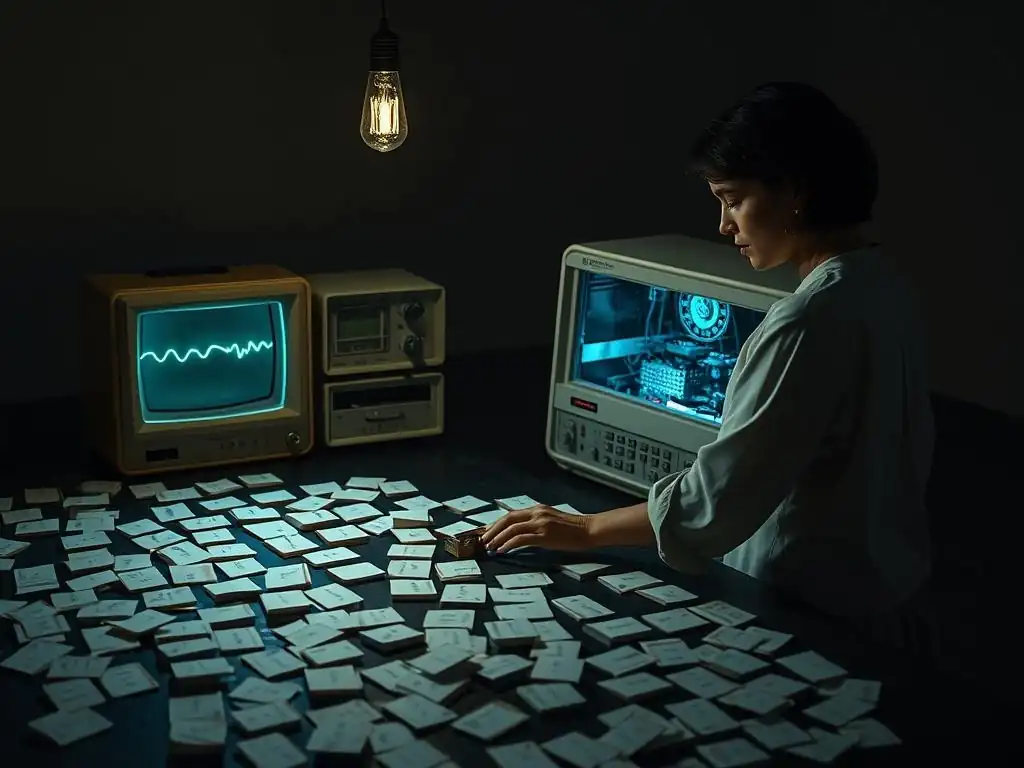
Gender Bias and Limited Opportunities in STEM Fields
In the mid-20th century, societal norms heavily steered women away from careers in science, technology, engineering, and mathematics (STEM). Despite their proven mathematical abilities, formal educational and professional opportunities in these fields were largely reserved for men. Women often entered programming through less conventional routes, such as wartime calculation roles or as mathematicians whose skills were suddenly needed in the nascent computer industry.
Even when employed, women in computing often faced subtle, and sometimes overt, gender bias. Their work, particularly in programming, was frequently perceived as a "clerical" or "support" function, rather than a highly skilled intellectual endeavor. This perception limited their access to advanced training, leadership roles, and equitable recognition, making their significant women’s early machine language work often invisible outside their immediate teams.
The Struggle for Recognition and Advancement
Despite their foundational contributions to machine language development and early software engineering, many women struggled to gain proper recognition for their intellectual achievements. Their names were often omitted from official reports, or their work was attributed to male supervisors or colleagues. This systemic lack of acknowledgment meant that their groundbreaking innovations were frequently absorbed into a broader, male-centric narrative of computing history.
This struggle extended to professional advancement. As programming gained prestige and moved from perceived "clerical" work to a specialized engineering discipline, opportunities for women to ascend to higher-level positions or to be recognized as leading experts diminished. The pioneering women’s early machine language work they performed, which was crucial for establishing the field, paradoxically became less valued as the industry matured and became more male-dominated.
Overcoming Societal Expectations and Barriers
The women who pioneered machine language programming often had to contend with significant societal expectations that dictated women's roles primarily within the domestic sphere. Pursuing demanding technical careers required immense personal determination and often meant defying cultural norms. They had to navigate a professional landscape that was not designed to accommodate them, from a lack of female restrooms in early computing centers to outright skepticism about their technical capabilities.
Their resilience in the face of these barriers is a testament to their passion for science and technology. Many found support in informal networks or within forward-thinking organizations, but ultimately, it was their sheer intellectual prowess and indispensable contributions to women’s early machine language work that allowed them to carve out essential roles in a rapidly evolving field, proving their worth through the tangible results of their programming innovations.
Specific Examples of Women's Machine Language Innovations
UNIVAC: Grace Hopper and Ida Rhodes' Work on the First Commercial Computer
The UNIVAC I (Universal Automatic Computer I), delivered to the U.S. Census Bureau in 1951, was the first commercial electronic digital computer produced in the United States. Grace Hopper's work on UNIVAC was transformative; her A-0 compiler, completed in 1952, was revolutionary. It allowed programmers to write code using symbolic representations, which the compiler would then translate into the UNIVAC's specific machine language. This innovation drastically reduced the time and effort required to program the machine, moving away from laborious manual binary coding and making complex computations more feasible.
Ida Rhodes, working at the National Bureau of Standards, also made significant contributions to UNIVAC programming. She focused on developing robust programming techniques for data processing, including early sorting and merging routines that were critical for handling large datasets like census information. Her deep understanding of the UNIVAC's machine architecture allowed her to optimize these processes, directly influencing the efficiency of early database management systems. This collaborative women’s early machine language work was essential for the practical deployment of the UNIVAC in government and business.
LEO: Mary Coombs' Contributions to Early Business Computing Applications
The LEO I (Lyons Electronic Office) computer, operational in 1951, was unique in its explicit design for business applications. Mary Coombs, as one of its pioneering programmers, was responsible for translating complex business logic into the LEO's specific machine language instructions. For instance, she worked on programs for payroll, inventory control for J. Lyons & Co.'s bakeries, and even tea distribution logistics. Each task required meticulous coding to handle thousands of records.
Programming LEO involved writing detailed instructions for every operation, from fetching data from magnetic tape to performing arithmetic calculations, all in the machine's native code. This precision enabled LEO to process the weekly payroll for 10,000 employees in just a few hours, a task that previously took days of manual effort. Coombs' practical women’s early machine language work demonstrated the immense potential of computers for transforming business operations, laying the groundwork for modern enterprise resource planning (ERP) systems.
ARC: Kathleen Booth's Assembly Language Development for an Early Computer
At Birkbeck College in the late 1940s, Kathleen Booth was at the forefront of designing the instruction set and programming for the Automatic Relay Calculator (ARC). Her seminal contribution was the development of the assembly language for the ARC, a crucial step in abstracting away from direct binary machine code. Instead of writing sequences of 0s and 1s, programmers could use symbolic mnemonics (e.g., "ADD" for addition, "JMP" for jump) that were then translated into the ARC's specific machine instructions.
This assembly language significantly improved the efficiency and readability of programs for the ARC and its successors, such as the APE(X)C. Booth's work provided a more manageable interface for programmers, reducing errors and speeding up development. Her detailed explanations of this system in her 1947 textbook solidified her role as a foundational figure in programming methodology. This women’s early machine language work was a critical stepping stone towards higher-level programming languages, making computing more accessible and practical.
The Legacy of Women's Early Machine Language Work
Impact on Modern Programming Languages and Computer Science
The foundational concepts developed by women in the early days of machine language programming continue to underpin modern computer science. Grace Hopper's invention of the compiler, for instance, is the direct ancestor of every compiler used today to translate high-level languages like Python, Java, or C++ into machine code. Without this innovation, programming would remain an incredibly arduous task, making the vast software ecosystem we rely on virtually impossible.
Similarly, Kathleen Booth's work on assembly language laid the groundwork for symbolic programming, a necessary abstraction that made programming more human-readable and manageable. The meticulous debugging techniques, data handling strategies, and logical problem-solving approaches refined during women’s early machine language work are embedded in current software development practices. Their contributions are not just historical footnotes; they are the very building blocks of computational logic.
Inspiring Future Generations of Women in Tech
By illuminating the crucial roles women played in developing machine languages, we provide powerful role models for young women considering careers in technology today. For too long, the narrative of computing has been dominated by male figures, inadvertently suggesting that women are newcomers or less central to the field. Showcasing the extensive women’s early machine language work performed by pioneers like Hopper, Booth, Rhodes, and Coombs demonstrates that women have been at the forefront of innovation since the very beginning.
These stories of resilience, intellectual prowess, and groundbreaking achievement can inspire a new generation to pursue STEM fields with confidence, knowing that they are building upon a rich legacy. Recognizing these historical contributions is not just about correcting the past; it is about shaping a more inclusive and diverse future for technology, encouraging more women to enter and lead in an industry that desperately needs their talent and perspective.
Preserving and Celebrating Their Stories
Despite their monumental contributions, the stories of many women who shaped early computer science remain largely unknown to the public. Efforts to preserve and celebrate their narratives are crucial for historical accuracy and for inspiring future innovators. Websites like WomenInScienceHistory.com play a vital role in documenting their biographies, their specific technical achievements, and the challenges they overcame.
This ongoing work involves meticulous research into archival materials, interviews with surviving pioneers, and the careful reconstruction of their technical contributions to low-level programming. By ensuring that women’s early machine language work is properly documented and widely disseminated, we can foster a more comprehensive understanding of computing history. This continuous celebration helps ensure that these remarkable women receive the recognition they deserve and that their legacy continues to influence and motivate.
Conclusion: Acknowledging the Foundational Contributions of Women in Low-Level Programming
Re-evaluating the History of Computing Through a Gendered Lens
The traditional narrative of computing history, often focusing on hardware development and the contributions of a few prominent male figures, is incomplete and often misleading. A true understanding of how computers evolved from complex machines to indispensable tools requires acknowledging the pivotal role women played, particularly in the foundational stages of programming and machine language development. Re-evaluating this history through a gendered lens reveals that women were not merely supporting staff but were intellectual architects of the software revolution.
This re-evaluation highlights that the very methodologies for communicating with computers—from direct binary code to the first symbolic languages and compilers—were significantly shaped by women’s early machine language work. Their meticulousness, logical thinking, and problem-solving skills were indispensable in translating abstract mathematical concepts into executable instructions, thereby bridging the gap between human thought and machine operation.
The Importance of Recognizing Women's Early Machine Language Expertise
Recognizing the expertise of women in early machine language programming is paramount for several reasons. Firstly, it provides a more accurate and equitable account of scientific and technological progress, ensuring that significant intellectual contributions are not overlooked. Secondly, it challenges persistent stereotypes about gender roles in STEM, demonstrating women's innate capabilities and historical presence in technical fields.
Ultimately, celebrating women’s early machine language work inspires future generations. By showcasing these pioneering women, we not only honor their legacy but also empower young girls and women to envision themselves as leaders and innovators in technology. Their stories underscore that the fundamental principles of computing, from the lowest-level machine instructions to the highest-level programming paradigms, bear the indelible mark of women's ingenuity and foundational contributions.
Frequently Asked Questions
What does "WomenInScienceHistory.com" primarily focus on?
The website focuses on celebrating the contributions of women to science throughout history, highlighting their biographies and groundbreaking work, particularly in overcoming challenges in male-dominated fields. It aims to inspire future generations.
Why is it important to highlight women's contributions to science history?
Highlighting these contributions addresses the historical oversight of women's narratives in science and inspires future generations by showcasing their achievements and resilience in the face of adversity.
What is meant by "women's early machine language work" within the context of the article?
This refers to the foundational contributions made by women to the development of low-level programming languages, which are closely tied to the hardware of computers, during the early stages of computer science.
What were some of the challenges women faced in the early days of computer science?
Women faced significant challenges including gender bias, limited access to education and resources, and societal expectations that often steered them away from STEM fields.
How does "WomenInScienceHistory.com" aim to inspire future generations?
The platform inspires future generations by showcasing the achievements and resilience of pioneering female scientists, providing role models and demonstrating that women can excel in any scientific field.
Final Reflection: Honoring the Unsung Architects of Code
The exploration of women's foundational work in low-level programming reveals a history often overlooked, yet profoundly impactful. The legacy of these pioneering women continues to resonate in today's technological landscape, shaping the very foundations upon which our digital world is built. Their contributions, often obscured by historical biases, deserve recognition and celebration as essential cornerstones of computer science.
This journey into the past underscores the critical importance of acknowledging diverse perspectives in STEM fields. It reminds us that innovation thrives when all voices are heard and valued, and that overlooking the contributions of any group diminishes our collective potential. The most effective way to do it, is to do it.
- Amelia Earhart. This quote, though not directly related to computer science, perfectly encapsulates the spirit of these women who, despite facing societal barriers, persevered and shaped the future of technology.
As we reflect on the remarkable achievements of these early female programmers, let us commit to fostering a more inclusive and equitable future for all in technology. Let us actively seek out and amplify the stories of those who have been historically marginalized, ensuring that their contributions are not only recognized but also serve as inspiration for generations to come. The future of innovation depends on our collective ability to learn from the past and build a more inclusive present.
Empower the Future: Celebrate Women in Tech!
Thank you for delving into the groundbreaking contributions of women in early machine language development. Your curiosity helps preserve and amplify these vital stories. Now, let’s turn this knowledge into action.
- Share this article with one person who would be inspired by these untold stories.
- Dive deeper! Research a woman in tech history whose story resonates with you and share your findings on social media.
- Contribute to a future where women's contributions are always recognized. Mentor a young woman interested in STEM.
What small step will you take today to honor the legacy of these pioneering women?