
Before Marie Curie's Shadow: Were There Female Precursors in 19th Century Radioactivity Research?


Welcome to WomenInScienceHistory.com!
Delve into the often-untold stories of remarkable women who shaped the scientific landscape. Did you know that the fascinating world of radioactivity research in the 19th century held secrets beyond the well-known name of Marie Curie? Prepare to be enlightened as we explore the contributions and challenges faced by 19th Century Female Radioactivity Research pioneers, paving the way for future breakthroughs. Uncover their groundbreaking work and the obstacles they overcame in a male-dominated field, sparking a renewed appreciation for their legacy and inspiring a deeper exploration of their scientific journeys.
- Before Marie Curie's Shadow: Unveiling 19th Century Female Pioneers in Luminescence and Early Radiation Research
- 19th Century Physics Landscape: Opportunities and Obstacles for Women
- Early Observations of Luminescence and Radiation: Setting the Stage
- Investigating Potential Female Contributors to Luminescence and Early Radiation Research Before 1900
- The Significance of Supporting Roles: Women in Laboratories and Research Teams
- Why Were Female Contributions Often Overlooked?
- Conclusion: Reframing the History of 19th Century Luminescence and Early Radiation Research
-
Frequently Asked Questions
- What was the general climate for women in science during the 19th century?
- Besides Marie Curie, were any other women involved in early radioactivity research?
- What challenges did women specifically face when trying to contribute to radioactivity research in the 19th century?
- How does WomenInScienceHistory.com contribute to understanding the role of women in 19th-century science?
- Why is it important to remember and recognize these "precursors" to Marie Curie?
- Final Reflection: Illuminating Forgotten Pioneers
- Unearth Hidden Legacies: Continue the Journey!
Before Marie Curie's Shadow: Unveiling 19th Century Female Pioneers in Luminescence and Early Radiation Research
The Dominance of Marie Curie's Narrative in Radioactivity History
Marie Curie is synonymous with the field of radioactivity, a beacon of scientific achievement whose name is inextricably linked with the discovery of polonium and radium. Her groundbreaking work, which earned her two Nobel Prizes—one in Physics in 1903 (shared with her husband Pierre Curie and Henri Becquerel) and another in Chemistry in 1911 (solely awarded to her)—rightfully cemented her legacy as the definitive figure in the early understanding of radioactivity.
This narrative, while entirely deserved for its profound impact and meticulous experimental rigor, often overshadows the broader scientific landscape of the late 19th century, particularly the contributions, or potential contributions, of other researchers.
Her unparalleled success in identifying and characterizing new radioactive elements, along with her systematic approach to the field, placed her at the absolute forefront of this nascent scientific discipline. However, an exclusive focus on Curie can inadvertently create a historical vacuum, suggesting that the entire path to understanding radioactivity began and ended with her. This perspective can neglect the preceding decades of related scientific inquiry and the diverse individuals, including women, who might have contributed to the intellectual groundwork or made tangential observations related to what would eventually be defined as radioactivity.
The Aim: Highlighting Pre-Curie Era Women in 19th Century Luminescence and Early Radiation Research
This article endeavors to explore the scientific terrain before Marie Curie's pivotal discoveries, specifically seeking to identify if there were 19th Century Female Radioactivity Research precursors, or women engaged in closely related fields like luminescence, electrical phenomena, and chemical reactions that laid foundational groundwork. It's a challenging task, as direct "radioactivity research" as a formally defined field largely emerged with Curie's work. The very term "radioactivity" was coined by Marie Curie herself in 1898.
Instead, we will investigate women whose work in physics, chemistry, or related disciplines might have intersected with the early observations of strange rays, light emission, and energetic phenomena that eventually coalesced into the study of radioactivity. This exploration aims to broaden our understanding of the diverse scientific efforts of the late 19th century and to acknowledge the often-unseen roles women played in this era of discovery, even if their contributions were indirect or not immediately recognized as 19th Century Female Radioactivity Research.
19th Century Physics Landscape: Opportunities and Obstacles for Women
Limited Access to Education and Research Institutions for Women
The late 19th century presented significant systemic barriers for women aspiring to careers in science. While some universities in Europe and the United States began to admit women, their access was often restricted to specific courses or non-degree programs, particularly in fields like physics and chemistry.
For instance, at Cambridge University, women were allowed to attend lectures and sit for exams, but they were not formally awarded degrees until 1948, effectively hindering their professional advancement and recognition in the scientific community. Similarly, in Germany, women were largely excluded from universities until the very end of the century, with full access only coming in the early 1900s.
Beyond formal education, access to cutting-edge research laboratories and scientific equipment was even more limited. These spaces were predominantly male domains, often requiring apprenticeships or connections that were largely inaccessible to women. Without direct access to these facilities, state-of-the-art equipment, and the mentorship of established scientists, women's opportunities to conduct independent, groundbreaking 19th Century Female Radioactivity Research or related studies were severely curtailed, forcing many into less visible or uncredited roles.
Beyond institutional barriers, pervasive gender bias and deeply ingrained societal expectations profoundly impacted women's scientific pursuits. During this period, women were often steered towards "acceptable" female roles, such as teaching, nursing, or domestic management, rather than demanding scientific research. Those who did pursue science frequently faced skepticism regarding their intellectual capabilities, dedication, and suitability for rigorous scientific inquiry, often being relegated to supportive, uncredited roles within laboratories.
This bias extended to the publication and recognition of scientific work. Research conducted by women was less likely to be published in prestigious journals or, if published, often received less attention or was even attributed to male collaborators. This systemic under-recognition, later termed the "Matilda Effect," meant that even when women made significant observations related to luminescence or early radiation phenomena, their contributions were frequently overlooked or downplayed, making the recovery of their 19th Century Female Radioactivity Research histories incredibly difficult and often incomplete.
Early Observations of Luminescence and Radiation: Setting the Stage
The Discovery of Cathode Rays, X-rays, and Initial Observations of Uranium Salts
The final quarter of the 19th century was a period of intense discovery in physics, laying the crucial groundwork for the eventual understanding of radioactivity. In 1895, Wilhelm Röntgen's accidental discovery of X-rays while experimenting with cathode ray tubes captivated the scientific world. His observation that these mysterious rays could pass through opaque objects and expose photographic plates marked a monumental shift in understanding invisible forms of radiation, sparking widespread and immediate investigation into similar phenomena across numerous laboratories globally.
Following Röntgen's discovery, Henri Becquerel, in 1896, was investigating phosphorescence in uranium salts, hoping to find a connection to X-rays. He serendipitously discovered that uranium salts spontaneously emitted a new type of penetrating radiation, even without exposure to light, which could blacken photographic plates. This unprecedented observation of natural radioactivity, though not yet fully understood or named, was the direct precursor to Marie Curie's subsequent systematic work and marked the true, albeit initially undefined, beginning of the phenomena that would underpin 19th Century Female Radioactivity Research.
The Role of Key Male Figures: Röntgen, Becquerel, and Others
Wilhelm Röntgen's meticulous work not only led to the discovery of X-rays but also prompted a global scientific race to understand these new phenomena. His initial paper, "On a New Kind of Rays (Eine neue Art von Strahlen)," published in December 1895, generated immense excitement and immediate replication efforts worldwide. Within months, hundreds of scientific papers were published on X-rays, demonstrating the rapid dissemination of knowledge and the collaborative, albeit competitive, nature of the burgeoning field of radiation physics.
Henri Becquerel's subsequent discovery of natural radioactivity from uranium salts built directly upon Röntgen's findings. His initial experiments involved placing uranium salts on photographic plates wrapped in black paper, observing the spontaneous emission. While Becquerel correctly identified the spontaneous nature of these "Becquerel rays," it was Marie Curie who, in her doctoral research beginning in 1898, systematically investigated various elements, coined the term "radioactivity," and isolated new radioactive elements (polonium and radium), transforming Becquerel's observation into a new scientific discipline and paving the way for dedicated 19th Century Female Radioactivity Research.
Investigating Potential Female Contributors to Luminescence and Early Radiation Research Before 1900
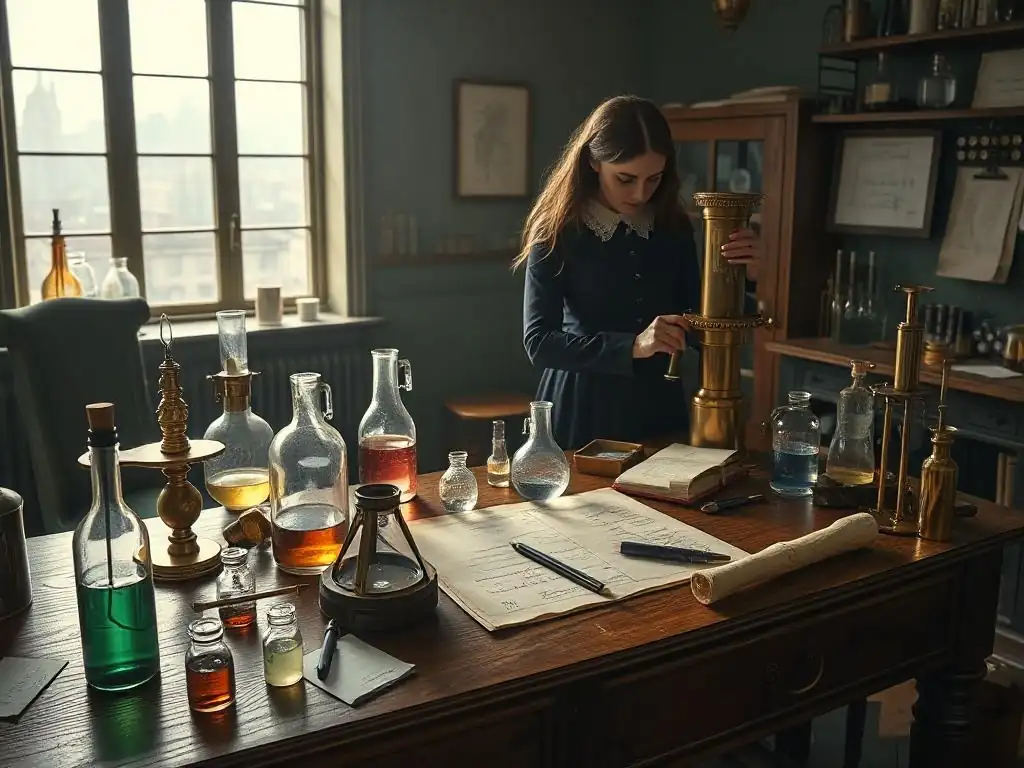
Examining Her Research on the behavior of electric arcs and light emission.
Phoebe Sarah Hertha Ayrton (1854–1923) was a remarkable British engineer, mathematician, and physicist, renowned for her groundbreaking work on electric arcs and ripples in sand and water. Her most significant contributions to physics revolved around the electric arc, a crucial component in early electric lighting and industrial processes. From the 1890s, Ayrton meticulously studied the arc's stability, luminosity, and the causes of its "hissing" sound, publishing numerous papers and ultimately a comprehensive book, The Electric Arc, in 1902. Her investigations involved precise measurements of current, voltage, and light intensity, demonstrating a deep understanding of electrical discharge phenomena.
Her detailed investigations into the physical properties of the electric arc, including its intense light emission and complex electrical characteristics, placed her at the forefront of understanding high-energy electrical phenomena. While not directly 19th Century Female Radioactivity Research, her work involved intense light and electrical discharges, phenomena that were often explored in conjunction with the nascent understanding of X-rays and other "new rays" in the late 19th century. Her expertise in electrical physics and light generation positioned her uniquely to understand related energetic processes that were captivating the scientific community.
Assessing Her Potential Connection to early X-ray research and related electrical phenomena.
While there is no direct evidence linking Hertha Ayrton's published research to the discovery or systematic study of X-rays or radioactivity, her profound expertise in electric arcs and their associated electrical discharges makes her work tangentially relevant to the broader context of late 19th-century physics. The generation of X-rays, for instance, relied on high-voltage electrical discharges within evacuated tubes, a field closely related to Ayrton's domain of electric arcs and their behavior under various conditions.
It is highly plausible that her discussions and collaborations within the scientific community, particularly at institutions like the Cavendish Laboratory or the Royal Society, would have involved the exciting new discoveries of X-rays and Becquerel rays. Though her published work primarily focused on the practical and theoretical aspects of the electric arc, her deep understanding of electrical phenomena and light emission meant she was operating in a scientific landscape where the very nature of energy and matter was being redefined, potentially informing or being informed by these parallel investigations into invisible radiations.
Elizabeth Fulhame: Her Work in Chemical Reactions and Luminescence
Analyzing Her publications for hints of chemical reactions producing light or influencing radiation.
Elizabeth Fulhame (fl. 1794) was a Scottish chemist whose pioneering work, primarily her 1794 book, An Essay on the Production of Artificial Light, significantly predates the 19th century, making her a more distant precursor to the specific context of 19th Century Female Radioactivity Research. Her significant contribution was her detailed description of various chemical reactions where metals were reduced from their solutions by the action of light. She was particularly interested in the role of water in these reactions and observed instances where chemical changes produced light or color changes, often in the absence of heat.
While Fulhame's work focused on photochemistry and the reduction of metals, not on what we now understand as radioactivity, her investigations into the interplay of light, chemical reactions, and material transformation were foundational. She meticulously documented instances where chemical processes led to visible light, a form of luminescence (e.g., phosphorescence), which, in the broader historical arc, connects to the subsequent interest in phenomena like phosphorescence and fluorescence that captivated scientists like Becquerel and ultimately led to the discovery of natural radioactivity.
Evidence and Limitations in Linking Her Work to Early Observations of Radiation.
Direct evidence linking Elizabeth Fulhame's work to the early observations of radiation, particularly X-rays or Becquerel rays, is non-existent due to the chronological gap of over a century. Her research predates the very concept of radioactivity and the sophisticated technologies that enabled its discovery. Her focus was on the chemical transformations induced by visible light and heat, not on spontaneous emissions from elements, and her observations were limited to visible light.
However, her systematic approach to understanding how light influences chemical reactions and her observations of chemical luminescence represent an important thread in the history of science. Her work contributed to the understanding of how energy could be absorbed and re-emitted by substances, a principle that underpinned later investigations into phosphorescence and fluorescence, which were directly relevant to Becquerel's initial discovery of radioactivity from uranium salts. Thus, while not a direct precursor in 19th Century Female Radioactivity Research, her legacy lies in the broader intellectual framework of light-matter interactions.
Cornelia Ferreira: Exploring Her Contributions to Medical Applications of Light
Evaluating Her involvement in early medical uses of light and potential connections to radiation research.
Cornelia Ferreira (1875–1937) was a South African physicist who worked with Professor John Cox at McGill University in Montreal during the late 1890s, a period when Ernest Rutherford was also conducting his groundbreaking work on radioactivity there. Ferreira's research, for which she received her M.A. in 1898, focused on the properties of light, particularly its absorption and scattering in various media. While her primary published work, The Absorption of Light by the Atmosphere, dealt with atmospheric optics, her presence in a leading physics laboratory during the nascent stages of radioactivity research is highly significant.
Her involvement in a department where pioneering 19th Century Female Radioactivity Research was actively taking place, specifically under Professor Cox who was keenly interested in X-rays and collaborated with Rutherford, suggests she was exposed to and potentially contributed to discussions and experiments related to these new forms of radiation. Although her published work does not directly address radioactivity, her expertise in light absorption and measurement could have found applications in the burgeoning field of medical imaging or therapeutic uses of light and radiation, which were rapidly developing at the turn of the century.
The Challenges of Identifying Indirect Contributions to the Understanding of Radiation Effects.
Identifying Cornelia Ferreira's indirect contributions to the understanding of radiation effects is challenging due to the limited scope of her published work and the nature of collaborative scientific environments of the era. Her official publications do not explicitly mention X-rays or radioactivity. However, in an era where scientific discoveries were rapidly shared and discussed within university departments, it is highly probable that she was aware of and perhaps even assisted with experiments related to these new phenomena, given the intense focus on radioactivity at McGill.
Many women in scientific laboratories during this period served as assistants, technicians, or uncredited collaborators, their contributions often lost to historical record. While we cannot definitively state that Ferreira directly engaged in 19th Century Female Radioactivity Research, her presence in a laboratory where such work was actively pursued, and her expertise in related optical physics, highlight the potential for unacknowledged involvement in the broader scientific milieu that shaped the understanding of radiation.
The Significance of Supporting Roles: Women in Laboratories and Research Teams
The Unsung Labor: Female Assistants and Technicians in Physics Labs
Beyond the few women who managed to secure independent research positions, countless others contributed to scientific progress in less visible, often uncredited, roles. Women frequently served as laboratory assistants, technicians, and human "computers," performing crucial tasks like preparing samples, calibrating equipment, taking meticulous measurements, and performing complex calculations. This labor was indispensable, providing the data and precision necessary for groundbreaking discoveries that formed the bedrock of 19th Century Female Radioactivity Research.
For instance, in the late 19th and early 20th centuries, women were instrumental in astronomical observatories, painstakingly analyzing photographic plates to classify stars and nebulae, as seen with the "Harvard Computers." Similarly, in physics laboratories, women often handled delicate chemical preparations, operated newly developed electrical apparatus, or performed tedious but vital calculations, directly supporting the experimental work that led to discoveries like X-rays and radioactivity. Their names, however, rarely appeared on published papers or in historical accounts, making their contributions largely unsung.
Documenting Their Contributions: Challenges in Historical Record-Keeping
The primary challenge in documenting the contributions of these women lies in the nature of historical record-keeping. Scientific publications of the era typically listed only the principal investigators, often male professors or lead scientists. Laboratory notebooks, if preserved, sometimes offer glimpses into the daily work of assistants, but these records are often incomplete or ambiguous regarding individual contributions, rarely crediting specific insights or experimental breakthroughs to the assistants.
Furthermore, societal norms reinforced the idea that scientific credit belonged to the male head of the laboratory, regardless of who performed the actual work. This systemic bias meant that even when women performed critical experiments or made significant observations, their efforts were often subsumed under the name of their male supervisors, making it incredibly difficult to trace specific instances of 19th Century Female Radioactivity Research conducted by uncredited women. This historical erasure continues to challenge efforts to fully reconstruct the diverse tapestry of scientific discovery.
Why Were Female Contributions Often Overlooked?
The "Matilda Effect": Systematic Under-Recognition of Women Scientists
The "Matilda Effect," coined by science historian Margaret Rossiter in 1993, describes the phenomenon where the achievements of female scientists are systematically overlooked, denied, or attributed to their male colleagues. This effect was profoundly evident in the late 19th century, a period when scientific institutions were solidifying their patriarchal structures. Even when women conducted independent research or made significant discoveries, their work was often met with skepticism or simply ignored by the male-dominated scientific establishment.
A compelling example, though slightly later than the 19th century, is Lise Meitner's exclusion from the Nobel Prize for the discovery of nuclear fission, which was awarded solely to Otto Hahn despite her critical theoretical insights and experimental contributions. This pattern of under-recognition applied broadly, impacting women's ability to gain professorships, research grants, and public acclaim, thereby obscuring their potential 19th Century Female Radioactivity Research efforts and broader scientific contributions.
Lack of Recognition and Attribution in Collaborative Research
Collaborative scientific research, while essential for progress, often presents challenges in attributing credit, particularly for those in less prominent roles. In the 19th century, this issue was compounded by prevailing gender norms. Women working in laboratories, whether as paid assistants or unpaid volunteers, frequently contributed vital experimental data, theoretical insights, or technical expertise, yet their names rarely appeared on publications. For instance, many wives of prominent scientists, like Mary Somerville, performed extensive calculations and experimental work without formal recognition.
The prevailing academic culture often assumed that the ideas and credit belonged to the male head of the laboratory. This meant that the intellectual contributions of women, including any insights related to luminescence, X-rays, or early radiation phenomena, were often absorbed into the collective work of the team without individual recognition. This systemic lack of attribution makes it exceedingly difficult to pinpoint specific 19th Century Female Radioactivity Research contributions by women who were part of larger research groups, as their efforts became invisible within the published record.
Deep-seated gender stereotypes significantly undermined the scientific authority of women in the 19th century. Women were often perceived as inherently less rational, less capable of abstract thought, or simply unsuited for the rigorous demands of scientific inquiry. These stereotypes created an environment where even brilliant observations or innovative experiments by women were less likely to be taken seriously or to be seen as groundbreaking by the male-dominated scientific establishment.
This prejudice extended to professional interactions, where women might be excluded from informal scientific discussions, conferences, or networks crucial for career advancement and intellectual exchange. For example, the Royal Society in London did not admit its first female Fellows until 1945, nearly a century after its founding. Such exclusion further marginalized their work and prevented their ideas, including any nascent 19th Century Female Radioactivity Research insights, from gaining traction or being widely recognized within the broader scientific community.
Conclusion: Reframing the History of 19th Century Luminescence and Early Radiation Research
Acknowledging the Challenges of Recovering Lost Histories
The quest to uncover the full extent of 19th Century Female Radioactivity Research and related contributions is inherently fraught with challenges. The historical records are incomplete, often biased, and frequently silent on the specific roles of women. Many women worked in uncredited positions, their names absent from publications, or their work subsumed under that of male colleagues. The very definition of "radioactivity research" was fluid in the late 19th century, making it difficult to pinpoint direct engagement before the field was formally established and named by Marie Curie.
Despite these formidable obstacles, the effort to recover these lost histories is crucial. It requires meticulous archival research, critical re-reading of existing scientific literature, and a willingness to look beyond conventional narratives. While definitive evidence of widespread, independent 19th Century Female Radioactivity Research before Curie remains elusive, the exploration itself reveals the systemic barriers women faced and the subtle ways they nonetheless contributed to the scientific understanding of the era, often through foundational or tangential work.
The Importance of Continued Research into Women's Roles in Early Physics
Continued scholarly investigation into women's roles in early physics, particularly concerning phenomena like luminescence, X-rays, and the precursors to radioactivity, is vital. This ongoing research helps to correct the historical record, providing a more accurate and inclusive understanding of scientific progress. By shining a light on previously overlooked figures and their contributions, we can inspire future generations of scientists and provide a more nuanced perspective on the collaborative and often complex nature of scientific discovery.
Furthermore, this research helps to identify the subtle but significant ways women influenced scientific thought and practice, even when not directly credited. It reveals the often-invisible networks of support, the critical technical skills, and the intellectual contributions that underpinned major breakthroughs. Understanding the full scope of 19th Century Female Radioactivity Research and related fields requires this sustained commitment to historical re-evaluation, ensuring that no contribution, however small or indirect, remains unacknowledged.
Beyond Marie Curie: Recognizing the Broader Context of 19th Century Female Luminescence and Early Radiation Research
While Marie Curie stands as an undeniable titan in the history of radioactivity, acknowledging the broader context of 19th Century Female Radioactivity Research and related fields enriches our understanding of scientific progress. It highlights that scientific discovery is rarely the work of a single genius operating in isolation, but rather a cumulative process built upon the efforts of many, often unseen, individuals. This perspective does not diminish Curie's achievements but places them within a richer, more diverse historical tapestry.
By exploring the lives and work of women like Hertha Ayrton, Elizabeth Fulhame, and Cornelia Ferreira—even if their direct connection to "radioactivity" is indirect or speculative—we recognize their intellectual engagement with the most pressing scientific questions of their time. This broader perspective ensures that the history of science is not just a chronicle of celebrated breakthroughs but a rich tapestry woven with the diverse, often challenging, and frequently overlooked contributions of all who sought to unravel the mysteries of the universe, including those who were pioneers in 19th Century Female Radioactivity Research in its nascent forms.
Frequently Asked Questions
What was the general climate for women in science during the 19th century?
The 19th century presented significant obstacles for women pursuing scientific careers. They faced limited educational opportunities and pervasive gender bias within academic and professional circles.
Besides Marie Curie, were any other women involved in early radioactivity research?
Yes, while Marie Curie is the most famous, research suggests there were likely female precursors and assistants involved. Identifying them and their specific contributions is an ongoing area of historical research.
What challenges did women specifically face when trying to contribute to radioactivity research in the 19th century?
Women often found themselves relegated to support roles and denied formal recognition for their work. They also faced social and professional exclusion hindering their advancement.
How does WomenInScienceHistory.com contribute to understanding the role of women in 19th-century science?
The site highlights overlooked narratives by featuring biographies and discussions about pioneering women. It aims to inspire future generations by showcasing their contributions to fields like radioactivity research.
Why is it important to remember and recognize these "precursors" to Marie Curie?
Acknowledging these women provides a more complete and accurate historical record of scientific progress. It also combats the historical erasure of female scientists and inspires future researchers from all backgrounds.
Final Reflection: Illuminating Forgotten Pioneers
The journey through the annals of 19th-century science reveals a truth often obscured: the contributions of women to radioactivity research extend far beyond the well-known figure of Marie Curie. While her legacy is undeniable, recognizing the groundwork laid by lesser-known female scientists is crucial for a complete and accurate understanding of the field's development. Their stories, though often fragmented and incomplete, deserve to be brought to light, challenging the traditional narrative and enriching our appreciation of scientific progress.
This exploration has profoundly impacted my understanding of scientific history, highlighting the systemic barriers faced by women in pursuing their intellectual passions. It underscores the importance of actively seeking out and amplifying marginalized voices, ensuring that their contributions are not lost to the sands of time. The history of science is not just a history of great men, but a history of great ideas, and those ideas can come from anywhere, from anyone.
This quote reminds us that brilliance knows no gender, and that a more inclusive historical record is a more accurate and inspiring one.
As we close this chapter on 19th-century female radioactivity research, let us not simply acknowledge these forgotten pioneers, but actively champion their stories. Consider how you can contribute to a more equitable and inclusive understanding of history in your own field. Seek out the untold narratives, challenge conventional wisdom, and ensure that future generations are inspired by the full spectrum of human ingenuity. The past is not just a record; it is a foundation upon which we build a more just and enlightened future.
Thank you for delving into the untold stories of women who paved the way in radioactivity research. We hope this exploration has sparked a newfound appreciation for their vital, often overlooked contributions. Now, it's time to take this inspiration and turn it into action.
- Delve deeper: Identify one overlooked female scientist mentioned (or hinted at) in the article and conduct further research on her life and work. Share your findings with your network!
- Amplify these voices: Share this article on your social media channels, using the hashtag #WomenInScienceHistory, and start a conversation about the importance of recognizing female pioneers.
- Engage and enlighten: Leave a comment below sharing your biggest takeaway from this article. Did anything surprise you? What questions remain unanswered?
What other overlooked areas of women’s contributions in 19th-century science deserve more attention?