
Beyond 'Hidden Figures': More Untold Stories of Women in MidCentury Math

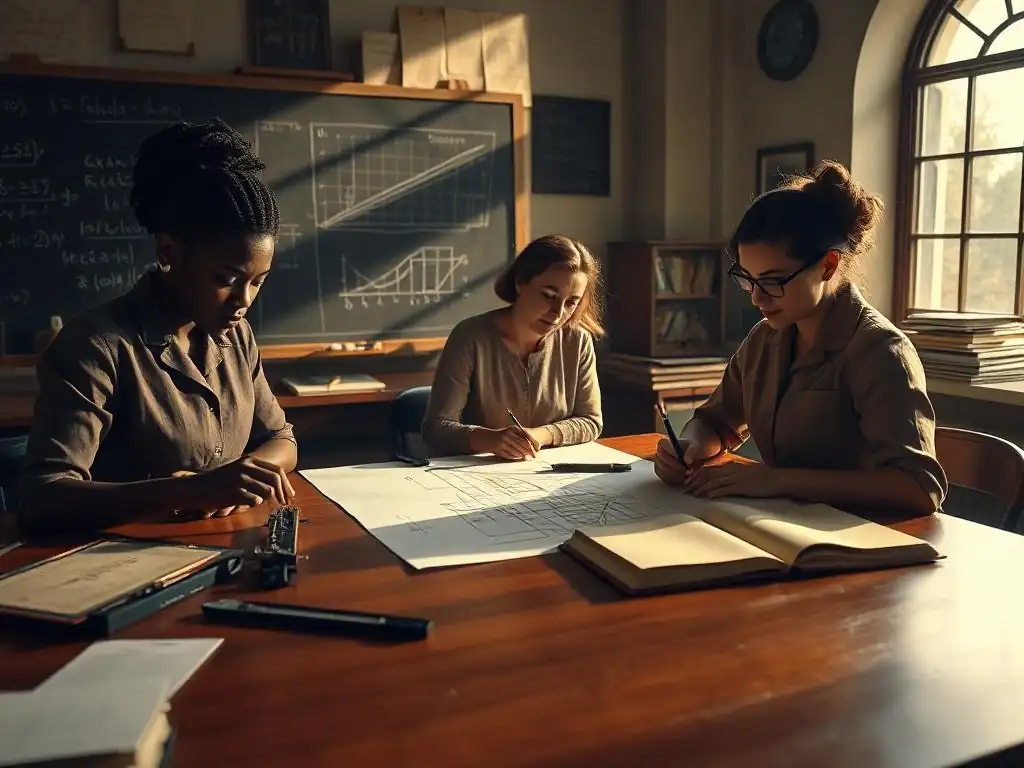
Welcome to WomenInScienceHistory.com!
Dive into the fascinating world of forgotten heroines as we uncover the groundbreaking contributions of women in science. Today, we're venturing beyond the familiar story of Hidden Figures to explore the untold stories of Women in midcentury math. Prepare to be inspired by their brilliance and resilience, and discover the vital role they played in shaping the technological landscape. But what challenges did they face, and how did they overcome them? Read on to find out more and begin your exploration of their captivating lives and work!
- Unveiling the Forgotten Contributions of Women in Mid-20th Century Mathematics
- Pioneering Female Mathematicians of the Mid-20th Century: Profiles and Achievements
- The Challenges and Obstacles Faced by Women in Mathematics During the Mid-Century
- The Impact of World War II and the Space Race on Women's Roles in STEM
- Mid-Century Female Mathematicians in Computer Science and Programming
- Rediscovering and Celebrating the Legacy of Women in Mid-Century Math
- The Future of Women in Mathematics: Building on the Foundation Laid by Mid-Century Pioneers
-
Frequently Asked Questions
- How does WomenInScienceHistory.com contribute to the recognition of women in science?
- Why is it important to focus specifically on "Women in Midcentury Math"?
- What kind of challenges did women in midcentury math typically face?
- Besides biographies, what other types of content does WomenInScienceHistory.com offer?
- How can learning about "Women in Midcentury Math" inspire future generations?
- Final Reflection: Illuminating the Legacy of Women in Midcentury Math
- Unveil Your Inner Math Maven!
Unveiling the Forgotten Contributions of Women in Mid-20th Century Mathematics
Reframing the Narrative: Women Beyond the Shadows of History
The popular narrative surrounding women in science, often encapsulated by the compelling story of the "Hidden Figures" at NASA, has rightly brought much-needed attention to the invaluable contributions of Black women to the space race. However, this powerful portrayal represents merely a fraction of the broader tapestry of women in midcentury math who shaped scientific and technological progress. Many brilliant female mathematicians, working in various fields from pure theory to nascent computer science, remain largely unsung, their achievements obscured by historical oversight and systemic biases.
Expanding this narrative is not just an academic exercise; it is crucial for a complete and accurate understanding of scientific history. Overlooking these contributions diminishes the true scope of human ingenuity and deprives current and future generations of vital role models. The diverse roles these women played—ranging from designing algorithms for early computers to groundbreaking theoretical work in topology—demonstrates their profound impact across the entire spectrum of mathematics during a period of immense global change and technological acceleration.
The Importance of Recognizing Women's Roles in Mathematical Advancements
Acknowledging the foundational roles played by women in midcentury math is essential for correcting historical inaccuracies and providing a more comprehensive picture of scientific progress. During the mid-20th century, as fields like computer science emerged and matured, women were often at the forefront, performing complex calculations and developing logical frameworks that underpinned new technologies. Their work was not merely supportive; it was often innovative and pivotal, directly influencing the direction of mathematical and technological development.
Furthermore, by showcasing the perseverance and intellectual brilliance of these women, we inspire new generations to pursue careers in STEM. Their stories illustrate how, despite significant societal and institutional barriers, individuals can achieve remarkable feats. For instance, the sheer determination required for women to excel in male-dominated academic and industrial environments highlights a resilience that transcends time, offering a powerful message to young women contemplating a path in mathematics today.
Pioneering Female Mathematicians of the Mid-20th Century: Profiles and Achievements
Grace Hopper: Breaking Barriers in Computer Science
Early Life and Education of Grace Hopper
Grace Brewster Murray Hopper, born in New York City in 1906, was a true pioneer in the field of computer science, a domain deeply rooted in mathematical principles. She pursued her higher education at Vassar College, graduating in 1928 with a bachelor's degree in mathematics and physics. Her academic journey continued at Yale University, where she earned her master's degree in 1930 and, notably, a Ph.D. in mathematics in 1934, making her one of the few women in midcentury math to achieve such a high academic qualification at that time.
During World War II, driven by a desire to contribute to the war effort, Hopper joined the U.S. Naval Reserve (WAVES) in 1943. Her exceptional mathematical aptitude quickly led her to the Bureau of Ordnance Computation Project at Harvard University. There, she was assigned to the Mark I computer programming staff, working under Howard Aiken, a pivotal experience that transitioned her focus from pure mathematics to the burgeoning field of applied computing. This early exposure to the practical application of mathematical logic set the stage for her revolutionary contributions.
Key Contributions to Computer Programming and Compiler Development
Grace Hopper's most profound impact came through her visionary work in compiler development. In 1952, she developed the A-0 System, considered the first compiler, which could translate mathematical code into machine-readable instructions. This invention was a monumental leap, making programming accessible to a wider range of users by allowing them to write code using symbolic notation rather than complex binary or machine language. Her subsequent work led to FLOW-MATIC, a programming language designed for business data processing, which significantly influenced the development of COBOL (Common Business-Oriented Language).
Hopper was a staunch advocate for machine-independent programming languages, believing that computers should be able to "understand" instructions written in English-like syntax. Her persistence in this vision, despite initial skepticism from peers, fundamentally changed how software was developed and used. She also popularized the term "debugging" after a moth caused a malfunction in the Mark II computer, a term now ubiquitous in the technology world. Her innovations dramatically streamlined programming processes, greatly accelerating the adoption and utility of computers across industries.
Challenges Faced and Overcome by Grace Hopper
Grace Hopper navigated a professional landscape that was largely male-dominated, particularly in the emerging field of computer science. She often faced resistance to her unconventional ideas, especially her insistence on developing higher-level programming languages that deviated from the prevailing low-level machine code. Many in the technical community initially viewed her concepts as impractical or unnecessary, preferring direct machine interaction.
Despite these challenges, Hopper's tenacity and unwavering belief in her vision propelled her forward. She not only overcame technical hurdles but also societal expectations, demonstrating that women in midcentury math could lead significant technological advancements. Her dual career as a naval officer, eventually achieving the rank of Rear Admiral, alongside her groundbreaking scientific work, illustrates her remarkable ability to excel in multiple demanding environments, consistently breaking barriers throughout her illustrious career.
Marjorie Lee Browne: Shaping the Landscape of Topology
The Groundbreaking Research of Marjorie Lee Browne in Topology
Marjorie Lee Browne holds a distinguished place in the history of women in midcentury math as one of the first African American women to earn a Ph.D. in mathematics. She achieved this significant milestone in 1949 from the University of Michigan, a testament to her profound intellect and determination. Her doctoral dissertation, titled "Studies of One Parameter Subgroups of Certain Topological Groups," delved into the complex area of topology, a branch of mathematics concerned with the properties of space that are preserved under continuous deformations, such as stretching, crumbling, and bending.
Browne's research contributed to the understanding of continuous groups and their applications within topological structures. Her work was highly theoretical, requiring an advanced grasp of abstract algebra and geometry. Beyond her direct research, she dedicated the majority of her professional life to academia, serving as a professor at North Carolina Central University (NCCU) for over three decades. There, she taught a wide array of mathematics courses, from algebra and calculus to advanced topology, shaping countless students' understanding of the discipline.
Impact of Marjorie Lee Browne's Work on Modern Mathematics
While Marjorie Lee Browne's direct research in topology was significant within its specialized field, her most profound and enduring impact on modern mathematics was through her dedication to education and mentorship. She recognized the critical need to expand opportunities for minority students in STEM fields. At NCCU, she was instrumental in securing grants to establish a computer center in the early 1960s, making it one of the first historically Black colleges and universities to offer computer science education. This initiative exposed a generation of students to computing at its nascent stage.
Browne's legacy extends far beyond her academic contributions; she became a powerful force for diversification within mathematics. She mentored numerous students, many of whom went on to earn their own Ph.D.s in mathematics and related fields, directly influencing the demographic landscape of the academic world. Her tireless efforts to support and encourage her students, often providing financial aid from her own pocket, created a ripple effect that continues to benefit the mathematical community today.
Legacy and Recognition for Marjorie Lee Browne
Marjorie Lee Browne's pioneering spirit and unwavering commitment to both mathematical scholarship and educational equity have earned her posthumous recognition. Her achievements paved the way for countless minority mathematicians who followed in her footsteps. The University of Michigan, her alma mater, established the Marjorie Lee Browne Scholarship to honor her groundbreaking work and dedication to fostering diversity in mathematics.
Her story powerfully illustrates the dual challenges faced by many women in midcentury math, particularly those from underrepresented groups. Browne not only navigated a field that was largely unwelcoming to women but also overcame racial barriers in academia. Her life and career stand as a testament to intellectual brilliance and profound resilience, serving as an inspiring example of how one individual can significantly shape the future of a discipline through both research and dedicated mentorship.
The Challenges and Obstacles Faced by Women in Mathematics During the Mid-Century
Gender Bias and Discrimination in Academia and Research Institutions
During the mid-20th century, women in midcentury math frequently encountered pervasive gender bias and outright discrimination within academic and research institutions. It was common for women to be subtly, or overtly, steered away from "serious" or theoretical mathematics, often relegated to roles perceived as more clerical or supportive, such as "computors" or statistical assistants, rather than leading researchers. Anecdotal evidence from the era suggests that female candidates, even with equivalent or superior qualifications, were significantly less likely to be hired for tenure-track faculty positions compared to their male counterparts.
The informal "old boys' network" further exacerbated these challenges, limiting women's access to crucial professional opportunities. This network often excluded women from vital collaborations, informal discussions, and mentorship relationships that were essential for career advancement. Furthermore, salary disparities were a common reality; women often earned substantially less than men for performing similar work, highlighting a systemic devaluation of their intellectual contributions and labor within the mathematical community.
Limited Opportunities and Support for Female Mathematicians
Beyond direct discrimination, women in midcentury math faced a landscape characterized by severely limited opportunities and inadequate institutional support. Very few women held professorships, especially at prestigious research universities, and leadership roles within mathematics departments or research institutions were almost exclusively occupied by men. Access to research funding, laboratory resources, and even prestigious publications was often restricted, making it challenging for female mathematicians to pursue independent research or gain widespread recognition for their work.
Professional societies, which served as critical platforms for networking, presenting research, and establishing credibility, were predominantly male-dominated, creating unwelcoming or isolating environments for women. This lack of visible female role models in senior positions compounded the issue, creating a cyclical barrier. Young women contemplating a career in mathematics had fewer examples to emulate and less encouragement to pursue advanced studies, perpetuating the underrepresentation of women in the field.
Balancing Career and Family: A Constant Struggle
Societal expectations during the mid-century placed the primary burden of childcare and household management squarely on women, creating an immense challenge for those attempting to pursue demanding careers in mathematics. This often forced women to make an agonizing choice between their professional ambitions and their family responsibilities, a dilemma rarely faced by their male colleagues. Many talented women in midcentury math either left the field entirely after marriage or childbirth, or were compelled to work part-time, significantly hindering their professional growth and advancement.
Institutional policies, or the lack thereof, provided little relief. Maternity leave was virtually non-existent or woefully inadequate, making it nearly impossible for women to take time off for childbirth without jeopardizing their careers. The absence of affordable childcare and flexible work arrangements meant that even those who continued to work full-time often did so under immense personal strain, frequently sacrificing research time for domestic duties, which ultimately slowed their progress and diminished their visibility in the mathematical community.
The Impact of World War II and the Space Race on Women's Roles in STEM

Increased Demand for Mathematical Expertise
World War II dramatically altered the landscape for women in midcentury math by creating an unprecedented and urgent demand for skilled labor, particularly in fields requiring advanced mathematical expertise. As men were deployed to fight, women were called upon to fill critical roles in various sectors, including ballistics, aerodynamics, code-breaking, and complex engineering calculations. This societal shift temporarily opened doors that had previously been largely closed to women, allowing them to demonstrate their intellectual capabilities in practical, high-stakes environments.
The subsequent Cold War and the intense competition of the Space Race further amplified this demand for mathematical and scientific talent. Projects related to rocketry, aerospace engineering, and the burgeoning field of computer science required vast numbers of skilled individuals. Women, often with strong mathematical backgrounds, were recruited into roles that were once exclusively male domains, contributing significantly to national defense and technological advancement during this critical period.
Women Filling Critical Roles in Wartime Research
During World War II, women played pivotal, though often uncredited, roles in wartime research. The most prominent example involves the "computors"—many of whom were trained mathematicians—who worked on projects like calculating ballistics trajectories for artillery at sites like the Aberdeen Proving Ground. These women were instrumental in programming the ENIAC, the first electronic digital computer, to perform these complex calculations, effectively laying the groundwork for modern computer programming. Betty Holberton, Jean Bartik, and others were among these initial programmers, whose meticulous work made the ENIAC functional.
Beyond ballistics, women were deeply involved in intelligence agencies, contributing significantly to code-breaking efforts. At places like Bletchley Park in the UK or the U.S. Army's Signal Intelligence Service, women applied advanced mathematical, logical, and linguistic skills to decipher enemy communications. Their contributions were often classified for decades, meaning their vital intellectual labor remained largely unacknowledged, further highlighting the hidden nature of many women in midcentury math contributions.
The Shifting Landscape of Opportunities After the War
The end of World War II brought a complex shift in opportunities for women in STEM. While the war had opened many doors, there was a societal push for women to return to traditional domestic roles, leading to a decline in female representation in some scientific and engineering fields. Many women who had performed critical technical work were displaced by returning servicemen.
However, the rapid emergence of the computer industry presented a new and evolving landscape. While some women were pushed out of established engineering roles, the completely new and undefined field of computer programming became a significant avenue for women in midcentury math. Initially viewed as a clerical task, programming allowed many women to continue applying their mathematical and logical skills, often becoming the earliest experts in this revolutionary technology, even as the field began to professionalize and eventually became male-dominated.
Mid-Century Female Mathematicians in Computer Science and Programming
Early Pioneers in Computer Programming
Before "computer programming" was a recognized profession, women were often the first individuals to perform the intricate tasks required to operate and instruct early calculating machines. This historical precedent dates back to Ada Lovelace's theoretical work in the 19th century, envisioning the analytical engine's capabilities beyond mere calculation. In the mid-20th century, as electronic computers began to emerge, the role of programming was often considered a low-status, almost clerical, task, which paradoxically made it more accessible to women.
The six original programmers of the ENIAC, the Electronic Numerical Integrator and Computer, stand as prime examples of these early female pioneers. Kathleen Antonelli (née McNulty), Jean Bartik, Betty Holberton, Marlyn Meltzer, Frances Spence, and Ruth Teitelbaum were instrumental in making the ENIAC functional. They developed the fundamental programming techniques, debugging methods, and subroutines that allowed the massive machine to perform complex calculations, effectively writing the first software and laying the groundwork for all future computer programming.
Women's Contributions to the Development of Algorithms and Software
Beyond merely operating machines, women in midcentury math were deeply involved in designing the logical frameworks and abstract structures that underpinned early computing. Figures like Kathleen Antonelli and Frances Spence, among others, developed sophisticated algorithms for complex mathematical and scientific calculations, transforming theoretical problems into executable machine instructions. Their work was not just about inputting data; it was about conceptualizing the computational process itself.
From Grace Hopper's groundbreaking work on compilers to the development of early operating systems and nascent software applications, women were at the forefront of shaping the digital world. They translated complex mathematical principles into functional code, making computers useful tools for a wide array of applications, from business automation to scientific research. Their intellectual contributions were critical in moving computing beyond a niche academic pursuit to a foundational technology.
Kathleen Booth's Assembly Language and Early Computer Design
British mathematician Kathleen Booth (born 1922) made significant, yet often overlooked, contributions to early computer design and programming. Working at Birkbeck College, University of London, in the late 1940s and 1950s, she was a key member of the team that designed and built the ARC (Automatic Relay Calculator) and the SEC (Simple Electronic Computer). Her expertise in logical design was crucial to the architectural development of these pioneering machines.
Crucially, Kathleen Booth developed the first assembly language for the ARC, a revolutionary step that made programming more accessible and efficient than raw machine code. This innovation allowed programmers to use mnemonic codes rather than binary numbers, significantly simplifying the process of writing instructions for the computer. Her foundational work on assembly language and her contributions to early computer architecture laid essential groundwork for future advancements in both software and hardware design, firmly establishing her as an influential figure among women in midcentury math.
Rediscovering and Celebrating the Legacy of Women in Mid-Century Math
Initiatives to Promote Awareness of Women's Contributions to Mathematics
In recent decades, there has been a growing movement to unearth and highlight the historical contributions of women in midcentury math, ensuring their stories are no longer confined to the shadows. Documentaries like Hidden Figures and numerous books have brought some narratives to the mainstream, but a multitude of academic research projects and dedicated websites, such as "Women in Science History," continue to explore and share these often-untold stories. These initiatives are vital in correcting historical oversights and providing a more inclusive view of scientific progress.
Furthermore, various professional organizations and academic institutions have launched specific programs and awards to honor historical female mathematicians. Events like the Grace Hopper Celebration of Women in Computing, which annually draws tens of thousands of attendees, celebrate the achievements of women in technology and remember the pioneers who laid the groundwork. Such efforts not only raise the profile of these remarkable women but also ensure that their groundbreaking work receives the recognition it justly deserves.
Resources for Researching and Learning About Female Mathematicians
For those interested in delving deeper into the lives and work of women in midcentury math, a wealth of resources is becoming increasingly available. University archives and special collections often hold primary source materials, including personal papers, correspondence, and technical reports from pioneering female mathematicians. Digital repositories and online databases are also making these historical documents more accessible to a global audience.
Academic journals, particularly those focused on the history of science and technology, frequently publish new research on overlooked figures. Biographies and collective works, such as "Notable Women in Mathematics" or "Women in Computing," provide curated insights into their lives and contributions. Engaging with historical societies and organizations dedicated to women in STEM can also provide valuable curated lists, educational materials, and networking opportunities for those passionate about this field of study.
Inspiring Future Generations of Women in STEM
Showcasing the historical figures of women in midcentury math provides tangible and powerful role models for young girls and women considering careers in STEM today. Their stories demonstrate that intellectual brilliance, coupled with unwavering perseverance, can overcome significant societal and institutional barriers. Seeing how women like Grace Hopper or Marjorie Lee Browne navigated complex professional landscapes and achieved groundbreaking results provides a blueprint for contemporary ambition.
Understanding the struggles and triumphs of these pioneers can empower current generations of women to pursue their ambitions in mathematics and related fields with greater confidence and determination. By illustrating that women have always been integral to scientific and technological progress, we can dismantle lingering stereotypes and foster an environment where every individual, regardless of gender, feels encouraged and supported to contribute their full potential to the advancement of knowledge.
The Future of Women in Mathematics: Building on the Foundation Laid by Mid-Century Pioneers
Addressing the Ongoing Challenges and Promoting Gender Equality in STEM
While significant progress has been made since the mid-20th century, women in mathematics and STEM fields continue to face challenges. Issues such as implicit bias, the "imposter syndrome" often experienced by women in male-dominated fields, and the persistent struggle to balance career demands with family responsibilities remain prevalent. Data still indicates an underrepresentation of women in senior academic positions, leadership roles, and certain highly specialized fields within mathematics, demonstrating that the journey towards full gender equality is ongoing.
Current initiatives are actively working to address these disparities. Diversity and inclusion programs within universities and research institutions aim to create more equitable environments. Mentorship schemes, designed to connect experienced female mathematicians with emerging talent, provide crucial guidance and support. Furthermore, policy changes promoting parental leave, flexible work arrangements, and transparent hiring practices are vital steps towards building a more inclusive and supportive ecosystem for all mathematicians.
To build on the foundation laid by women in midcentury math, it is crucial to actively encourage more women to pursue careers in mathematics and its related fields. This begins with robust early STEM education, fostering a love for numbers and problem-solving from a young age. Showcasing the diverse and exciting applications of mathematics, from artificial intelligence and data science to cryptography and climate modeling, can attract a wider range of talent and demonstrate the profound real-world impact of mathematical skills.
Mentorship and visible role models are also critical in this endeavor. When young women see successful female mathematicians, whether in academia or industry, it validates their aspirations and provides a clear path forward. Promoting the breadth of career opportunities available with a strong mathematical background can inspire more women to choose this challenging yet incredibly rewarding discipline.
The Importance of Mentorship and Role Models
Mentorship plays an indispensable role in nurturing the next generation of female mathematicians. Experienced professionals can offer invaluable advice on navigating academic hurdles, securing research opportunities, and building professional networks. They can provide emotional support, helping to mitigate the effects of imposter syndrome and fostering resilience in the face of setbacks. Effective mentorship creates a supportive community where young women feel empowered to ask questions, explore new ideas, and overcome obstacles.
By continually illuminating the stories of women in midcentury math, we provide powerful narratives of resilience, intellectual prowess, and groundbreaking achievement. These historical figures serve as enduring role models, demonstrating that despite immense challenges, women have always been at the forefront of mathematical innovation. Celebrating their legacies not only corrects historical records but also inspires and empowers the next wave of female mathematical innovators to push the boundaries of knowledge and contribute to a more inclusive scientific future.
Frequently Asked Questions
How does WomenInScienceHistory.com contribute to the recognition of women in science?
The website celebrates and highlights the contributions of women in various scientific fields throughout history. It aims to inspire future generations by shedding light on overlooked narratives and showcasing the achievements of pioneering female scientists.
Why is it important to focus specifically on "Women in Midcentury Math"?
Focusing on this group reveals the untold stories and struggles of women who made significant contributions to mathematics during a pivotal era. It also helps address the historical underrepresentation and erasure of women in STEM fields.
What kind of challenges did women in midcentury math typically face?
They often faced gender bias and discrimination in male-dominated academic and professional environments. They also encountered limited opportunities for advancement and recognition of their work, leading to struggles for visibility.
Besides biographies, what other types of content does WomenInScienceHistory.com offer?
The site includes discussions of groundbreaking work done by female scientists, exploring the impact of their research. It also examines the societal and institutional barriers they faced, adding context to their achievements.
How can learning about "Women in Midcentury Math" inspire future generations?
By showcasing their resilience, ingenuity, and contributions, it demonstrates that women can excel in STEM fields. Their stories can empower young people to pursue their passions in mathematics and science, breaking down stereotypes.
Okay, here's a final reflection designed to resonate with readers of your article "Beyond 'Hidden Figures': More Untold Stories of Women in MidCentury Math," while also keeping your SEO goal in mind:
Final Reflection: Illuminating the Legacy of Women in Midcentury Math
The stories unearthed in this article serve as a powerful reminder that the contributions of women in midcentury math were far more extensive and impactful than history often acknowledges. These narratives, finally brought to light, challenge the prevailing narratives and underscore the urgent need to continue seeking out and celebrating the unsung heroes who shaped our technological landscape.
The ongoing influence of these women extends beyond their specific mathematical achievements. Their perseverance in the face of systemic barriers continues to inspire generations of women in STEM fields, demonstrating that talent knows no gender. You can't be what you can't see,
as Marian Wright Edelman so eloquently stated. These women, now visible, provide crucial role models and a testament to the power of resilience and dedication.
As we close this chapter, let us not simply admire these remarkable women from afar. Instead, let us actively champion the cause of inclusivity in STEM, ensuring that future generations of mathematicians, regardless of gender, have the opportunity to thrive and contribute their unique talents to the world. Reflect on the biases that may still exist in our own perceptions and actions, and commit to creating a more equitable and supportive environment for all.
Unveil Your Inner Math Maven!
Thank you for diving into these amazing stories of women in mid-century math! You've glimpsed the brilliance often hidden in history, and now it's time to keep the momentum going. Here's how you can celebrate these unsung heroes and ignite your own passion:
- Boldly research one female mathematician mentioned, focusing on the specifics of their contributions and sharing your findings with a friend.
- Delve deeper: Explore resources on the history of women in STEM to understand the barriers they faced.
- Imagine a movie scene showcasing one of their key breakthroughs. What would the setting be? What obstacles would they overcome? Share your scene description in the comments!
Ready to start rewriting history, one calculation at a time?