
The Interdisciplinary Edge: How Women Wield Applied Math Across Scientific Frontiers

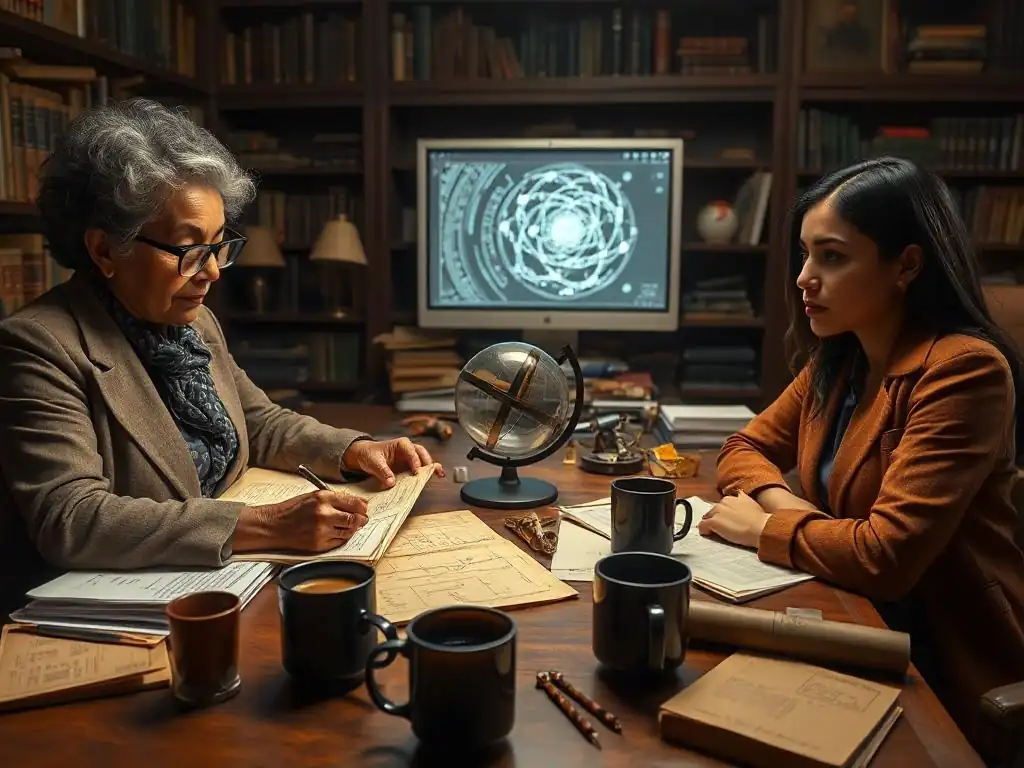
Welcome to WomenInScienceHistory.com, where we uncover the remarkable stories of women who shaped the scientific world. Dive into a realm where brilliance meets resilience, and discover the untold narratives of female pioneers. This month, we spotlight women in applied mathematics history, exploring how their innovative approaches have revolutionized diverse scientific fields. Prepare to be inspired as we reveal the interdisciplinary edge that these extraordinary mathematicians brought to the forefront. What crucial problems did they solve, and what obstacles did they overcome? Read on to find out!
- Introduction: Women in Applied Mathematics History and Scientific Innovation
- Pioneering Women in Applied Mathematics: Historical Perspectives
- Applied Mathematics and its Applications Across Disciplines
- Contemporary Women in Applied Mathematics: Breaking New Ground
- Challenges and Opportunities for Women in Applied Mathematics Careers
- The Importance of Recognizing Women's History in Applied Mathematics
- Conclusion: The Enduring Legacy of Women in Applied Mathematics
-
Frequently Asked Questions
- How does WomenInScienceHistory.com contribute to the understanding of Women in applied mathematics history?
- What specific scientific fields have women in applied mathematics historically impacted?
- Why is it important to highlight the stories of Women in applied mathematics history?
- What were some of the common obstacles faced by women pursuing applied mathematics careers historically?
- What kind of groundbreaking work did Women in applied mathematics history engage in?
- Final Reflection: Embracing the Interdisciplinary Power of Applied Math
- Ignite Your Inner Mathematician!
Introduction: Women in Applied Mathematics History and Scientific Innovation
Celebrating the Contributions of Women to Applied Mathematics
The narrative of scientific progress often overlooks the foundational contributions of women, particularly in fields as rigorous and impactful as applied mathematics. Historically, female mathematicians have navigated significant societal and institutional barriers to pursue their passions and make groundbreaking discoveries. Their work, though frequently underrepresented in conventional accounts, has been instrumental in shaping various scientific disciplines, from engineering to medicine, and continues to influence modern technological advancements. Recognizing these pivotal roles is essential for a complete understanding of our scientific heritage.
This article aims to shed light on the remarkable journey of women in applied mathematics history, highlighting their ingenious solutions to real-world problems. By examining their intellectual prowess and perseverance, we not only correct historical oversights but also provide inspiring role models for future generations. The stories of these pioneering women demonstrate that mathematical aptitude knows no gender, and their legacy serves as a powerful testament to the enduring impact of diverse perspectives in scientific inquiry.
The Interdisciplinary Nature of Applied Math: A Catalyst for Scientific Discovery
Applied mathematics serves as a vital bridge between abstract mathematical theory and the tangible challenges of the physical, biological, and social sciences. It is the discipline that translates complex real-world phenomena into mathematical models, allowing for analysis, prediction, and optimization. From designing aircraft to forecasting disease outbreaks, the tools and techniques of applied mathematics are indispensable for scientific discovery and technological innovation. This inherent interdisciplinary quality makes it a particularly fertile ground for groundbreaking work.
Throughout history, women have leveraged this interdisciplinary nature to make significant contributions across a broad spectrum of fields. Their ability to connect mathematical principles with diverse scientific problems has often led to novel approaches and profound insights. Whether developing algorithms for computational fluid dynamics, statistical models for public health, or complex systems for environmental analysis, women in applied mathematics have consistently pushed the boundaries of what is possible, acting as crucial catalysts for scientific advancement.
Pioneering Women in Applied Mathematics: Historical Perspectives
Early Pioneers: Laying the Foundation for Women in Mathematical Sciences
The path for early women in mathematical sciences was fraught with formidable obstacles, including limited access to education, societal expectations, and outright discrimination within academic institutions. Despite these challenges, remarkable individuals emerged, whose foundational work laid critical groundwork for future generations. These trailblazers often had to pursue their studies informally or publish under pseudonyms to gain recognition, yet their intellectual contributions were undeniable and far-reaching.
One such figure was Sophie Germain (1776–1831), a French mathematician, physicist, and philosopher. Denied formal university education due to her gender, she studied independently using lecture notes and corresponded with leading mathematicians like Lagrange and Gauss, often initially under the male pseudonym "Monsieur Le Blanc."
Her most significant work in applied mathematics involved elasticity theory, specifically her contributions to understanding the vibration of elastic surfaces, which was crucial for architectural and engineering applications. Her rigorous mathematical derivations for vibrating plates were honored by the Paris Academy of Sciences in 1816, a rare recognition for a woman at that time, and her principles found practical application in the construction of the Eiffel Tower, years after her passing.
Emmy Noether - Abstract Algebra and Theoretical Physics
Emmy Noether (1882–1935) stands as one of the most influential mathematicians of the 20th century, renowned for her groundbreaking work in abstract algebra and its profound implications for theoretical physics. Despite facing immense sexism in academia, including being denied official faculty positions for years, her intellectual brilliance and leadership transformed fields such as ring theory, field theory, and algebra. She was a pivotal figure in the development of modern algebra, creating a robust framework that continues to be fundamental for pure and applied mathematics.
Noether's most celebrated contribution to applied mathematics and physics is Noether's Theorem, published in 1918. This elegant theorem establishes a fundamental connection between symmetries in physical systems and conservation laws. For example, the symmetry of time translation corresponds to the conservation of energy, and spatial translation symmetry corresponds to the conservation of momentum.
This theorem revolutionized theoretical physics, providing a powerful tool for understanding the underlying principles of nature. Its impact spans general relativity, particle physics, and quantum field theory, making it a cornerstone of modern physics and a testament to the interdisciplinary power of abstract mathematical thought applied to the physical world.
Dorothy Vaughan - Human Computer and Programming Contributions
Dorothy Vaughan (1910–2008) was a pioneering African American mathematician who made indelible contributions to the early days of the U.S. space program. As one of the "human computers" at the National Advisory Committee for Aeronautics (NACA), which later became NASA, she performed complex mathematical calculations crucial for the success of aerospace projects. Vaughan led the West Area Computing unit at Langley Research Center, a segregated group of African American female mathematicians, making her one of NASA's first African American managers.
Vaughan's foresight and adaptability were critical during the transition from mechanical calculators to electronic computers in the 1960s. Recognizing the impending shift, she self-taught herself FORTRAN, one of the earliest computer programming languages, and subsequently trained her entire team in its use.
Her leadership ensured that her unit remained indispensable as technology evolved, directly contributing to critical missions such as Project Mercury and the Apollo program. The accurate calculations performed by Vaughan and her team for orbital trajectories, flight paths, and launch windows were absolutely essential for ensuring the safety of astronauts and the success of the nascent American space endeavors, solidifying her place in the history of women in applied mathematics.
Applied Mathematics and its Applications Across Disciplines
Applied Math in Physics and Engineering: Women's Contributions
The fields of physics and engineering are inherently reliant on sophisticated mathematical frameworks, and women have made profound, often unsung, contributions to their development and application. From designing more efficient systems to understanding fundamental physical phenomena, female mathematicians have applied their analytical prowess to solve some of the most complex challenges in these domains. Their work has directly influenced the technologies and infrastructure that define modern society.
One of the most celebrated examples is Katherine Johnson (1918–2020), another brilliant "human computer" at NASA, whose manual calculations of orbital mechanics were absolutely critical for the success of early U.S. manned spaceflights. Her precision was so trusted that astronaut John Glenn specifically requested her to verify the electronic computer's calculations before his historic orbital flight in 1962, stating, "If she says they're good, then I'm ready to go."
Her work ensured the safety and accuracy of trajectories for Project Mercury and the Apollo lunar missions, including the Apollo 11 flight to the Moon. Similarly, Lillian Gilbreth (1878–1972), an industrial engineer and psychologist, applied mathematical principles to time-motion studies, optimizing efficiency in workplaces and homes, leading to significant advancements in ergonomics and productivity.
Biomathematics and Epidemiology: Female Mathematicians Shaping Public Health
Biomathematics and epidemiology represent crucial interdisciplinary fields where mathematical modeling directly informs public health policy and disease control. Female mathematicians have played a significant role in developing the complex models used to understand disease transmission, predict outbreaks, and evaluate intervention strategies. Their analytical work provides the quantitative backbone for public health responses and medical research.
For instance, early in the 20th century, female statisticians contributed to the foundational understanding of population dynamics and disease statistics, providing the rigorous methods needed for public health surveillance. In more contemporary times, women have been at the forefront of developing sophisticated epidemiological models, such as those used to track the spread of infectious diseases like influenza, HIV/AIDS, or more recently, COVID-19.
These models leverage differential equations, statistical analysis, and computational methods to simulate various scenarios, estimate key parameters like R0 (the basic reproduction number), and predict the impact of vaccinations, social distancing, or other public health measures. Their work provides evidence-based insights that directly guide governmental and international health organizations in formulating effective strategies to protect global populations.
Women in Applied Mathematical Modeling for Environmental Science
Environmental science, a field grappling with complex and interconnected systems, relies heavily on applied mathematical modeling to understand and address global challenges like climate change, biodiversity loss, and resource depletion. Women have been instrumental in developing and refining these models, translating vast environmental data into actionable insights. Their contributions are vital for informing policy decisions and conservation efforts.
Female mathematicians have, for example, developed sophisticated climate models that simulate atmospheric and oceanic processes, helping scientists predict global warming trends and their regional impacts. These models, often involving complex partial differential equations and numerical analysis, are essential for the Intergovernmental Panel on Climate Change (IPCC) reports. Beyond climate, women have contributed to ecological modeling, such as population dynamics for endangered species or the spread of invasive species, aiding conservation efforts.
Furthermore, their work in hydrological modeling helps manage water resources, predict floods, and assess drought risks. These quantitative approaches are crucial for understanding the intricate balance of natural systems and for developing sustainable solutions for the planet's future, showcasing the critical role of women in applied mathematics within environmental research.
Contemporary Women in Applied Mathematics: Breaking New Ground

Ingrid Daubechies - Research and Impact in Wavelet Theory
Ingrid Daubechies, a Belgian-American mathematician, is widely recognized as one of the world's leading experts in wavelet theory, a field with profound implications for signal processing and data compression. Her groundbreaking research in the late 1980s led to the construction of orthonormal compactly supported wavelets, often referred to as "Daubechies wavelets." This mathematical innovation provided a highly efficient method for representing and analyzing complex data, revolutionizing numerous scientific and technological applications.
The impact of Daubechies' work is pervasive. Her wavelets are fundamental to the JPEG 2000 image compression standard, widely used for digital photography and medical imaging, allowing for high-quality image storage with significantly reduced file sizes. Beyond image processing, her contributions are critical in diverse areas such as medical diagnostics (e.g., in MRI and ultrasound imaging for clearer resolution), geophysical exploration, and even in forensic science for analyzing fingerprints. Daubechies' ability to translate abstract mathematical concepts into practical, widely adopted tools exemplifies the power of applied mathematics and solidifies her place as a transformative figure in the field.
Maryam Mirzakhani - Advancing Theoretical Mathematics in Geometry and Dynamical Systems
Maryam Mirzakhani (1977–2017) was an Iranian mathematician and the first, and to date only, woman to be awarded the Fields Medal, the highest honor in mathematics, in 2014. While her primary work was in pure mathematics, specifically in the dynamics and geometry of Riemann surfaces and their moduli spaces, her profound insights have significant implications for applied fields, particularly in understanding complex systems and dynamics. Her research explored the properties of geometric shapes and the behavior of billiard trajectories on polygonal surfaces, which, while abstract, relates to concepts found in various physical and engineering problems.
Mirzakhani's approach was characterized by a unique blend of intuition and rigorous proof, often involving the creation of new techniques to tackle notoriously difficult problems. Her work on counting simple closed geodesics on hyperbolic surfaces, for example, provided deep insights into the structure of these spaces.
Although not directly applied in the sense of building a device, her fundamental contributions expanded the mathematical toolkit available for understanding chaotic systems, network theory, and the geometry of spacetime, demonstrating how advances in theoretical mathematics can lay the groundwork for future applied breakthroughs. Her legacy continues to inspire women in applied mathematics and across all mathematical sciences.
The Role of Mentorship and Support Networks for Women in Applied Mathematics Today
For contemporary women in applied mathematics, mentorship and robust support networks are crucial for navigating academic and professional landscapes, fostering career growth, and promoting retention in STEM fields. These networks provide invaluable guidance, share experiences, and facilitate collaborations that can accelerate research and development. From navigating tenure tracks to securing leadership positions, a strong support system can make a significant difference in a mathematician's career trajectory.
Organizations such as the Association for Women in Mathematics (AWM) and similar initiatives play a vital role by offering mentorship programs, networking events, and professional development workshops. These platforms connect aspiring female mathematicians with experienced professionals, creating spaces for knowledge exchange and mutual encouragement. This support is particularly important in fields where women might still be underrepresented, helping to combat isolation and build confidence. By fostering a sense of community and providing avenues for guidance, these networks are indispensable for empowering women in applied mathematics to achieve their full potential and contribute to the field's advancement.
Challenges and Opportunities for Women in Applied Mathematics Careers
Addressing Gender Bias in STEM Fields: Creating a More Equitable Landscape
Despite significant progress, women in STEM fields, including applied mathematics, continue to face persistent challenges rooted in gender bias. These challenges manifest in various forms, from implicit biases in hiring and promotion to stereotype threat, which can undermine performance and confidence. Data indicates that while women comprise approximately half of the overall workforce, their representation in STEM professions, particularly in leadership and senior research roles, remains disproportionately low. For instance, women hold less than 30% of STEM jobs globally, with even lower percentages in some specialized areas of mathematics and computer science.
Addressing these systemic biases requires multifaceted approaches. Implementing blind review processes for grants and publications, promoting diverse hiring and promotion committees, and establishing clear, objective criteria for evaluation can help mitigate unconscious bias. Furthermore, fostering inclusive workplace cultures that actively challenge stereotypes and provide equitable opportunities for growth and recognition are essential. By dismantling these barriers, the landscape for women in applied mathematics can become more equitable, allowing talent to flourish irrespective of gender.
Promoting Women's Leadership in Applied Mathematics Research and Industry
Increasing the representation of women in leadership positions within applied mathematics research, academia, and industry is not merely a matter of equity; it is a strategic imperative for innovation and progress. Diverse leadership teams have been shown to foster more creative problem-solving, broader perspectives, and ultimately, more robust scientific outcomes. Currently, women are often underrepresented in senior academic faculty roles, principal investigator positions, and executive leadership within technology and research companies.
To promote women's leadership, targeted initiatives are necessary. This includes leadership development programs designed specifically for women in STEM, mentorship by senior female and male leaders, and policies that support work-life balance, such as flexible work arrangements and adequate parental leave. Organizations can also implement transparent promotion pathways and actively seek out and sponsor talented women for leadership roles. Visible female leaders in applied mathematics serve as powerful role models, inspiring younger generations and demonstrating that successful careers at the highest levels are achievable, thereby enriching the entire field.
The Future of Applied Mathematics: Encouraging the Next Generation of Female Mathematicians
The future of applied mathematics is dynamic and expansive, with emerging fields like artificial intelligence, data science, quantum computing, climate modeling, and bioinformatics creating unprecedented demand for mathematical talent. As these areas continue to evolve, the need for diverse perspectives and problem-solving approaches becomes even more critical. Encouraging the next generation of female mathematicians to enter and thrive in these fields is paramount for sustained innovation and global competitiveness.
Strategies for fostering this talent pipeline must begin early. Promoting engaging, hands-on STEM education in schools, showcasing diverse role models, and providing accessible resources for learning about applied mathematics can ignite interest from a young age. At university levels, creating supportive and inclusive academic environments, offering strong mentorship, and highlighting the real-world impact of applied mathematics can attract and retain female students. By actively nurturing and empowering young women to pursue careers in this vital discipline, we ensure that the future of applied mathematics is rich with diverse talent and groundbreaking discoveries.
The Importance of Recognizing Women's History in Applied Mathematics
Why Highlighting Women in Applied Mathematics Matters
Highlighting the rich history of women in applied mathematics is far more than an academic exercise; it is a crucial endeavor for several profound reasons. Firstly, it rectifies historical omissions, ensuring that the full breadth of human ingenuity and contribution to scientific progress is acknowledged. For too long, the narratives of scientific discovery have been dominated by male figures, obscuring the critical roles played by women who often worked in the shadows or received inadequate recognition. By bringing these stories to light, we gain a more accurate and comprehensive understanding of how scientific knowledge has evolved.
Secondly, recognizing these historical figures provides powerful and relatable role models for current and future generations of girls and women. Seeing the achievements of pioneering female mathematicians, who overcame immense societal and institutional barriers, can inspire confidence, ambition, and perseverance in young individuals considering STEM careers. It demonstrates that excellence in applied mathematics is achievable for anyone with passion and dedication, irrespective of gender. This visibility is vital for fostering an inclusive scientific community that values and nurtures talent from all backgrounds.
Resources for Further Learning About Women in Applied Mathematics History
For those eager to delve deeper into the fascinating lives and groundbreaking work of women in applied mathematics history, a wealth of resources exists. Academic journals, such as those focusing on the history of science and mathematics, often publish detailed biographies and analyses of female mathematicians' contributions. University archives and specialized collections frequently house correspondence, papers, and other primary sources that offer unique insights into their experiences and intellectual journeys.
Additionally, numerous books and comprehensive databases have been compiled by historians of science and mathematical organizations dedicated to documenting the achievements of women in STEM. These resources provide accessible pathways to learn about both well-known figures like Ada Lovelace and lesser-known but equally impactful individuals whose work shaped various fields. Exploring these materials not only enriches one's understanding of mathematical history but also reinforces the significant, often overlooked, legacy of women in applied mathematics.
Conclusion: The Enduring Legacy of Women in Applied Mathematics
Women's Impact on Applied Mathematics and its Continued Relevance
The journey through the history of women in applied mathematics reveals a profound and enduring legacy. From the foundational theoretical work of early pioneers to the computational breakthroughs of the space age and the sophisticated modeling of contemporary challenges, women have consistently been at the forefront of applying mathematical principles to solve real-world problems. Their contributions span diverse fields, including physics, engineering, public health, environmental science, and data analysis, demonstrating the pervasive and indispensable role of applied mathematics in modern society.
The relevance of their work continues to resonate today, as the mathematical frameworks and problem-solving methodologies developed by these remarkable women form the backbone of countless technological advancements and scientific discoveries. Whether it's the algorithms powering our digital world, the models predicting climate change, or the statistical analyses informing medical breakthroughs, the intellectual fingerprints of female mathematicians are evident. Their impact is not merely historical; it is a living, evolving force that continues to shape the future of science and technology.
Inspiring Future Generations of Female Mathematicians and Scientists Through History
The stories of women in applied mathematics history serve as powerful narratives that transcend their specific mathematical achievements. They are tales of resilience, intellectual curiosity, and unwavering dedication in the face of adversity. By celebrating these contributions, we not only honor the past but also actively inspire the future. Understanding the challenges these women overcame and the extraordinary impact they made can empower young girls and aspiring female scientists to pursue their passions in mathematics and STEM fields with confidence and determination.
The recognition of this rich history is a vital step toward creating a more inclusive and equitable scientific landscape. By showcasing diverse role models and demonstrating the limitless potential of all individuals in the pursuit of knowledge, we encourage the next generation of female mathematicians and scientists to break new ground, tackle complex global challenges, and ultimately, leave their own indelible mark on the world. The enduring legacy of women in applied mathematics is a beacon, guiding and motivating future innovators.
Frequently Asked Questions
How does WomenInScienceHistory.com contribute to the understanding of Women in applied mathematics history?
The website celebrates the achievements of women in applied mathematics by showcasing their biographies and groundbreaking work. It also addresses the challenges they faced in the field.
What specific scientific fields have women in applied mathematics historically impacted?
Women have made significant contributions across various fields, including physics, engineering, and computer science, using applied mathematics as a tool. Their work often helped solve complex real-world problems.
Why is it important to highlight the stories of Women in applied mathematics history?
Highlighting their stories inspires future generations of women to pursue careers in STEM fields. It also corrects historical narratives that often overlook their contributions.
What were some of the common obstacles faced by women pursuing applied mathematics careers historically?
Women often faced discrimination and limited access to education and research opportunities. They had to overcome gender bias in male-dominated environments.
What kind of groundbreaking work did Women in applied mathematics history engage in?
They engaged in work ranging from developing mathematical models for complex systems to creating algorithms for data analysis. Their work often had a direct impact on technological advancements.
Final Reflection: Embracing the Interdisciplinary Power of Applied Math
The narratives we've explored, highlighting the groundbreaking contributions of women in applied mathematics, are not just historical accounts; they are a testament to the enduring power of interdisciplinary thinking and the critical role women play in shaping scientific progress. These stories resonate deeply today, as we grapple with increasingly complex global challenges that demand innovative solutions forged at the intersection of diverse fields.
The impact of these women extends far beyond their individual achievements. Their perseverance and ingenuity have paved the way for future generations of mathematicians and scientists, inspiring a more inclusive and collaborative approach to problem-solving. Their legacy reminds us that true innovation thrives when diverse perspectives are not only welcomed but actively sought out. The best way to predict the future is to create it.
- Peter Drucker. This quote encapsulates the spirit of these women, who, against societal odds, actively shaped the future of science and mathematics.
As we reflect on the interdisciplinary edge wielded by these remarkable women, let us be inspired to cultivate our own capacity for cross-disciplinary thinking. Embrace the challenge of connecting seemingly disparate fields, and champion the inclusion of diverse voices in the pursuit of knowledge. The future of scientific discovery depends on our willingness to learn from the past and build a more equitable and innovative world for all.
Ignite Your Inner Mathematician!
Thank you for exploring the fascinating intersection of women, applied mathematics, and scientific discovery. We hope this article has inspired you to see the powerful impact of mathematics across diverse fields. Now, let's put that inspiration into action!
Here are a few things you can do:
- Embrace Applied Math: Explore a new application of math that genuinely interests you. Dive into the world of bioinformatics, climate modeling, or even financial engineering.
- Share the Spark: Spread the word about the incredible women highlighted in this article! Share it on social media and tag three friends who need to hear these stories.
- Discover local organizations supporting women in STEM and consider attending events to network.
What specific real-world problem will you tackle using the power of applied mathematics? Let us know in the comments!