
Their Calculations, Our Future: Women's Vital Role in Math (19502000)

Welcome to WomenInScienceHistory.com!
Dive into a world where brilliance knows no gender. Here, we uncover the untold stories of remarkable women who shaped the scientific landscape. Today, we're focusing on Women’s math history contributions between 1950 and 2000, revealing their pivotal role in advancing mathematics. What groundbreaking discoveries were made, and what obstacles did they overcome to leave their indelible mark on the field? Explore the article below to find out, and be inspired by their legacy.
- From Slide Rules to Software: Women's Enduring Impact on Mathematics (1950-2000)
- Introduction: Acknowledging Women's Crucial Mathematical Contributions in the Late 20th Century
- Overcoming Obstacles: The Growing Presence of Women in Mathematics (1950-2000)
- Influential Women Mathematicians: Profiles and Groundbreaking Work (1950-2000)
- Key Areas of Influence: Women's Impact on Mathematical Progress
- Societal Impact: The Far-Reaching Effects of Women's Mathematical Expertise
- Preserving and Promoting Women’s Mathematical Legacy
- Conclusion: A Continuing Legacy of Excellence and Innovation in Mathematics
-
Frequently Asked Questions
- What were some of the major challenges faced by women in mathematics between 1950 and 2000?
- Can you name a few prominent female mathematicians who made significant contributions during the 1950-2000 period?
- How did the contributions of women in mathematics from 1950-2000 impact other scientific fields?
- How did the rise of computers affect the opportunities for women in mathematics during this period?
- How does WomenInScienceHistory.com aim to improve the recognition of women's math history contributions?
- Final Reflection: Celebrating Enduring Mathematical Legacies
- Unlock Your Inner Mathematician: Explore, Connect, Inspire!
From Slide Rules to Software: Women's Enduring Impact on Mathematics (1950-2000)
Introduction: Acknowledging Women's Crucial Mathematical Contributions in the Late 20th Century
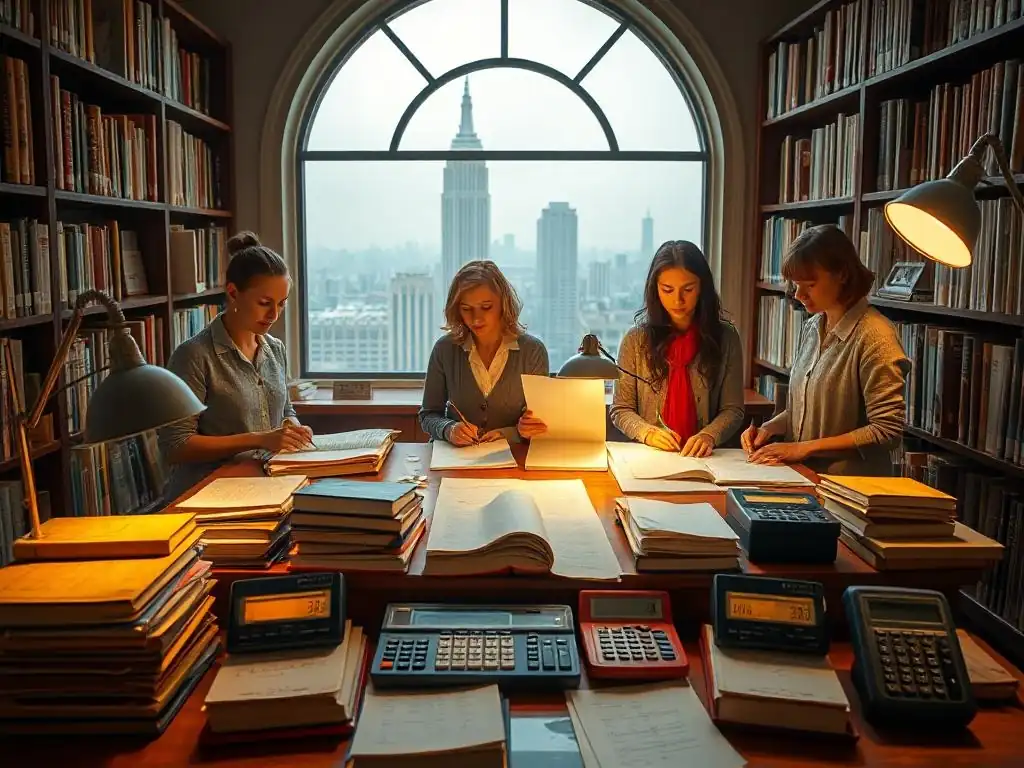
The period from 1950 to 2000 marked a pivotal era in mathematics, witnessing the transition from mechanical computation to the digital age. Within this transformative landscape, countless women made profound, yet often unacknowledged, contributions. Many were employed as "human computers" in government agencies, research institutions, and nascent technology companies, performing complex calculations that were foundational to scientific and engineering advancements. Their meticulous work, though often behind the scenes, was indispensable before the widespread adoption of electronic computers.
These women, often operating in roles that were initially deemed suitable for "nimble fingers" rather than intellectual prowess, laid much of the groundwork for modern computation and data analysis. For instance, at institutions like NACA (later NASA), women constituted a significant portion of the computing workforce.
While precise figures for the entire period are complex, estimates suggest that by the mid-1960s, women comprised approximately 25-30% of the programming workforce in the United States, a figure that would unfortunately decline in later decades as the field gained prestige. Their collective women’s math history contributions during this foundational period are a testament to their skill and perseverance.
The Significance of Highlighting Women's Mathematical Achievements
Highlighting the mathematical achievements of women from 1950 to 2000 is crucial for several reasons. Firstly, it rectifies historical omissions, providing a more complete and accurate narrative of scientific progress. For too long, the stories and innovations of these brilliant minds were overlooked, often overshadowed by their male counterparts or simply not recorded with the same prominence. Recognizing their specific women’s math history contributions ensures that their intellectual legacy is properly honored.
Secondly, showcasing these women serves as a powerful source of inspiration for future generations. When young women see trailblazers like Katherine Johnson or Grace Hopper, it breaks down stereotypes about who can excel in mathematics and STEM fields. It demonstrates that talent and ingenuity know no gender, fostering a more inclusive vision for the future of science and technology. This acknowledgment is vital for encouraging diversity and ensuring that all potential is harnessed for future innovation.
Overcoming Obstacles: The Growing Presence of Women in Mathematics (1950-2000)
Societal Biases and Discrimination Faced by Women Mathematicians
Despite their undeniable talents, women mathematicians between 1950 and 2000 frequently encountered significant societal biases and systemic discrimination. Gender stereotypes often dictated that women were less capable of abstract mathematical thought or were better suited for supportive, rather than leading, roles. This often translated into limited access to advanced educational programs, particularly in prestigious universities, or exclusion from informal networks that were crucial for career advancement. For example, women often faced challenges in securing tenure-track positions in academia, with many being relegated to adjunct or lecturer roles, even with comparable qualifications to their male peers.
Furthermore, women in mathematical fields often experienced pay disparities and a lack of promotion opportunities. They might be hired for computational roles but rarely ascended to leadership positions or received recognition for their intellectual property. The professional landscape was largely male-dominated, making it difficult for women to find mentors or advocates within their fields. This pervasive bias meant that many significant women’s math history contributions were made in environments that were far from equitable, requiring extraordinary resilience and determination.
Expanding Educational and Professional Opportunities in Mathematical Sciences
Despite the formidable barriers, the latter half of the 20th century saw a gradual, albeit slow, expansion of educational and professional opportunities for women in mathematical sciences. The post-World War II era, with its burgeoning Cold War demands and the space race, created an increased need for skilled mathematicians, leading to more open doors in certain sectors. Universities began to admit more women into graduate programs, and the rise of computer science as a new discipline offered fresh avenues, often less constrained by traditional academic hierarchies.
By the 1970s and 1980s, the number of women pursuing higher degrees in mathematics began to show a modest but steady increase. For instance, while women earned only about 4% of mathematics PhDs in the United States in 1966, this figure slowly climbed to approximately 10% by the early 1980s and approached 25% by the late 1990s. This growth, though still indicating underrepresentation, reflected increasing access to education and a shifting professional landscape where mathematical skills were in high demand across various industries, from finance to technology.
Key Organizations Championing Women in Mathematics
The growing awareness of gender disparities led to the formation of crucial organizations dedicated to supporting women in mathematics. A landmark development was the founding of the Association for Women in Mathematics (AWM) in 1971.
Established by a group of women mathematicians, including Alice T. Schafer and Mary W. Gray, the AWM aimed to encourage women and girls to study and have careers in the mathematical sciences, and to promote equal opportunity and the equal treatment of women in the mathematical community. The AWM provided a vital network, mentorship, and advocacy for women who often felt isolated in their fields.
Other professional bodies, such as the American Mathematical Society (AMS), also gradually began to address issues of gender equity, albeit later in the period. These organizations established committees, offered grants, and organized conferences designed to highlight the work of women mathematicians and address systemic biases. Their collective efforts were instrumental in fostering a more supportive environment and ensuring that the women’s math history contributions of the era were not entirely lost to time.
Influential Women Mathematicians: Profiles and Groundbreaking Work (1950-2000)
Katherine Johnson: Calculating Trajectories and Beyond at NASA
Katherine Johnson (1918-2020) stands as an iconic figure whose mathematical prowess was critical to the success of early American spaceflight. As one of NASA's "human computers" at the Langley Research Center, her meticulous calculations were indispensable. She famously performed the trajectory analysis for Alan Shepard's 1961 mission, America's first human spaceflight, and verified the electronic computer's calculations for John Glenn's orbital flight in 1962, a task Glenn specifically requested she perform manually. Her work involved complex orbital mechanics, calculating launch windows, trajectories, and emergency return paths with extraordinary precision.
Johnson's contributions extended to the Apollo program, where she calculated the trajectory for the Apollo 11 mission that landed humans on the Moon in 1969. Her ability to visualize complex geometry in space and her unwavering accuracy earned her immense respect. She continued her work at NASA until her retirement in 1986, having contributed to numerous missions, including the Space Shuttle program. Her remarkable women’s math history contributions were eventually recognized with the Presidential Medal of Freedom in 2015, bringing her story to a wider audience.
Grace Hopper: Pioneering Computer Programming and Compiler Technology
Rear Admiral Grace Hopper (1906-1992) was a visionary computer scientist and mathematician whose work fundamentally shaped the digital age. A prominent figure in the U.S. Navy, she joined the Harvard Mark I computer project in 1944, becoming one of its first programmers. Her most significant innovation was the invention of the first compiler, the A-0 System, in 1952. This groundbreaking software translated symbolic mathematical code into machine language, allowing programmers to write code in a more human-readable format rather than tedious binary. This radically simplified programming and made computers accessible to a broader range of users.
Hopper continued to innovate, developing FLOW-MATIC, one of the first English-language data processing compilers, in 1955-1959. Her work directly led to the development of COBOL (Common Business-Oriented Language) in the late 1950s, a programming language that became ubiquitous in business and government applications and remains in use today. Her advocacy for machine-independent programming languages and her belief that computers should be user-friendly transformed computing. Hopper’s enduring legacy as a pioneer in programming and her profound women’s math history contributions to computer science continue to influence technology globally.
Marjorie Lee Browne: Advancing Research and Opportunities in Algebra and Topology
Marjorie Lee Browne (1914-1979) was a distinguished mathematician and educator, notable as one of the first African American women to earn a Ph.D. in mathematics. She received her doctorate from the University of Michigan in 1949, a remarkable achievement in an era of significant racial and gender discrimination. Her primary fields of research were topology and abstract algebra, particularly in the areas of group theory and matrix theory. Her academic career was primarily spent at North Carolina Central University (NCCU), where she began teaching in 1951.
At NCCU, Browne became a transformative figure, dedicating herself not only to teaching and research but also to expanding opportunities for her students. She was instrumental in establishing the university's first computer center in the 1960s, securing a grant that provided access to computing resources for her students and faculty. She also initiated a summer institute for high school math teachers, aiming to enhance their skills and foster interest in mathematics among younger generations. Her tireless efforts in both theoretical mathematics and educational outreach underscore her significant women’s math history contributions to both academia and the broader community.
Key Areas of Influence: Women's Impact on Mathematical Progress

Women's Contributions to Computer Science and Software Development
The period from 1950 to 2000 saw women play a foundational role in the burgeoning field of computer science and software development. In the early decades, programming was often seen as a clerical task, and women were actively recruited for roles as "coders" and "programmers." This led to a significant percentage of women in early computing teams.
For instance, the original ENIAC programmers in the 1940s were all women, and by the 1960s, it's estimated that close to 30% of computer programmers were female. These women were not merely transcribing code; they were designing algorithms, debugging complex systems, and innovating new ways for machines to communicate.
Their contributions included developing operating systems, pioneering early programming languages, and creating foundational software applications that are still in use today. Figures like Grace Hopper, who developed the first compiler and co-created COBOL, exemplify this profound impact. These women’s math history contributions laid the groundwork for the entire digital revolution, demonstrating that women were at the forefront of the technological advancements that reshaped the world.
The Role of Women in Statistical Analysis and Data Modeling
Women mathematicians also made substantial inroads into the field of statistical analysis and data modeling, which became increasingly vital across various disciplines during this period. Their expertise was crucial in areas ranging from public health and epidemiology to social sciences, market research, and quality control in manufacturing. They developed sophisticated statistical methods to analyze large datasets, identify trends, and predict outcomes, contributing directly to evidence-based decision-making.
For example, in public health, women statisticians helped design clinical trials, analyze disease patterns, and evaluate the effectiveness of new treatments and prevention strategies. In government and business, their work in data modeling informed economic forecasts, demographic studies, and operational efficiencies. These women’s math history contributions to statistics provided the analytical backbone for advancements in medicine, social policy, and economic planning, proving indispensable in an increasingly data-driven world.
Advancements in Operations Research and Optimization Led by Women
Operations Research (OR), a discipline that uses advanced analytical methods to improve decision-making, significantly benefited from the expertise of women mathematicians. Emerging during World War II, OR found widespread application in industry and government throughout the latter half of the 20th century. Women contributed to developing and applying mathematical models for optimizing complex systems, including logistics, supply chain management, resource allocation, and scheduling.
Their work in areas such as linear programming, network optimization, and simulation helped industries streamline processes, reduce costs, and increase efficiency. For instance, women in OR developed models to optimize airline scheduling, factory production lines, and even national defense strategies. These practical applications of mathematical theory demonstrated how women’s math history contributions directly translated into tangible economic and societal benefits, making systems more effective and responsive.
Contributions to Mathematical Logic and Theoretical Foundations
Beyond applied mathematics, women also made significant, though often less visible, contributions to mathematical logic and theoretical foundations. This includes work in abstract algebra, topology, number theory, and the philosophical underpinnings of mathematics. Their research in these pure mathematical fields expanded the boundaries of knowledge, providing the conceptual frameworks necessary for future breakthroughs in both theoretical and applied sciences.
While specific "data" on the direct impact of theoretical advancements can be elusive, the cumulative effect of these pure mathematical contributions is profound. For example, advances in mathematical logic laid groundwork for theoretical computer science, and developments in abstract algebra found applications in cryptography and coding theory. These women’s math history contributions to the theoretical bedrock of mathematics ensured the discipline's continued growth and intellectual vitality, underpinning many of the technological leaps seen by the turn of the millennium.
Societal Impact: The Far-Reaching Effects of Women's Mathematical Expertise
Scientific Breakthroughs Enabled by Women in Mathematics
The mathematical expertise of women from 1950 to 2000 directly enabled numerous scientific breakthroughs that reshaped the world. Katherine Johnson’s precise calculations were fundamental to the success of America's space program, allowing astronauts to safely journey into orbit and to the Moon. Grace Hopper's pioneering work in compilers and programming languages revolutionized computing, making it accessible and paving the way for the personal computer revolution and the internet.
Beyond these well-known examples, women mathematicians contributed to advancements in diverse fields. Their statistical analyses underpinned medical research, leading to new treatments and understandings of diseases. Their work in computational fluid dynamics assisted in aircraft design, and their contributions to cryptography enhanced national security. These vital women’s math history contributions were not merely academic exercises but were integral to the scientific progress that defined the latter half of the 20th century.
Economic Growth Driven by Women's Mathematical Skills
The burgeoning technology sector, financial markets, and data-intensive industries of the late 20th century were significantly propelled by the mathematical skills of women. As computer science and software development became central to the global economy, women who had entered these fields early on played crucial roles in developing the tools and systems that drove economic growth. Their work in programming, data modeling, and operations research directly contributed to increased efficiency, innovation, and profitability across various sectors.
In finance, women mathematicians worked as quantitative analysts, developing complex algorithms for trading and risk assessment. In manufacturing, their optimization models improved production lines and supply chains, leading to cost savings and increased output. The proliferation of software, driven in part by their efforts, created entirely new industries and job markets. These women’s math history contributions were indispensable to the economic expansion and technological advancements that characterized the period.
Inspiring and Empowering Future Generations of Women in STEM
Perhaps one of the most profound societal impacts of these pioneering women mathematicians is their enduring role as inspirations and empowerers for future generations. By excelling in a field traditionally dominated by men, they broke down stereotypes and demonstrated that women are equally capable of achieving greatness in mathematics and related STEM disciplines. Their stories, once hidden, now serve as powerful narratives that challenge conventional perceptions and encourage young women to pursue their passions without limitation.
The visibility of figures like Katherine Johnson, Grace Hopper, and Marjorie Lee Browne, even if belated, provides tangible role models. Their achievements illustrate the immense possibilities within mathematics and science, helping to dismantle the notion that STEM fields are exclusively for men. This inspiration is critical for fostering a more diverse and inclusive scientific community, ensuring that future women’s math history contributions continue to enrich society.
Preserving and Promoting Women’s Mathematical Legacy
Archiving and Celebrating the Achievements of Women Mathematicians
The task of preserving and celebrating the achievements of women mathematicians from 1950 to 2000 is an ongoing and essential endeavor. Historical archives, university special collections, and dedicated online platforms play a vital role in documenting their lives and work. Initiatives to collect oral histories, digitize personal papers, and create comprehensive biographies ensure that their stories are not lost to time. Websites like WomenInScienceHistory.com are crucial in making these narratives accessible to a global audience, highlighting their specific women’s math history contributions.
By meticulously cataloging their research papers, professional correspondence, and personal accounts, these archiving efforts provide invaluable resources for researchers, educators, and the general public. This documentation helps to reconstruct a more accurate and inclusive history of mathematics, ensuring that the foundational work of these women receives the recognition it deserves. The continuous effort to unearth and present these stories is a testament to their lasting significance.
Contemporary Initiatives Supporting Women in Mathematics
Today, numerous contemporary initiatives continue to support and promote women in mathematics, building upon the foundations laid by earlier pioneers. Organizations like the Association for Women in Mathematics (AWM) remain at the forefront, offering mentorship programs, scholarships, and networking opportunities for female mathematicians at all career stages. University departments are increasingly implementing diversity and inclusion programs, aiming to recruit and retain more women in their mathematics faculties and graduate programs.
Furthermore, efforts are being made to address systemic biases through unconscious bias training and inclusive teaching practices. Conferences and workshops dedicated to women in mathematics provide platforms for sharing research, fostering collaboration, and celebrating achievements. These ongoing initiatives are crucial for cultivating an environment where the women’s math history contributions of the past are honored, and future generations of female mathematicians can thrive without facing the same obstacles as their predecessors.
The Enduring Importance of Recognizing Their Contributions
Recognizing the contributions of women mathematicians from 1950 to 2000 holds enduring importance for several compelling reasons. Firstly, it completes the historical record, acknowledging that scientific and technological progress is a collective human endeavor, not solely the domain of one gender. Acknowledging their work provides a more truthful and comprehensive understanding of how modern society was shaped.
Secondly, it serves as a powerful corrective to historical injustices, ensuring that individuals who were often overlooked or undervalued receive the recognition they earned. This validation is not just about historical accuracy but also about inspiring current and future generations. By highlighting these women’s math history contributions, we foster a more equitable and inclusive scientific community, encouraging diverse talent to pursue careers in mathematics and ensuring that the field continues to benefit from the fullest range of human intellect and creativity.
Conclusion: A Continuing Legacy of Excellence and Innovation in Mathematics
Reflecting on the Enduring Influence of Women's Mathematical Contributions (1950-2000)
The period from 1950 to 2000 was a time of immense change and progress in mathematics, driven significantly by the often-underestimated efforts of women. From their foundational work as "human computers" to their groundbreaking innovations in programming, statistics, and theoretical mathematics, their influence is undeniable. They were instrumental in the space race, the birth of computing, and the development of data analysis techniques that underpin countless modern industries. Their resilience in the face of societal biases and discrimination highlights their extraordinary dedication and intellectual prowess.
The women’s math history contributions during these five decades laid critical groundwork for the digital age and continue to resonate in every aspect of scientific and technological advancement today. Their calculations, algorithms, and theoretical insights were not merely academic exercises but direct catalysts for progress that transformed daily life and propelled humanity forward. Their legacy is a testament to the power of perseverance and the universal nature of mathematical talent.
The Future of Women in Mathematics: Building on Progress and Breaking Barriers
Looking forward, the future of women in mathematics is one of both continued progress and persistent challenges. While the visibility and support for women in STEM have grown significantly since 2000, disparities still exist, particularly in senior academic and leadership positions. However, the rich history of women’s math history contributions provides a powerful narrative to inspire ongoing efforts to break down remaining barriers.
Building on the legacy of pioneers from 1950-2000 means fostering inclusive educational environments, providing robust mentorship, and actively promoting the achievements of women in mathematics. By continuing to champion diversity and equity, we can ensure that mathematics remains a field where talent is recognized regardless of gender, and where the next generation of women mathematicians can innovate and contribute without limitation, further enriching the field for centuries to come.
Frequently Asked Questions
What were some of the major challenges faced by women in mathematics between 1950 and 2000?
Women faced persistent gender bias and limited access to mentorship and opportunities in research and academia. The prevailing societal expectations often steered them away from STEM fields.
Can you name a few prominent female mathematicians who made significant contributions during the 1950-2000 period?
Many women excelled, including Katherine Johnson, known for her critical calculations for NASA's space missions, and Emmy Noether, whose work laid the foundation for modern abstract algebra even though she had a long career before this period.
How did the contributions of women in mathematics from 1950-2000 impact other scientific fields?
Their work was vital in fields like computer science, engineering, and physics. Their mathematical models and algorithms were crucial for advancements in these areas.
How did the rise of computers affect the opportunities for women in mathematics during this period?
The growing computer industry created new roles, especially in programming and data analysis. Women found opportunities to apply their mathematical skills in these emerging fields.
How does WomenInScienceHistory.com aim to improve the recognition of women's math history contributions?
The website highlights biographies and achievements of female mathematicians. It also aims to inspire future generations by showcasing their impact and overcoming historical biases.
Final Reflection: Celebrating Enduring Mathematical Legacies
The preceding exploration of women's mathematical contributions between 1950 and 2000 reveals not just a history lesson, but a powerful testament to resilience and brilliance. The impact of these women, often working against significant societal barriers, continues to shape the technological and scientific landscape we inhabit today. Their groundbreaking work in fields ranging from computer science to theoretical physics laid the foundation for many of the innovations we now take for granted, proving that talent knows no gender.
The narrative of these mathematicians profoundly influences our understanding of what's possible when dedication meets opportunity. It reminds us that progress is not a linear path, but a tapestry woven with the threads of individual struggles and triumphs. The stories of these women, often overlooked in mainstream historical accounts, serve as a potent reminder of the importance of inclusivity and the untapped potential that exists within marginalized communities. You have to believe in yourself when no one else does – that makes you a winner right there.
– Venus Williams, a sentiment that resonates deeply with the experiences of these pioneering women.
As we conclude this journey through the mathematical achievements of these remarkable women, let us not simply admire their past accomplishments. Instead, let us be inspired to create a future where every individual, regardless of gender, has the opportunity to pursue their passions and contribute their unique talents to the world. Consider how you can champion inclusivity in STEM fields, mentor aspiring mathematicians, and actively support initiatives that empower women to reach their full potential. The future of innovation depends on it.
Unlock Your Inner Mathematician: Explore, Connect, Inspire!
Thank you for diving into the history of women who shaped mathematics. You've now glimpsed the power and impact of their contributions. Ready to take the next step?
Here’s how you can continue the journey:
- Begin your own mathematical journey: Tackle a challenging math problem or explore a new mathematical concept this week. Rediscover the joy of problem-solving and analytical thinking.
- Share this article with fellow students, teachers, or anyone passionate about STEM and gender equality. Let's amplify these incredible stories.
- Join our community forum on WomenInScienceHistory.com to discuss your favorite female mathematicians and inspire others with your own discoveries.
What mathematical puzzle will you conquer this week, inspired by these amazing women?