
Beyond "Little Green Men": The Science of Pulsars with Jocelyn Bell Burnell (HS)

Welcome to WomenInScienceHistory.com!
Dive into the fascinating world of scientific discovery and uncover the untold stories of remarkable women who shaped our understanding of the universe. In this article, we explore the groundbreaking work of Jocelyn Bell Burnell and the science of pulsars, venturing beyond the initial mystery of those intriguing "little green men." Discover how this pivotal discovery continues to influence our understanding of astrophysics and inspires educators today. What were the challenges she faced, and how did her work revolutionize the field? Read on to find out!
- Beyond "Little Green Men": The Science of Pulsars with Jocelyn Bell Burnell
- Introduction: Jocelyn Bell Burnell and the Discovery of Pulsars
- Understanding Pulsars: A Deep Dive into Neutron Stars
- The "Little Green Men" Hypothesis and its Rejection
- Jocelyn Bell Burnell's Role in Pulsar Science: Addressing the Nobel Controversy
- Hands-on Activity: Modeling Pulsar Emission (High School Lesson Plan)
- Further Exploration: Resources for Students and Educators
- Connecting Pulsar Science to Broader Concepts
- Conclusion: The Enduring Legacy of Pulsar Science and Jocelyn Bell Burnell
-
Frequently Asked Questions
- What role did Jocelyn Bell Burnell play in the discovery of pulsars?
- What are pulsars, and why were they initially nicknamed "Little Green Men"?
- What challenges did Jocelyn Bell Burnell face as a woman in science during her time?
- How does "WomenInScienceHistory.com" highlight Jocelyn Bell Burnell's story?
- Why is it important to celebrate the achievements of women like Jocelyn Bell Burnell in science history?
- Final Reflection: Echoes of Discovery
- Unveil the Mysteries of the Cosmos!
Beyond "Little Green Men": The Science of Pulsars with Jocelyn Bell Burnell
Introduction: Jocelyn Bell Burnell and the Discovery of Pulsars
Honoring a Pioneer: Jocelyn Bell Burnell's Contribution to Radio Astronomy
Jocelyn Bell Burnell stands as a towering figure in the history of radio astronomy, her name inextricably linked with one of the 20th century's most profound astrophysical discoveries: pulsars. As a postgraduate student at the University of Cambridge, working under the supervision of Antony Hewish, she meticulously analyzed data from a newly constructed radio telescope, leading to the detection of unprecedented cosmic signals. Her keen observational skills and unwavering perseverance in identifying and characterizing these anomalous pulses were absolutely pivotal to unlocking a new understanding of the universe.
Her groundbreaking work not only revolutionized our understanding of neutron stars but also highlighted the critical contributions of women in scientific research, often in environments where their efforts were historically underrecognized. Bell Burnell's legacy extends beyond the initial discovery; she has become an ardent advocate for inclusivity in science, inspiring countless aspiring scientists, particularly young women, to pursue careers in physics and astronomy. Her journey embodies the spirit of curiosity and rigorous inquiry that drives all scientific progress.
The Initial Observation: Unveiling the Repeating Radio Signals
The journey to discovering pulsars began in 1967, when Jocelyn Bell Burnell was sifting through reams of paper charts produced by the Interplanetary Scintillation Array, a radio telescope designed to study quasars. Day after day, she meticulously scanned the data, searching for subtle patterns. On August 6th, she noticed a peculiar "scruff" of signals that pulsed with extraordinary regularity, approximately every 1.337 seconds. This signal, originating from a specific point in the sky, was unlike anything astronomers had ever observed.
Initially, the team, including her supervisor Antony Hewish, considered various prosaic explanations, from terrestrial radio interference to faulty equipment. However, Bell Burnell’s persistent monitoring revealed that the signal consistently reappeared from the same celestial coordinates, precisely every 1.337 seconds, ruling out many conventional sources. The unwavering periodicity of these radio bursts was so precise that it prompted a playful, albeit serious, internal designation: "LGM-1," short for "Little Green Men," reflecting the remote possibility of an extraterrestrial origin.
From Anomalies to Breakthrough: Recognizing the Significance of Pulsars
The unusual stability and precise timing of the LGM-1 signal spurred Bell Burnell and her colleagues to undertake a systematic and rigorous investigation. They meticulously checked for any possible earthly or instrumental sources, moving the antenna, examining different receivers, and even altering the telescope's configuration. Each test confirmed the extraterrestrial nature of the pulses, deepening the mystery. The discovery of a second similar, but distinct, pulsing source in a different part of the sky, followed by a third and a fourth, proved to be the decisive turning point.
This multiplicity of sources strongly indicated that these were not unique artificial signals but rather a new class of natural astrophysical objects. The term "pulsar" was coined to describe these pulsating radio sources, a portmanteau of "pulsating star." This realization transformed what was initially an astronomical anomaly into one of the most significant astrophysical breakthroughs of the 20th century, revealing the existence of rapidly rotating, highly magnetized neutron stars, a phenomenon previously theorized but never directly observed.
Understanding Pulsars: A Deep Dive into Neutron Stars
What are Pulsars? Defining Rapidly Rotating, Magnetized Neutron Stars
Pulsars are essentially the super-dense, rapidly rotating remnants of massive stars that have undergone supernova explosions. When a star much more massive than our Sun exhausts its nuclear fuel, its core collapses under immense gravitational forces.
This collapse can be so extreme that protons and electrons are squeezed together to form neutrons, resulting in a neutron star. These objects are incredibly compact; a typical neutron star has a diameter of only about 20 kilometers (roughly the size of a city like San Francisco or Manhattan), yet it can contain a mass greater than that of our entire Sun, perhaps 1.4 to 2.5 solar masses.
The density of a pulsar is truly mind-boggling: a single teaspoon of neutron star material would weigh billions of tons, equivalent to the mass of Mount Everest. As the star's core collapses, its angular momentum is conserved, causing it to spin incredibly fast, much like an ice skater pulling in her arms. This rapid rotation, combined with an extraordinarily powerful magnetic field, gives rise to the unique properties that define pulsars and allow us to detect them across vast cosmic distances.
The Physics Behind Pulsars: Radio Emission, Magnetic Fields, and Relativistic Jets
The defining characteristic of pulsars—their pulsed emission—is explained by the "lighthouse model." Pulsars possess incredibly strong magnetic fields, often trillions of times stronger than Earth's magnetic field (ranging from 10^8 to 10^15 Gauss). These powerful fields are misaligned with the star's rotational axis, typically by about 10 to 45 degrees. Charged particles, primarily electrons and positrons, are accelerated to nearly the speed of light along the magnetic field lines near the pulsar's magnetic poles.
As these particles are accelerated, they emit beams of electromagnetic radiation, primarily in the radio spectrum, but sometimes also in X-rays or gamma rays. Because the magnetic axis is tilted relative to the rotation axis, these beams sweep through space like the rotating beam of a lighthouse. When one of these beams happens to sweep across Earth, we detect a brief, intense pulse of radiation. The extraordinary regularity of these pulses is a direct consequence of the neutron star's stable and rapid rotation, making them some of the most precise cosmic clocks known.
Types of Pulsars: Millisecond Pulsars, Magnetars, and Their Unique Properties
While all pulsars are rapidly rotating neutron stars, astronomers have identified several distinct types based on their rotational periods, magnetic field strengths, and emission characteristics. Millisecond pulsars (MSPs) are a particularly fascinating class, characterized by their extremely fast rotation rates, with periods as short as 1.4 milliseconds (spinning over 700 times per second). These pulsars are thought to be "recycled" pulsars, spun up to such incredible speeds by accreting matter and angular momentum from a companion star in a binary system. Their extreme rotational stability makes them invaluable tools for high-precision timing experiments, including the search for gravitational waves.
On the other other end of the magnetic field spectrum are magnetars, which are neutron stars with magnetic fields that are orders of magnitude stronger than typical pulsars, reaching up to 10^15 Gauss. These extreme magnetic fields are so powerful that they can twist and deform the star's crust, leading to sudden, powerful bursts of X-rays and gamma rays, known as soft gamma repeaters (SGRs) and anomalous X-ray pulsars (AXPs). Magnetars provide unique insights into the behavior of matter under the most extreme magnetic conditions in the universe, and their powerful flares can even affect Earth's ionosphere.
The "Little Green Men" Hypothesis and its Rejection
The Initial Interpretation: Was it Extraterrestrial Communication?
When Jocelyn Bell Burnell first detected the remarkably regular radio signals, the immediate and most striking characteristic was their extreme periodicity. The pulses arrived with a precision that seemed almost artificial, appearing every 1.337 seconds without any variation. In the context of the 1960s, with burgeoning interest in the search for extraterrestrial intelligence (SETI), such a perfectly timed, non-random signal from space naturally led to speculation. The initial, playful moniker "LGM-1" (Little Green Men 1) reflected this remote, yet intriguing, possibility.
The idea that these signals might be from an advanced alien civilization was certainly exciting, and it was a hypothesis that the team, including Bell Burnell and Hewish, had to seriously consider and systematically rule out. The precision of the timing, far exceeding any known natural astrophysical phenomenon at the time, made the "LGM" hypothesis a valid, if far-fetched, initial working theory within the scientific process of exploring all plausible explanations.
Scientific Rigor: Ruling Out Terrestrial Interference and Instrumental Errors
The scientific method demands that extraordinary claims be met with extraordinary evidence, and that all mundane explanations be exhausted before considering the truly revolutionary. Jocelyn Bell Burnell and her team undertook rigorous checks to eliminate every conceivable source of interference. They first ruled out terrestrial interference by confirming that the signals were not coming from Earth-based transmitters, such as radar or military communications, which often have regular patterns. They did this by observing the signals' consistent sidereal time, meaning they appeared at the same celestial coordinates as the Earth rotated, not at the same local time.
Furthermore, they meticulously investigated the possibility of instrumental errors. They performed tests on different parts of the telescope, checked the wiring, and ensured that no local electronic equipment was causing the anomaly. This painstaking process of elimination, characteristic of robust scientific inquiry, was crucial. Bell Burnell's dedication to re-checking and verifying every aspect of the observation was paramount to moving beyond mere speculation and toward a definitive understanding of the signals' origin.
The Realization: Pulsars as Natural Astrophysical Objects
The breakthrough that definitively ruled out the "Little Green Men" hypothesis and confirmed the natural astrophysical origin of these signals came with the discovery of more, distinct pulsing sources. After the initial detection of LGM-1, Jocelyn Bell Burnell continued her diligent analysis of the vast amounts of data. Within a few months, she identified three more similar pulsating sources, each with its own unique, but equally precise, period (e.g., 1.2 seconds, 0.25 seconds, 0.5 seconds).
The existence of multiple, independent, and geographically dispersed sources strongly suggested that these were not intelligent signals from a single civilization but rather a common, naturally occurring phenomenon in the cosmos. It became statistically improbable that four different alien civilizations would simultaneously be broadcasting precisely timed radio signals from distinct points in the sky. This realization marked the true birth of pulsar science, shifting the focus from speculative extraterrestrial communication to the profound new insights these objects offered into the extreme physics of neutron stars.
Jocelyn Bell Burnell's Role in Pulsar Science: Addressing the Nobel Controversy
The Nobel Prize Debate: Acknowledging Bell Burnell's Fundamental Discovery
The discovery of pulsars was recognized with the 1974 Nobel Prize in Physics, awarded to Antony Hewish and Martin Ryle "for their pioneering work in radio astrophysics: Ryle for his observations and invention of the aperture synthesis technique, and Hewish for his decisive role in the discovery of pulsars." The exclusion of Jocelyn Bell Burnell, who was the first to observe the anomalous signals, meticulously track them, and identify their unique properties, sparked widespread controversy and remains a significant point of discussion in the history of science.
Many prominent scientists, including Fred Hoyle and Hermann Bondi, publicly voiced their strong objections, arguing that Bell Burnell's direct involvement and critical observational work were indispensable to the discovery and deserved explicit recognition. Her contribution was not merely that of a technician; she was the astute observer who spotted the anomaly, and her persistent analysis confirmed its reality, fundamentally shaping the initial understanding of these new cosmic objects.
The Importance of Collaboration: Bell Burnell's Perspective on the Team Dynamic
Despite the controversy surrounding her omission from the Nobel Prize, Jocelyn Bell Burnell has maintained a remarkably gracious and pragmatic perspective. She has often stated that she views scientific discovery, particularly in large-scale projects like the one at Cambridge, as an inherently collaborative endeavor. She acknowledges that supervisors like Antony Hewish bear the ultimate responsibility for the direction and success of a research group, and that prizes are typically awarded to the senior researchers overseeing such projects.
Bell Burnell consistently emphasizes that scientific breakthroughs are rarely the work of a single individual in isolation, especially in modern astronomy where large teams and complex instruments are the norm. Her perspective highlights the often-complex dynamics of scientific collaboration and the hierarchical structures within academia. While her personal humility is evident, her perspective also underscores a broader systemic issue regarding the recognition of junior researchers and women in science.
Legacy and Impact: Inspiring Future Generations of Scientists in STEM
Jocelyn Bell Burnell's legacy extends far beyond the Nobel Prize controversy. After her Ph.D., she went on to have a distinguished career in astronomy and physics, holding prestigious positions at institutions like the Royal Observatory, Edinburgh, and the Open University. She has been a tireless advocate for women in science, actively working to promote diversity and inclusivity in STEM fields, recognizing the systemic barriers that often hinder women and underrepresented groups.
In 2018, she was awarded the Special Breakthrough Prize in Fundamental Physics for her "fundamental contribution to the discovery of pulsars and her inspiring scientific leadership." In a remarkable act of generosity, Bell Burnell donated her entire £2.3 million prize money to the Institute of Physics to establish a fund that supports graduate students from underrepresented groups in physics, including women, ethnic minorities, and refugees. This act solidified her commitment to ensuring that future generations, particularly those from diverse backgrounds, have the opportunity to make their own groundbreaking contributions to pulsar science and beyond.
Hands-on Activity: Modeling Pulsar Emission (High School Lesson Plan)
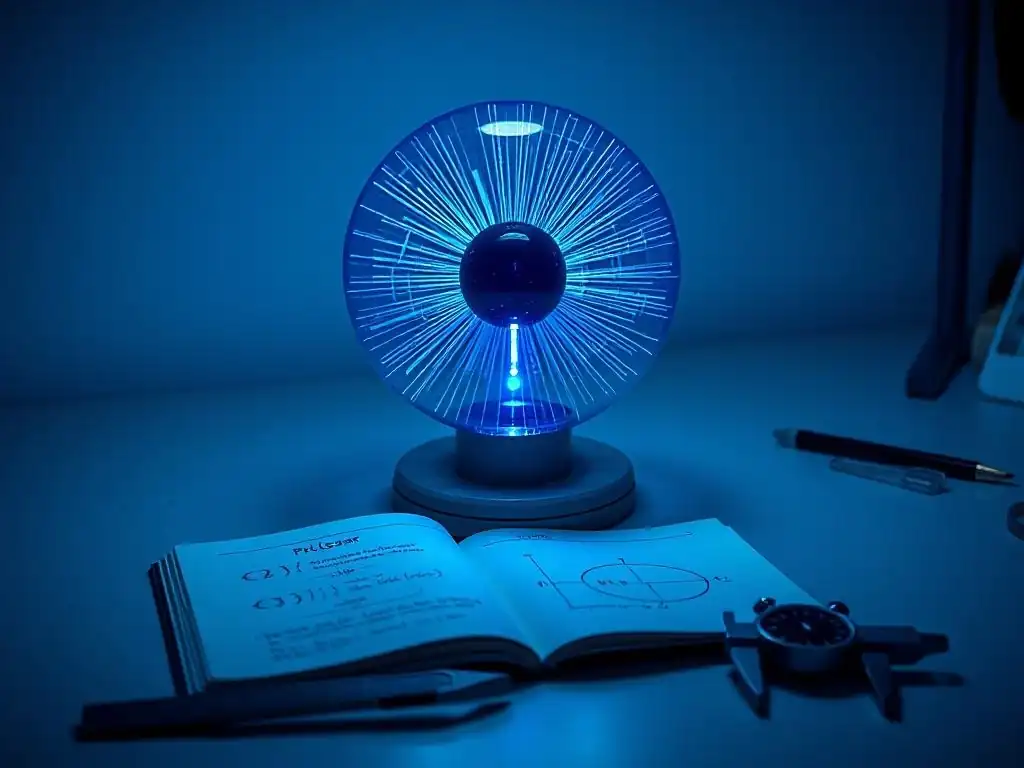
Materials Needed: Constructing a Simple Pulsar Model with Rotating Beam
To construct a basic model demonstrating pulsar emission, students will need readily available materials that simulate the key components: a rotating neutron star and its sweeping radio beam. The following items are recommended:
- A spherical object: A basketball, a styrofoam ball (approximately 8-12 inches in diameter), or a small globe works well to represent the neutron star.
- A light source: A small, bright flashlight or a laser pointer will serve as the pulsar's emission beam.
- A stand or clamp: To hold the spherical object securely, allowing it to rotate. A ring stand with a clamp, a sturdy tripod, or even a modified desk lamp base can be used.
- Means to attach the light source: Duct tape, strong adhesive, or a small clamp to fix the flashlight/laser pointer to the sphere at an angle.
- A dark room or large box: To clearly observe the light beam.
- Optional: A protractor to measure the angle of the light source relative to the sphere's rotation axis.
Step-by-Step Instructions: Demonstrating Pulsar Rotation and Emission Mechanisms
This activity visually explains the "lighthouse model" of pulsar emission:
- Prepare the "Neutron Star": Secure the spherical object onto its stand. Ensure it can rotate freely around a clear axis. This axis represents the pulsar's rotational axis.
- Attach the "Magnetic Beam": Securely attach the flashlight or laser pointer to the surface of the sphere. Crucially, position it so that the beam of light is not aligned with the sphere's rotational axis. Instead, angle it slightly, simulating the offset between a pulsar's magnetic axis and its rotational axis (e.g., 20-30 degrees off-axis).
- Set up the "Observer": Dim the lights in the room or place the model inside a large box to create a dark environment. Designate a fixed point in the room as the "observer" (e.g., a student's eye, a marked spot on a wall).
- Demonstrate Rotation and Emission: Slowly rotate the spherical object around its axis. As it rotates, the beam of light will sweep through space. The "observer" will only see the light beam briefly each time it sweeps past their fixed position, creating a "pulse" of light.
- Experiment with Variables: Encourage students to vary the speed of rotation to simulate different pulsar periods. They can also adjust the angle of the flashlight to see how it affects the detectability of the "pulse" from the observer's perspective.
Discussion Questions: Exploring Pulsar Properties and the Scientific Method
After the hands-on activity, engage students with questions that deepen their understanding of pulsar science and the scientific process exemplified by Jocelyn Bell Burnell's work:
- How does this model demonstrate why astronomers detect pulsars as regular "pulses" of radiation, even though the pulsar is continuously emitting?
- What would happen if the pulsar's magnetic axis were perfectly aligned with its rotational axis? Would an observer on Earth still detect pulses? Why or why not?
- If you were Jocelyn Bell Burnell, how would the extreme regularity of the "pulse" in this model have initially surprised or intrigued you, given what was known about cosmic radio sources at the time?
- How does the process of repeatedly observing the "pulse" from the same direction in the model relate to Bell Burnell's meticulous verification process, which eventually ruled out terrestrial interference?
- Imagine you detect a new "pulsar" signal that is perfectly regular, but then you discover three more similar signals from different parts of the sky. How would this realization, similar to Bell Burnell's experience, lead you to conclude that these are natural astrophysical objects rather than "Little Green Men"?
Further Exploration: Resources for Students and Educators
Online Simulations: Visualizing Pulsar Behavior with the NASA Pulsar Model
For a deeper interactive experience, several online simulations provide excellent visualizations of pulsar behavior. While specific links are not allowed, searching for "NASA pulsar model simulation" or "Interactive pulsar model" will often yield valuable resources. These simulations typically allow users to manipulate various parameters, such as the pulsar's rotation speed, the strength and orientation of its magnetic field, and the observer's viewing angle relative to the pulsar.
By adjusting these variables, students can observe in real-time how changes affect the detected pulse profile and period. This interactive approach helps solidify the "lighthouse model" concept and provides a dynamic understanding of why different pulsars have varying characteristics, enhancing their comprehension of pulsar science beyond static diagrams. Many models also show the relativistic particle jets emanating from the magnetic poles, further illustrating the complex physics at play.
Recommended Reading: "A Universe of Atoms, An Atom in the Universe" by Jocelyn Bell Burnell
For students and educators interested in a firsthand account of the pulsar discovery and the life of its discoverer, Jocelyn Bell Burnell's book, "A Universe of Atoms, An Atom in the Universe" (or similar titles of her published works and lectures), offers invaluable insights. This work goes beyond the scientific details of pulsar science, delving into her personal journey, the challenges she faced as a young woman in a male-dominated scientific field, and her reflections on the nature of scientific discovery itself.
Reading her narrative provides a unique perspective on the human element of groundbreaking research: the perseverance required, the unexpected turns, and the collaborative spirit that often underpins major breakthroughs. It serves as an inspiring testament to intellectual curiosity and resilience, making it a highly recommended resource for anyone interested in the history of astronomy and the role of women in science.
Video Resources: Interviews and Lectures Featuring Jocelyn Bell Burnell on Pulsar Discovery
Numerous video resources are available featuring Jocelyn Bell Burnell discussing her pivotal role in pulsar science. These include interviews where she recounts the moment of discovery, public lectures where she explains the physics of pulsars in an accessible manner, and documentary segments that explore the historical context of her work. Watching these videos offers a unique opportunity to hear directly from the scientist herself.
These visual and auditory resources can bring the story of pulsar science to life, providing context to the initial "Little Green Men" hypothesis and the scientific rigor that led to its rejection. They also offer a powerful insight into Bell Burnell's inspiring personality and her continued advocacy for inclusivity in STEM, making them excellent supplementary materials for any lesson plan on pulsars or women in physics.
Connecting Pulsar Science to Broader Concepts
Pulsars and General Relativity: Testing Gravitational Theories with Binary Pulsars
Pulsars are not just fascinating objects in their own right; they serve as extraordinary cosmic laboratories for testing the most fundamental theories of physics, particularly Einstein's General Theory of Relativity. The extreme gravitational fields and precise timing of pulsars, especially those in binary systems, allow scientists to probe the fabric of spacetime with unparalleled accuracy. A prime example is the Hulse-Taylor binary pulsar, PSR B1913+16, discovered in 1974 by Russell Hulse and Joseph Taylor. This system consists of two neutron stars orbiting each other every 7.75 hours.
By meticulously timing the arrival of pulses from PSR B1913+16 over decades, astronomers observed a subtle, but consistent, decrease in the orbital period. This orbital decay precisely matched the predictions of General Relativity for the energy loss due to the emission of gravitational waves. This observational evidence provided the first indirect confirmation of gravitational waves, a prediction of Einstein's theory, earning Hulse and Taylor the Nobel Prize in Physics in 1993. This groundbreaking work showcased how pulsar science can unlock profound insights into the nature of gravity itself.
Pulsars as Cosmic Clocks: High-Precision Timing and Gravitational Wave Detection
The extraordinary rotational stability of millisecond pulsars (MSPs), with their periods often stable to within a few nanoseconds over years, makes them the most precise natural clocks in the universe. This remarkable precision is harnessed by "Pulsar Timing Arrays" (PTAs) – international collaborations like NANOGrav, the European Pulsar Timing Array (EPTA), and the Parkes Pulsar Timing Array (PPTA). These arrays monitor dozens of MSPs across the galaxy, looking for minute deviations in their pulse arrival times.
These deviations could be caused by the stretching and squeezing of spacetime due to the passage of ultra-low frequency gravitational waves, particularly those originating from supermassive black hole binaries merging in the early universe. In June 2023, several PTAs announced compelling evidence for a gravitational wave background, a hum of gravitational waves permeating the cosmos. This monumental discovery, built upon decades of precise pulsar timing, opens a new window into the universe, allowing us to study phenomena previously undetectable and further cementing the role of pulsar science in modern astrophysics.
The Future of Pulsar Research: Exploring the Equation of State of Neutron Star Matter
The study of pulsars continues to be a vibrant field of research, with ongoing efforts to unravel the mysteries of neutron star interiors. One of the most significant challenges in nuclear physics and astrophysics is determining the "equation of state" (EOS) of super-dense matter—how matter behaves under the extraordinary pressures and densities found within neutron stars, which far exceed anything achievable in terrestrial laboratories. Pulsars, particularly through observations of their masses, radii, and cooling rates, provide crucial constraints on this EOS.
Future missions and next-generation telescopes, such as the Square Kilometre Array (SKA), promise to discover thousands more pulsars, including exotic types like ultra-compact binaries and even more extreme magnetars. These discoveries, combined with observations of neutron star mergers by gravitational wave detectors like LIGO and Virgo, will provide unprecedented data to refine our understanding of the EOS. This will shed light on fundamental questions about the nature of matter, the strong nuclear force, and the ultimate fate of massive stars, demonstrating the enduring relevance of pulsar science.
Conclusion: The Enduring Legacy of Pulsar Science and Jocelyn Bell Burnell
Celebrating Scientific Curiosity, Perseverance, and Inclusivity
The story of pulsar science, inextricably linked with the pioneering work of Jocelyn Bell Burnell, is a powerful testament to the core tenets of scientific inquiry. It celebrates the profound importance of keen observation, as Bell Burnell's meticulous attention to anomalous data led to a discovery that reshaped astrophysics. It underscores the value of scientific curiosity, which compelled the team to pursue the "Little Green Men" hypothesis, however outlandish, before systematically ruling it out through rigorous investigation.
Moreover, Bell Burnell's journey exemplifies remarkable perseverance in the face of both scientific challenges and societal biases. Her enduring legacy is not just in the discovery of pulsars, but in her unwavering advocacy for inclusivity in science, inspiring countless individuals, particularly women and underrepresented groups, to pursue their scientific passions. Her work reminds us that groundbreaking discoveries often arise from unexpected places and that a diverse scientific community is essential for truly comprehensive understanding.
Inspiring Future Women in Physics and Astronomy.
Jocelyn Bell Burnell's pivotal role in the discovery of pulsars serves as an enduring beacon for aspiring scientists, especially for future women in physics and astronomy. Her experience highlights both the immense potential for intellectual contribution at all levels of scientific research and the historical challenges faced by women in STEM fields. By overcoming these obstacles and continuing to contribute profoundly to science and society, Bell Burnell has become a powerful role model.
Her story encourages young women to embrace their scientific curiosity, to persist in the face of doubt, and to confidently pursue careers in fields like pulsar science, radio astronomy, and theoretical physics. The Women in Science History platform aims to amplify such narratives, ensuring that the groundbreaking contributions of women like Jocelyn Bell Burnell are celebrated, understood, and continue to inspire a new generation to explore the universe and push the boundaries of human knowledge.
Frequently Asked Questions
What role did Jocelyn Bell Burnell play in the discovery of pulsars?
Jocelyn Bell Burnell, as a graduate student, initially discovered the unusual signal while analyzing data from a radio telescope. She identified the regularity of the pulses, which led to the realization they were something new.
What are pulsars, and why were they initially nicknamed "Little Green Men"?
Pulsars are highly magnetized, rotating neutron stars that emit beams of electromagnetic radiation. They were initially nicknamed "Little Green Men" because the regularity of the signals seemed potentially artificial, suggesting extraterrestrial intelligence.
What challenges did Jocelyn Bell Burnell face as a woman in science during her time?
Bell Burnell faced the gender biases prevalent in academia at the time. Despite her crucial role, her advisor, Antony Hewish, received the Nobel Prize for the discovery, while she was not recognized.
How does "WomenInScienceHistory.com" highlight Jocelyn Bell Burnell's story?
The website features a biography discussing her pioneering work and the challenges she overcame in a male-dominated field. It aims to inspire future generations by showcasing her contributions.
Why is it important to celebrate the achievements of women like Jocelyn Bell Burnell in science history?
Celebrating their achievements helps correct historical imbalances and recognize overlooked contributions. It also encourages more women to pursue careers in STEM fields, fostering a more diverse and inclusive scientific community.
Final Reflection: Echoes of Discovery
The journey through the science of pulsars and the groundbreaking work of Jocelyn Bell Burnell reveals more than just celestial mechanics; it illuminates the enduring power of curiosity-driven research and its profound impact on our understanding of the universe. From the initial, almost whimsical, identification of "Little Green Men" to the sophisticated models we have today, the story of pulsars serves as a potent reminder that scientific breakthroughs often emerge from unexpected places.
The legacy of Jocelyn Bell Burnell extends far beyond the discovery itself. It underscores the importance of recognizing and celebrating the contributions of all scientists, regardless of their background or status. Her experience serves as a poignant reminder of the systemic biases that can hinder scientific progress and the ongoing need for greater inclusivity in STEM fields. It is sometimes said that people don't make discoveries, science makes discoveries. I think that's probably true.
This quote encapsulates the humility and collaborative spirit that should guide scientific endeavors, urging us to appreciate the collective effort behind every advancement.
As we gaze at the night sky, let us not only marvel at the beauty of the cosmos, but also reflect on the human stories behind the discoveries that have shaped our understanding of it. Consider how you can champion inclusivity and support the next generation of scientists, ensuring that their voices are heard and their contributions valued. The echoes of Jocelyn Bell Burnell's discovery resonate still; let us amplify them by fostering a more equitable and inspiring scientific landscape for all.
Unveil the Mysteries of the Cosmos!
Thank you for exploring the fascinating world of pulsars and the groundbreaking work of Jocelyn Bell Burnell! Now that you've glimpsed the universe's hidden wonders, it's time to take your curiosity a step further.
Here's how you can continue your cosmic journey:
- Dive deeper: Explore a collection of scientific papers and articles related to pulsars. Use keywords like "pulsar timing arrays," "neutron stars," and "radio astronomy" to unearth more knowledge.
- Share your newfound insights! Spread the word about Jocelyn Bell Burnell's story and the amazing science of pulsars on your favorite social media platform. Inspire others to look up!
- Visit a planetarium (even virtually)! Most planetariums host shows on similar topics and can offer even greater understanding of Jocelyn's work and discoveries.
What other women in science history should we uncover next? Share your thoughts in the comments below!