
Unlocking the Universe: The Role of Women in 19th Century Cosmological Physics

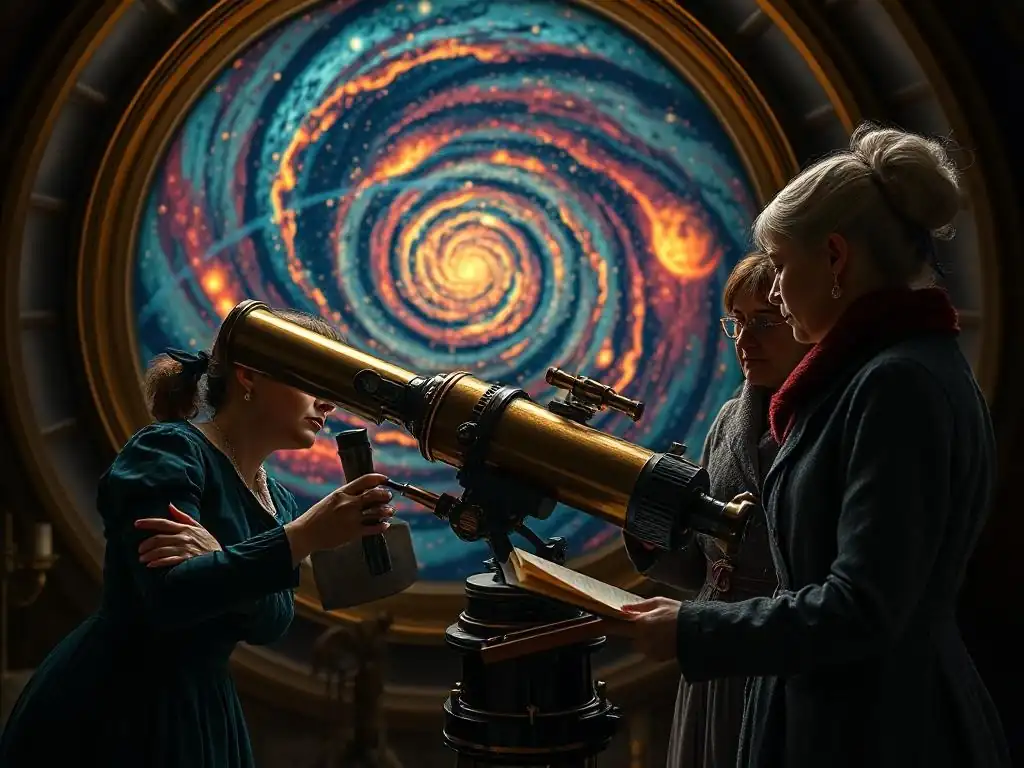
Welcome to WomenInScienceHistory.com!
Prepare to be amazed by the untold stories of brilliance and perseverance. This site shines a light on the remarkable women who shaped scientific understanding throughout history. Today, we delve into the captivating realm of cosmology and uncover the significant, yet often unacknowledged, contributions of women in cosmology during the 19th century. What groundbreaking theories did they help shape, and what obstacles did they overcome in a world that often overlooked their genius? Explore the article below to discover their fascinating journey!
- Introduction: Women's Pioneering Contributions to 19th Century Cosmology
- The Landscape of 19th Century Cosmological Physics
- Notable Women in 19th Century Cosmology: Breaking Barriers
- The Challenges Faced by Women in 19th Century Physics
- The Impact of Women's Work on the Development of Cosmology
- Rediscovering and Celebrating Women in 19th Century Cosmology
- Conclusion: The Unsung Heroines of 19th Century Cosmological Physics
-
Frequently Asked Questions
- What role did women play in 19th-century cosmology?
- What challenges did women face in pursuing cosmology in the 19th century?
- Can you name a specific example of a woman who contributed to cosmology in the 19th century?
- How did the contributions of women in the 19th century pave the way for future generations of female cosmologists?
- Why is it important to highlight the contributions of women in 19th-century cosmology today?
- Final Reflection: Illuminating Forgotten Stars
- Ignite Your Inner Astronomer: Explore the Cosmos Now!
Introduction: Women's Pioneering Contributions to 19th Century Cosmology
The Underrepresentation of Women in 19th Century Science: A Historical Overview
The 19th century marked a period of significant scientific advancement, yet the landscape of formal scientific institutions remained largely inaccessible to women. Universities, learned societies, and professional research laboratories were predominantly male domains, creating formidable barriers for women aspiring to careers in physics, astronomy, or any scientific field. This systemic exclusion meant that the intellectual contributions of many brilliant women went unrecognized, or their work was relegated to informal, often unpaid, roles as assistants or popularizers.
Despite these pervasive limitations, a select few women managed to carve out spaces for themselves, often through self-education, family connections, or by excelling in areas like observational astronomy that could be pursued from home or private observatories. Their struggle highlights not only the prevailing societal norms that confined women to domestic spheres but also the immense personal dedication and intellectual prowess required to overcome such deeply entrenched obstacles. The stories of these pioneering women in cosmology 19th century are crucial for a complete understanding of scientific progress during this era.
The Landscape of 19th Century Cosmological Physics
Key Theories and Discoveries Shaping 19th Century Cosmology
The 19th century was a dynamic period for cosmological thought, transitioning from a largely static Newtonian universe to one grappling with concepts of vast scales, stellar evolution, and the nature of nebulae. Key developments included the refinement of stellar parallax measurements, which provided the first reliable distances to stars beyond our solar system, confirming the immense scale of the cosmos. Astronomers like Friedrich Bessel, who in 1838 measured the parallax of 61 Cygni, provided concrete evidence that stars were distant suns.
Furthermore, the century saw intense debate and observation regarding nebulae. While some, like William Herschel in the late 18th century, had suggested these were "island universes" (galaxies), others believed they were simply gaseous clouds within our own Milky Way. The development of spectroscopy by Gustav Kirchhoff and Robert Bunsen in the mid-19th century allowed scientists to analyze the chemical composition of celestial bodies, providing unprecedented insights into stellar processes and the composition of nebulae, thereby laying groundwork for modern astrophysics and expanding the scope of 19th-century cosmological physics.
The Prevailing Scientific Culture and its Impact on Women
The scientific culture of the 19th century was characterized by its professionalization and institutionalization, which paradoxically served to exclude women. Scientific societies, such as the Royal Society of London or the French Academy of Sciences, rarely admitted women as full members, effectively denying them access to crucial networks, funding, and platforms for disseminating their research. Women were often relegated to supportive roles, such as illustrators, calculators, or assistants to their male relatives, with their intellectual contributions frequently uncredited or attributed to men.
Educational opportunities were also severely restricted. While a few pioneering institutions began to open their doors to women towards the latter half of the century, access to advanced scientific training, particularly in fields like physics or mathematics, remained exceptionally rare. This systemic exclusion meant that women who pursued scientific endeavors often did so against immense societal pressure, relying on self-study, private tutors, or the patronage of enlightened individuals. This challenging environment underscores the remarkable achievements of women in cosmology 19th century who managed to make significant impacts.
Notable Women in 19th Century Cosmology: Breaking Barriers
Maria Mitchell: Contributions to Astronomy and Comet Discovery
Early Life and Education: Overcoming Societal Obstacles
Maria Mitchell (1818–1889) was born into a Quaker family on Nantucket Island, Massachusetts, a community known for its progressive views on education for girls. Her father, William Mitchell, a passionate amateur astronomer and schoolteacher, played a pivotal role in her early scientific development, teaching her mathematics, navigation, and practical astronomy using his own instruments. Unlike many girls of her era, Maria received an unusually rigorous education, assisting her father with his astronomical observations and calculations from a young age.
Despite the lack of formal university education available to women, Mitchell's intellectual curiosity and observational skills flourished. By age 12, she was assisting her father in calculating the precise times of eclipses and mapping star positions. This hands-on, practical approach to learning, combined with her father's mentorship, provided her with the foundational knowledge and experience that would enable her to make significant contributions to the field, challenging the notion that advanced scientific work was beyond the capabilities of women.
Scientific Contributions: Comet Discovery and Astronomical Observations
Maria Mitchell's most famous scientific achievement occurred in 1847 when she discovered a new comet, later designated C/1847 T1, or "Miss Mitchell's Comet." This discovery earned her international recognition, including a gold medal from King Christian VIII of Denmark, a prize offered for the first discovery of a telescopic comet by a woman. This groundbreaking observation not only solidified her reputation but also brought her to the attention of the wider scientific community, marking a significant moment for women in cosmology 19th century.
Beyond her comet discovery, Mitchell engaged in extensive astronomical observations, meticulously documenting sunspots, nebulae, and double stars. Her work was characterized by its precision and dedication. She became the first woman elected to the American Academy of Arts and Sciences in 1848 and later, in 1865, became the first professor of astronomy at Vassar College, where she established an observatory and championed experiential learning for her students. Her rigorous approach to observation provided valuable data that contributed to the overall understanding of celestial mechanics and the structure of the universe.
Legacy and Recognition
Maria Mitchell's legacy extends far beyond her singular comet discovery. She was a tireless advocate for women's education and their participation in science, becoming a role model for countless aspiring female scientists. At Vassar, she not only taught but also mentored generations of young women, encouraging them to pursue scientific careers and challenging the prevailing gender stereotypes of the time. Her insistence on hands-on learning and her commitment to fostering a scientific community among her students left an indelible mark.
Her work helped to demonstrate that women were fully capable of rigorous scientific inquiry and discovery, directly impacting the perception of women in cosmology 19th century. Mitchell's life and career serve as a powerful narrative of perseverance and intellectual excellence, paving the way for future generations of women to enter scientific fields previously closed to them. Her contributions underscored the importance of observational astronomy in shaping our understanding of the cosmos.
Caroline Herschel: Exploring Nebulae and Assisting in Astronomical Discoveries
Navigating the Challenges of a Male-Dominated Field
Caroline Herschel (1750–1848) faced immense challenges in establishing her scientific career, primarily due to the societal expectations for women in 18th and early 19th century Europe. Initially brought from Hanover to England to manage her brother William Herschel's household and singing career, she gradually transitioned into becoming his indispensable astronomical assistant. While her brother's renown provided a unique entry point into the scientific world, her contributions were often seen as secondary or merely supportive, typical of the unacknowledged roles for women in cosmology 19th century.
Despite these limitations, Caroline demonstrated extraordinary dedication and skill, mastering complex astronomical calculations and spending countless hours assisting William with his telescope construction and observations. She learned to grind and polish telescope mirrors and became proficient in recording observations, often working through the night in harsh conditions. Her perseverance in this demanding, male-dominated field, against the backdrop of societal norms that discouraged women from intellectual pursuits, highlights her exceptional commitment to science.
Research on Nebulae and Catalogs
Caroline Herschel's independent scientific contributions are particularly significant for their focus on nebulae and star clusters, which were central to the burgeoning field of cosmology. From 1786 to 1797, she discovered eight new comets, including the first comet discovered by a woman, and made numerous independent astronomical observations. More importantly, she meticulously re-examined and cataloged thousands of nebulae and star clusters that her brother William had observed.
Her most significant work was the compilation of a comprehensive "Catalogue of Stars, taken from Mr. Flamsteed's Observations" (1798), which included an index of 561 new nebulae and clusters, adding to her brother's earlier catalogs. This systematic cataloging was crucial for future astronomical research, providing organized data that helped astronomers understand the distribution and nature of these distant objects. Her rigorous approach to observation and data organization significantly advanced the understanding of the universe's structure, solidifying her place among the foundational women in cosmology 19th century.
Impact on Modern Cosmology
Caroline Herschel's meticulous observational work and cataloging directly impacted the development of modern cosmology by providing foundational data for understanding the vastness and structure of the universe. Her catalogs of nebulae, alongside her brother's, laid the groundwork for later studies that would eventually distinguish between gaseous nebulae within our galaxy and distant island universes (galaxies). Her dedication to systematic observation contributed to a more organized and comprehensive view of the cosmos.
Her work also challenged prevailing notions about women's intellectual capabilities, demonstrating that women could perform rigorous scientific research and make original discoveries. In 1828, she received the Gold Medal of the Royal Astronomical Society, making her the first woman to be so honored, a testament to the undeniable quality and significance of her contributions. Her persistence and achievements continue to inspire, highlighting the often-overlooked but crucial roles of women in cosmology 19th century.
Mary Somerville: Advancing Scientific Understanding Through Writing and Translation
Family Background and its Influence on Scientific Pursuits
Mary Somerville (1780–1872) was born into a Scottish aristocratic family, a background that, while providing some intellectual stimulation, also imposed the conventional expectations for women of her social standing: marriage and domesticity. Despite limited formal schooling for girls, her innate curiosity and intellectual prowess led her to pursue self-education in mathematics and astronomy, often in secret. Her early intellectual development was largely self-driven, reading books on navigation and classical texts on mathematics.
Her first marriage to Samuel Greig, though brief, allowed her access to a library and financial independence, which she used to further her studies. It was her second marriage to William Somerville, a physician and scientist, that truly enabled her scientific career. He recognized and supported her intellectual ambitions, providing her with access to scientific circles and encouraging her to pursue her studies openly. This supportive environment was critical for a woman in the 19th century to transcend societal barriers and engage deeply with scientific ideas.
Work on Translating and Popularizing Scientific Texts
Mary Somerville's most significant contribution to 19th-century cosmology and science broadly was her remarkable ability to translate and popularize complex scientific concepts for a wider audience. Her first major work, "Mechanism of the Heavens" (1831), was a translation and simplification of Pierre-Simon Laplace's monumental five-volume Mécanique Céleste. Laplace's work was incredibly dense and mathematically challenging, even for trained scientists, and Somerville's lucid explanation made its profound insights into celestial mechanics accessible to English-speaking scholars.
This work was hailed for its clarity and accuracy, quickly becoming a standard textbook at Cambridge University. She followed this with "On the Connexion of the Physical Sciences" (1834), an ambitious synthesis of various branches of physical science, including astronomy, optics, heat, and magnetism. This book was a groundbreaking attempt to demonstrate the underlying unity of physical laws, a concept central to the development of modern physics and cosmology. Her ability to synthesize and communicate complex ideas played a vital role in disseminating advanced scientific knowledge, enriching the understanding of the universe for many.
Recognition within the Scientific Community
Mary Somerville's exceptional intellect and her ability to bridge the gap between highly specialized scientific research and a broader educated public earned her considerable recognition within the scientific community, a rare feat for women in cosmology 19th century. She was elected an honorary member of the Royal Astronomical Society in 1835, alongside Caroline Herschel, becoming one of the first two women to receive this distinction. This acknowledgment was a testament to the profound impact of her publications.
Her influence extended beyond her direct scientific contributions; she served as a mentor and inspiration for many, including Ada Lovelace. Her writings were widely read and admired, demonstrating that profound scientific understanding could be articulated with clarity and elegance. Somerville College at Oxford University, founded in 1879, was named in her honor, solidifying her enduring legacy as a pioneer who broadened access to scientific knowledge and championed the intellectual capabilities of women.
The Challenges Faced by Women in 19th Century Physics

Limited Access to Education and Research Opportunities
One of the most formidable barriers for women aspiring to careers in 19th-century physics and cosmology was the severe limitation on their access to formal education and research facilities. Universities, the primary hubs of advanced scientific training and research, were almost exclusively male institutions for much of the century. Women were generally denied admission to degree programs, lectures, and laboratories, effectively preventing them from acquiring the foundational knowledge and practical skills necessary for cutting-edge scientific work.
Even when informal opportunities arose, such as private tutelage or self-study, women lacked access to specialized equipment, observatories, and the collaborative research environments that were crucial for scientific progress. This systemic exclusion meant that brilliant minds were often confined to domestic spheres or relegated to unpaid, uncredited roles as assistants, severely limiting their potential to contribute to the rapidly evolving fields of physics and astronomy, and specifically, to the developing understanding of the universe.
Societal Expectations and Gender Bias in Science
Beyond institutional barriers, women in the 19th century faced pervasive societal expectations that confined them to roles as wives, mothers, and homemakers, viewing intellectual pursuits, especially in rigorous scientific fields, as unfeminine or even detrimental to their health. The prevailing belief was that women lacked the intellectual capacity for complex scientific reasoning or that such study would detract from their domestic duties. This deeply ingrained gender bias often led to ridicule, dismissal, or outright hostility towards women who dared to pursue scientific careers.
Scientific societies and publications, dominated by men, often perpetuated these biases, making it difficult for women to publish their work under their own names or to gain recognition for their discoveries. For instance, some of Caroline Herschel's initial contributions were implicitly subsumed under her brother's achievements. This cultural climate created an isolating and discouraging environment, requiring extraordinary resilience and determination for any woman to establish herself as a credible scientist in 19th-century cosmological physics.
Overcoming Discrimination and Building Scientific Careers
Despite these immense obstacles, the women who managed to build scientific careers in the 19th century did so through a combination of exceptional talent, relentless perseverance, and often, the support of enlightened family members or mentors. Maria Mitchell, for example, benefited from her father's progressive views and direct tutelage, which provided her with an education far beyond what was typical for girls. Similarly, Mary Somerville's second husband actively encouraged her intellectual pursuits and provided access to scientific networks.
These women often had to create their own opportunities, whether through private observatories, self-published translations, or by excelling in niche areas like computational astronomy that could be performed from home. Their success was not just about making scientific discoveries; it was also about challenging deeply entrenched prejudices and demonstrating, through their work, that intellectual capacity was not limited by gender. Their struggles highlight the systemic discrimination prevalent at the time, making their achievements as women in cosmology 19th century even more remarkable.
The Impact of Women's Work on the Development of Cosmology
How Women's Research Expanded our Understanding of the Universe
The contributions of women like Maria Mitchell, Caroline Herschel, and Mary Somerville significantly expanded the 19th century's understanding of the universe, despite the barriers they faced. Mitchell's meticulous observational work, including her comet discovery and sunspot observations, contributed to the growing body of data on celestial mechanics and solar activity. Her pedagogical methods at Vassar also inspired a new generation of observational astronomers, many of whom were women, who continued to map and analyze the cosmos.
Caroline Herschel's systematic cataloging of nebulae and star clusters provided crucial data that helped astronomers grapple with the scale and structure of the Milky Way and the nature of these fuzzy celestial objects. Her work contributed to the eventual realization that some nebulae were, in fact, distant galaxies. Mary Somerville's brilliant translations and syntheses of complex scientific theories, particularly Laplace's Mécanique Céleste, democratized access to the most advanced cosmological theories of the time, enabling a wider audience to grasp the mathematical elegance describing planetary motions and gravitational interactions across the universe.
Challenging Existing Theories and Paving the Way for Future Discoveries
While not always directly formulating new cosmological theories, the work of these women often provided the empirical data or the intellectual infrastructure necessary to challenge existing paradigms and pave the way for future discoveries. Caroline Herschel's rigorous observational catalogs, for instance, contributed to the ongoing debate about the nature of nebulae, providing the detailed empirical foundation that would eventually lead to the "island universe" theory gaining widespread acceptance in the 20th century. Her work helped to shift perspectives from a geocentric or even galactic-centric view to a more expansive understanding of the cosmos.
Mary Somerville's comprehensive syntheses, by demonstrating the interconnectedness of various physical sciences, encouraged a holistic approach to understanding the universe. Her ability to popularize complex mathematical astronomy meant that a broader intellectual base was prepared to engage with and build upon the theoretical frameworks that described the universe's mechanics. These foundational contributions, often overlooked, were critical stepping stones for the subsequent development of astrophysics and modern cosmology, underscoring the profound impact of women in cosmology 19th century.
The Enduring Legacy of 19th Century Female Cosmologists
The enduring legacy of 19th-century female cosmologists lies not only in their individual scientific achievements but also in their collective role as pioneers who broke significant ground for women in science. Their perseverance in the face of systemic discrimination proved that intellectual capacity and scientific talent were not gender-specific. Their work demonstrated the vital importance of observational astronomy, mathematical rigor, and scientific communication in advancing cosmological understanding.
Today, their stories serve as powerful reminders of the historical barriers women faced and the immense contributions they made despite those challenges. Colleges, observatories, and scientific societies now bear their names, honoring their memory and their foundational roles in shaping our understanding of the universe. The achievements of these women in cosmology 19th century continue to inspire and inform contemporary efforts to promote diversity and inclusion in STEM fields, ensuring that future generations of scientists, regardless of gender, have the opportunity to unlock the universe's mysteries.
Rediscovering and Celebrating Women in 19th Century Cosmology
The Importance of Recognizing and Honoring their Achievements
Recognizing and honoring the achievements of women in 19th-century cosmology is crucial for several reasons. Firstly, it provides a more accurate and complete historical narrative of scientific progress, acknowledging the contributions that were often marginalized or erased. By highlighting their work, we correct historical omissions and ensure that the full spectrum of intellectual endeavor in the 19th century is appreciated. This recognition not only gives these pioneering women their rightful place in history but also enriches our understanding of how scientific knowledge evolved.
Secondly, celebrating these achievements inspires current and future generations. For young women contemplating careers in STEM, seeing historical figures like Maria Mitchell or Caroline Herschel who overcame immense odds can be incredibly empowering. It demonstrates that excellence knows no gender and that dedication and intellect can surmount societal barriers. This historical recognition is vital for fostering an inclusive scientific community that values talent from all backgrounds, encouraging more women to pursue careers in physics and cosmology.
Resources for Further Research on Women in 19th Century Physics
For those interested in delving deeper into the lives and work of women in 19th-century physics and astronomy, a growing body of resources is available. Academic biographies, such as those detailing the correspondence and scientific papers of Maria Mitchell or Mary Somerville, offer invaluable insights into their daily lives, research methods, and the challenges they encountered. University archives and special collections often hold primary source materials, including personal letters, observational notebooks, and early publications, which provide direct windows into their scientific practices.
Furthermore, digital humanities projects and online databases dedicated to the history of women in science are increasingly making these stories accessible. Institutions like the Royal Astronomical Society's archives or university libraries with strong science history collections are excellent starting points for in-depth research. These resources are essential for anyone seeking to understand the intricate details of how women in cosmology 19th century contributed to the scientific landscape.
Inspiring Future Generations of Female Scientists Through Historical Narratives
The historical narratives of women in 19th-century cosmology serve as powerful tools for inspiring future generations of female scientists. By sharing stories of resilience, intellectual brilliance, and groundbreaking discoveries, we can counter persistent stereotypes about who can be a scientist. For instance, the story of Maria Mitchell, who discovered a comet and became America's first female professor of astronomy, demonstrates that a lack of formal opportunities can be overcome by sheer talent and determination.
These narratives provide tangible examples of women excelling in fields that were largely closed to them, thereby showing young girls and women that they too can pursue their passions in science, technology, engineering, and mathematics (STEM). Emphasizing the challenges these women faced, and how they overcame them, also equips future scientists with a sense of historical context and the understanding that progress often requires persistence against adversity. This historical perspective is crucial for fostering a diverse and inclusive scientific community that continues to push the boundaries of knowledge.
Conclusion: The Unsung Heroines of 19th Century Cosmological Physics
A Call to Action: Continuing to Support and Empower Women in STEM
The stories of women in 19th-century cosmological physics serve as a powerful reminder of the untapped potential and invaluable contributions that can be lost when systemic barriers exclude entire groups from scientific endeavors. While significant progress has been made, women continue to be underrepresented in many STEM fields, particularly in leadership roles and certain branches of physics and engineering. Therefore, a crucial call to action remains: to actively support and empower women in STEM today.
This involves dismantling remaining biases, ensuring equitable access to education and research opportunities from early schooling through advanced degrees, and fostering inclusive scientific environments where women feel valued and supported. Mentorship programs, scholarships, and policies that address work-life balance are vital components of this ongoing effort. By actively championing women in STEM, we ensure that the scientific community benefits from the full spectrum of human talent, accelerating discovery and innovation.
The Enduring Relevance of their Contributions to Modern Science
The contributions of 19th-century female cosmologists, though often made under challenging circumstances, hold enduring relevance for modern science. Their meticulous observational data, systematic cataloging, and ability to synthesize complex theories provided foundational elements upon which 20th and 21st-century astrophysics and cosmology have been built. For instance, the detailed star charts and nebulae catalogs compiled by Caroline Herschel were precursors to the vast astronomical databases used by today's researchers to study galaxy evolution and the large-scale structure of the universe.
Moreover, their legacy extends beyond specific scientific facts. These women demonstrated the power of perseverance, self-education, and the critical importance of communicating scientific knowledge to a broader audience. Their pioneering spirit continues to inspire those who strive to push the boundaries of understanding the cosmos, reminding us that every contribution, no matter how historically marginalized, plays a role in the grand narrative of scientific progress. The efforts of women in cosmology 19th century laid crucial groundwork for the expansive universe we understand today.
Frequently Asked Questions
What role did women play in 19th-century cosmology?
Women in the 19th century contributed significantly to cosmology, often as computers analyzing astronomical data and making crucial calculations for male astronomers. While often unrecognized, their work was essential for advancing our understanding of the universe.
What challenges did women face in pursuing cosmology in the 19th century?
Women faced significant barriers, including limited access to education and research positions. They were often relegated to support roles, and their contributions were frequently overlooked or attributed to their male colleagues.
Can you name a specific example of a woman who contributed to cosmology in the 19th century?
While few became publicly known as cosmologists, many women astronomers, like Williamina Fleming, contributed to related fields. Her work on stellar classification and discovering nebulae aided in the development of cosmological theories, and she was the first woman to be appointed Curator of Astronomical Photographs at Harvard.
How did the contributions of women in the 19th century pave the way for future generations of female cosmologists?
Their dedication and perseverance helped to break down barriers and demonstrate women's capabilities in scientific fields. This created a foundation for greater opportunities for women in science in later centuries.
Why is it important to highlight the contributions of women in 19th-century cosmology today?
Highlighting their contributions helps to correct historical biases and ensure a more complete and accurate understanding of scientific history. It also serves to inspire future generations of women to pursue careers in science, technology, engineering, and mathematics (STEM) fields.
Final Reflection: Illuminating Forgotten Stars
The journey through the lives and contributions of women in 19th-century cosmological physics reveals a profound truth: history often obscures brilliance. While their names may not be as widely recognized as their male counterparts, their intellectual rigor and dedication undeniably shaped our understanding of the universe. Their stories, unearthed from the archives, serve as a powerful reminder of the systemic barriers that women faced and the extraordinary resilience they demonstrated in the pursuit of knowledge.
The enduring impact of these women extends far beyond the scientific realm. Their perseverance in the face of adversity serves as a beacon for future generations, inspiring us to challenge preconceived notions and advocate for inclusivity in all fields. Their contributions, though often marginalized, laid the groundwork for many of the cosmological advancements we celebrate today. The important thing is not to stop questioning. Curiosity has its own reason for existing.
- Albert Einstein, a sentiment that perfectly encapsulates the spirit of these pioneering women.
As we close this chapter, let us not simply admire these forgotten stars, but actively work to ensure that their stories are told and their contributions are celebrated. Consider how you can champion inclusivity and equity in your own sphere of influence. How can you ensure that the voices of marginalized individuals are heard and valued? Let the legacy of these 19th-century women in cosmology inspire you to create a more just and equitable future, where brilliance knows no gender and the universe is truly open to all.
Ignite Your Inner Astronomer: Explore the Cosmos Now!
Thank you for delving into the fascinating world of 19th-century women in cosmological physics! We hope you've discovered a new appreciation for their groundbreaking contributions. Now, take inspiration from their dedication and continue your own journey of discovery:
- Delve deeper into the life and works of a 19th-century woman physicist. Visit your local library or an online archive to uncover her story and legacy.
- Share this article with friends and family to amplify the voices of these often-overlooked pioneers in science history.
- Consider supporting organizations that promote women in STEM fields and help to inspire the next generation of female scientists.
What small step will you take today to honor the legacy of these pioneering women and contribute to a more equitable future for science?