
From Enlightenment Salons to Modern Blogs: Tracing Women's Enduring Role in SciComm

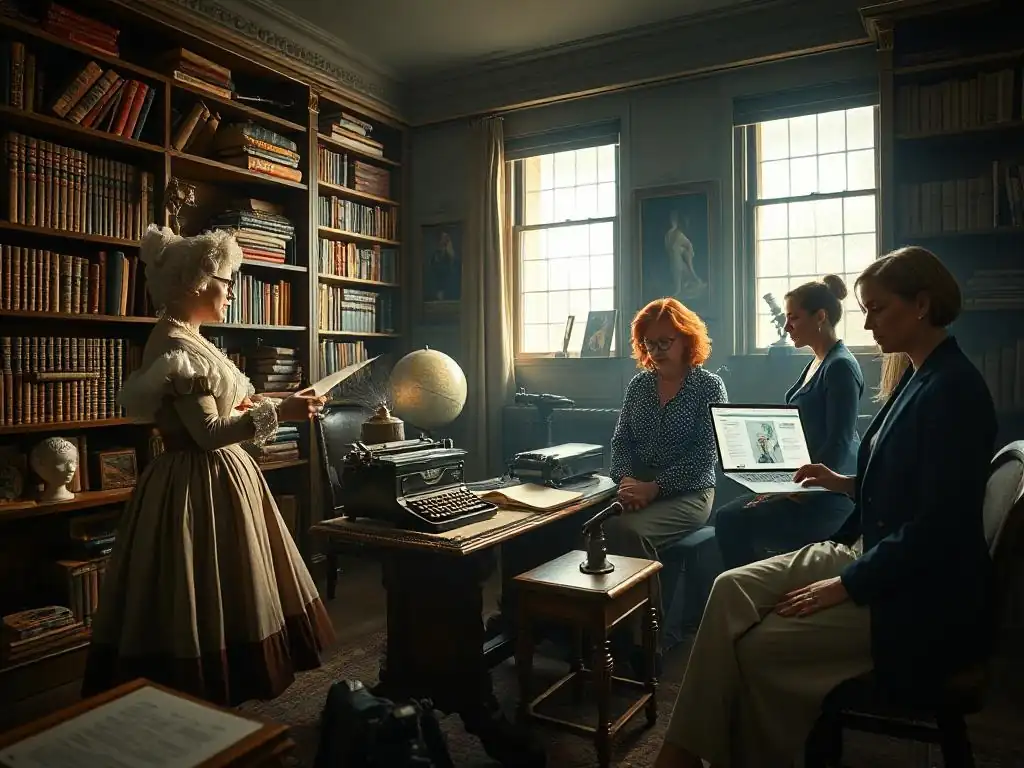
Welcome to WomenInScienceHistory.com!
Dive into the fascinating world where scientific discovery meets untold stories. This month, we're exploring Women’s Science Communication History Trends, uncovering how women have shaped the narrative of science through the ages. From the hushed salons of the Enlightenment to the vibrant digital landscapes of today, discover the enduring legacy of women in sharing scientific knowledge. Are you ready to unearth their vital contributions?
Introduction: Women's Impact on Science Communication Through the Ages
For centuries, women have played an indispensable, though often understated, role in shaping public understanding of scientific advancements. From the informal intellectual gatherings of the Enlightenment to the dynamic digital platforms of today, women have consistently found innovative ways to bridge the gap between complex scientific discoveries and the broader public. Their contributions span various formats, from translating intricate scientific texts to crafting popular science books, educating in classrooms, and pioneering new forms of digital outreach.
Understanding "women’s science communication history trends" reveals not just their individual brilliance but also the systemic barriers they often faced and ingeniously circumvented. This journey through time illuminates how women, often excluded from formal scientific institutions, forged their own paths to disseminate knowledge, inspire curiosity, and challenge prevailing norms. Their enduring influence has been crucial in democratizing science and fostering a more scientifically literate society.
- What were some of the earliest forms of science communication for women, as highlighted in the article?
- How did the historical gender dynamics in science impact women's opportunities in science communication?
- What role do modern blogs and online platforms play in women's science communication today?
- Does the website "WomenInScienceHistory.com" focus solely on historical figures, or does it also address contemporary issues?
- What are some of the key trends in women's science communication history that the article "From Enlightenment Salons to Modern Blogs: Tracing Women's Enduring Role in SciComm" identifies?
The Enlightenment Salon: A Crucible for Women in Early Science Communication
The Salonnière: Facilitating Scientific Discourse in the 18th Century
In 18th-century Europe, particularly in France, the intellectual salon emerged as a pivotal space for cultural and scientific exchange, and at its heart was the "salonnière." These influential women, often from aristocratic or wealthy backgrounds, hosted regular gatherings in their homes, inviting leading philosophers, scientists, writers, and artists. Unlike formal academies, which largely excluded women, salons provided an informal yet vibrant environment where new scientific theories, experimental results, and philosophical debates could be discussed and popularized among an educated elite.
The salonnière's role was more than just hosting; she curated the guest list, steered conversations, and fostered an atmosphere of intellectual camaraderie that was conducive to the free flow of ideas. This informal networking was crucial for the early "women’s science communication history trends," allowing for the rapid dissemination of scientific thought and the cultivation of intellectual communities outside traditional academic structures. They effectively became the first public relations agents for science, making it fashionable and accessible.
Key Female Figures in Enlightenment Science Salons: Madame Geoffrin, Emilie du Châtelet
Marie Thérèse Rodet Geoffrin, known as Madame Geoffrin, ran one of the most famous and influential Parisian salons from around 1749 until her death in 1777. Her salon was a hub for Enlightenment thinkers, including Diderot and d'Alembert, the principal editors of the monumental Encyclopédie.
Madame Geoffrin not only provided a meeting place but also financially supported the Encyclopédie's publication, a massive undertaking that aimed to compile and disseminate all human knowledge, including vast scientific information. Her salon served as a vital platform for the Encyclopédie's ideas to be discussed, refined, and spread, demonstrating a significant early "women’s science communication history trend."
Another towering figure was Émilie du Châtelet, a polymath who was not only a prominent salonnière but also a brilliant mathematician and physicist. Her most significant contribution to science communication was her French translation and commentary of Isaac Newton's Principia Mathematica, published posthumously in 1759.
This wasn't merely a linguistic transfer; her extensive annotations, clarifications, and original derivations made Newton's complex work understandable to a wider French-speaking audience, including Voltaire, with whom she had a long intellectual partnership. Du Châtelet's rigorous work exemplifies how women actively participated in and shaped the scientific discourse of their time, a critical moment in "women’s science communication history trends."
Salons served as a crucial avenue for women's intellectual participation in an era when formal educational and professional opportunities were largely denied to them. Within these informal settings, women could engage directly with leading scientists, learn about cutting-edge discoveries, and even contribute to discussions on an equal footing. This direct engagement allowed them to absorb and then disseminate scientific knowledge within their social circles, acting as informal educators and popularizers.
Furthermore, the networks forged in salons often provided women with opportunities to publish their own works, albeit sometimes anonymously or under male patronage. For instance, some salonnières facilitated the publishing of scientific texts or even contributed anonymously to scientific journals or popular almanacs. This empowerment, though constrained by societal norms, marked a significant step in "women’s science communication history trends," laying the groundwork for more formalized roles in the centuries to come.
19th-Century Science Writing and Women's Contributions
Women as Science Translators: Bridging the Gap Between Scientists and the Public
The 19th century saw a surge in scientific discovery and a growing demand for accessible scientific literature. Women played a crucial, though often uncredited, role as translators of complex scientific works, particularly from German and French into English. This was a vital form of science communication, as it made specialized knowledge from continental Europe available to a broader Anglophone audience, including non-specialists eager to learn about new scientific theories and findings.
These translations were often more than just linguistic conversions; they frequently included extensive explanatory notes, prefaces, and even original analyses by the translators themselves. For example, some women would add contextual information or simplify difficult passages, effectively popularizing dense academic texts. This meticulous work was fundamental in bridging the gap between the scientific community and the burgeoning educated public, illustrating a significant "women’s science communication history trend" in the dissemination of knowledge.
Notable Female Science Writers of the 1800s: Mary Somerville, Agnes Giberne
Mary Somerville (1780–1872) stands as a towering figure in 19th-century science writing. Despite lacking formal education, her self-taught brilliance led her to become a renowned mathematician and astronomer. Her most celebrated work, On the Connexion of the Physical Sciences (1834), was a groundbreaking synthesis of various scientific disciplines for a general audience.
The book sold over 10,000 copies and was widely praised, even influencing figures like John Couch Adams, who discovered Neptune. Somerville's ability to explain complex scientific concepts with clarity and elegance made science accessible to a broad readership, solidifying her place as a pioneer in "women’s science communication history trends."
Another influential writer was Agnes Giberne (1845–1939), who specialized in popular science books for young people. Her work, such as Sun, Moon, and Stars: A Book for Beginners (1880), aimed to ignite scientific curiosity in children and adolescents. Giberne's engaging narrative style and ability to simplify astronomical concepts made her books immensely popular and widely used in schools and homes. Her deliberate effort to make science appealing to a younger demographic highlights a crucial aspect of "women’s science communication history trends" – the cultivation of future generations' scientific literacy.
Challenges Faced by Women in Science Journalism During the Victorian Era
Despite their significant contributions, women science writers in the Victorian era faced substantial societal and institutional barriers. Limited access to formal higher education meant that many had to be self-taught, often working in isolation. Professional networks and publishing opportunities were largely dominated by men, making it difficult for women to gain recognition or secure regular commissions. Many resorted to writing under pseudonyms or relied on the patronage of male relatives or editors to get their work published in leading scientific journals or popular magazines.
Furthermore, prevailing gender stereotypes often dismissed women's intellectual capabilities, particularly in rigorous scientific fields. Their writings, even when highly accurate and insightful, sometimes faced skepticism or were relegated to "feminine" topics. Despite these formidable hurdles, the persistence and dedication of women in science journalism during this period were instrumental in expanding the reach of scientific knowledge and carving out a crucial niche within the evolving "women’s science communication history trends."
The Rise of Science Education and Women's Expanding Influence
Women's Colleges and Their Role in Fostering Scientific Literacy
The late 19th and early 20th centuries marked a pivotal period with the establishment of women's colleges in the United States and similar institutions abroad. Colleges such as Vassar (founded 1861), Wellesley (1875), Smith (1875), and Bryn Mawr (1885) provided unparalleled opportunities for women to receive formal, rigorous scientific education that was previously largely inaccessible. These institutions not only offered extensive curricula in physics, chemistry, biology, and astronomy but also often provided state-of-the-art laboratories and encouraged student research.
These colleges became crucial incubators for future female scientists, educators, and, importantly, science communicators. Graduates often went on to pursue careers in research, medicine, or teaching, carrying their scientific knowledge into various public spheres. By equipping women with a solid scientific foundation, these institutions played a fundamental role in fostering scientific literacy among a significant portion of the female population, thereby profoundly influencing "women’s science communication history trends" through formal academic training.
Women Educators and Their Impact on Science Communication in Classrooms
Beyond higher education, women educators, particularly at the primary and secondary school levels, were instrumental in communicating scientific concepts to young minds across the globe. As teaching became one of the few respectable professions open to educated women, they flocked to classrooms, bringing with them a passion for knowledge dissemination. They developed innovative pedagogical approaches, often using hands-on experiments and relatable examples, to make science engaging and comprehensible for children.
These educators were the unsung heroes of science communication, translating complex scientific principles into digestible lessons that laid the foundational scientific literacy for generations. They inspired countless students, both male and female, to pursue scientific interests. Their pervasive influence in shaping public understanding of science at a grassroots level represents a vital, yet often overlooked, aspect of "women’s science communication history trends."
Breaking Barriers: Women's Entry into Professional Scientific Societies
The late 19th and early 20th centuries also saw the slow but significant entry of women into professional scientific societies, which had historically been male-only domains. For instance, the American Association for the Advancement of Science (AAAS) began admitting women in 1875, and the Royal Society of London, though much slower, finally admitted its first two female Fellows in 1945. While initial numbers were small and progress was arduous, gaining membership provided women with crucial platforms.
Membership granted women access to scientific conferences, opportunities to present their research findings, and avenues for publication in peer-reviewed journals. This formal recognition legitimized their scientific contributions and provided new channels for them to communicate their work directly to their peers and, increasingly, to the wider public through lectures and published papers. This gradual integration into professional scientific bodies marked a significant shift in "women’s science communication history trends," allowing their voices to reach more authoritative audiences.
20th-Century Pioneers: Women Shaping Modern Science Communication
Women Scientists as Public Intellectuals: Rachel Carson, Margaret Mead
The 20th century witnessed women scientists stepping into the public intellectual sphere, using their expertise to inform and influence societal discourse. Rachel Carson (1907–1964) is perhaps the most iconic example. Her seminal work, Silent Spring (1962), meticulously documented the devastating effects of pesticides like DDT on the environment, particularly on bird populations.
Carson's accessible yet rigorously researched prose brought complex ecological science to a mass audience, sparking the modern environmental movement and leading to significant policy changes, including the eventual ban of DDT in the U.S. Her ability to translate scientific data into a compelling narrative transformed public understanding of environmental health, marking a profound "women’s science communication history trend."
Similarly, Margaret Mead (1901–1978), a renowned anthropologist, popularized complex cultural and social science concepts through her numerous books, lectures, and media appearances. Works like Coming of Age in Samoa (1928) and Male and Female (1949) challenged conventional wisdom about gender roles and cultural influences on human behavior. Mead was a frequent guest on television and radio, making anthropology understandable and relevant to millions. She effectively used her platform to communicate scientific insights on human society, significantly shaping "women’s science communication history trends" through her public engagement.
The Impact of Radio and Television on Women's Science Communication
The advent of mass media like radio in the 1920s and television in the mid-220th century provided unprecedented reach for science communicators. These new platforms allowed women to convey scientific information to millions of listeners and viewers, often bypassing traditional gatekeepers and breaking down barriers of literacy and geographical access. Women scientists and educators began appearing on educational programs, narrating documentaries, and hosting segments dedicated to science.
While specific data on the exact number of female hosts is scarce, anecdotal evidence and archival records indicate a growing presence. For example, prominent female botanists might discuss plant life on a radio show, or nutritionists might explain dietary science on early television programs. These appearances made science more relatable and brought female scientific expertise directly into homes, significantly advancing "women’s science communication history trends" towards mass media engagement and public accessibility.
Overcoming Gender Bias in Scientific Media
Despite their growing presence, women in science communication during the 20th century continued to face significant gender bias in media portrayals and professional recognition. They were often underrepresented in leadership roles within scientific media organizations, and their expertise might be questioned or their contributions minimized compared to their male counterparts. Studies from the mid-20th century occasionally highlighted the tendency to portray female scientists as assistants or in more traditionally feminine roles, rather than as leading experts.
However, many women actively challenged these biases. They used their platforms to advocate for greater recognition of female scientists, to promote accurate and inclusive portrayals of scientific work, and to highlight the importance of diversity in scientific fields. Their persistence gradually chipped away at entrenched stereotypes, contributing to an ongoing battle for equitable representation within "women’s science communication history trends" and in the broader scientific landscape.
The Digital Age: Women's Science Communication History Trends in Online Spaces
The turn of the 21st century and the rapid proliferation of the internet, blogs, and social media platforms (such as Twitter, Facebook, Instagram, and YouTube) fundamentally revolutionized science communication. This digital revolution empowered women to bypass traditional media gatekeepers—who often exhibited biases—and create their own platforms for disseminating scientific information. The accessibility and low cost of these tools allowed women to directly reach global audiences, share their expertise, and engage in dialogue without needing institutional approval.
These new digital spaces democratized science communication, enabling women to share insights, combat misinformation, and build direct connections with diverse audiences, often on topics previously underrepresented in mainstream media. This shift profoundly altered "women’s science communication history trends," moving from largely formal or mass-media channels to highly personalized and interactive online engagement.
Prominent Women Science Bloggers and YouTubers: Dr. Raven the Science Maven, Emily Graslie
Dr. Raven Baxter, widely known as Dr. Raven the Science Maven, exemplifies the innovative spirit of women in digital science communication. A molecular biologist, she uses rap and hip-hop music, vibrant visuals, and engaging storytelling to explain complex scientific topics, particularly in immunology, virology, and public health. Her YouTube channel and social media presence have garnered millions of views and followers, making sophisticated scientific concepts accessible and exciting to diverse audiences, including those historically underserved by traditional science communication. Her unique approach showcases a powerful contemporary "women’s science communication history trend."
Another prominent figure is Emily Graslie, creator and host of "The Brain Scoop" YouTube channel, produced in association with the Field Museum in Chicago. Graslie uses her platform to share behind-the-scenes insights into natural history collections, explain biological concepts, and advocate for scientific literacy and museum preservation. Her engaging personality and ability to convey enthusiasm for specimens and research have attracted over 500,000 subscribers, demonstrating the profound impact women can have in making science relatable and inspiring through digital video content, further shaping "women’s science communication history trends."
The Power of Online Communities in Supporting Women in STEM Communication
The digital age has also fostered the growth of robust online communities that provide vital support networks for women in science, technology, engineering, and mathematics (STEM) communication. Hashtags like #SciComm, #WomenInSTEM, and #AcademicChatter on platforms like Twitter connect thousands of female scientists and communicators, offering spaces for mentorship, collaboration, and shared experiences. These communities provide a sense of belonging and solidarity, which can be particularly crucial in fields where women might still feel isolated.
Beyond networking, these online communities amplify women's voices, challenge online harassment and misinformation, and collectively advocate for greater equity and visibility in science communication. They serve as powerful platforms for mutual support, shared learning, and collective action, forming a crucial and dynamic aspect of contemporary "women’s science communication history trends."
Analyzing Women’s Science Communication History Trends: A Comparative Perspective
Comparing Historical and Contemporary Challenges for Women in SciComm
A comparative analysis of "women’s science communication history trends" reveals both continuity and evolution in the challenges faced by women. Historically, women were largely excluded from formal scientific institutions and publishing avenues, forcing them to rely on informal salons or pseudonyms.
While today's formal barriers are fewer, contemporary women still face persistent challenges, including unconscious bias in editorial decisions, underrepresentation in mainstream science media, and significant online harassment. For instance, a 2021 study by the Pew Research Center indicated that women in STEM fields are more likely than men to experience gender discrimination at work, which can extend to communication opportunities.
Moreover, securing funding for independent science communication projects remains a hurdle, and the "publish or perish" culture in academia often de-prioritizes public engagement for female researchers. Despite the advent of digital platforms, the underlying issues of systemic bias and the need for greater equity in recognition and resources persist, highlighting that the battle for equitable representation in science communication is far from over.
The Evolving Role of Technology in Women's Science Outreach
Technology has played an increasingly transformative role in "women’s science communication history trends." In the Enlightenment, communication was limited to print and oral discourse in salons. The 19th century introduced more accessible print media, and the 20th century brought mass media like radio and television, allowing women to reach broader audiences. However, these platforms still had gatekeepers and required significant resources.
The digital age has democratized outreach profoundly. Women can now create and manage their own platforms—blogs, podcasts, YouTube channels, and social media accounts—with relatively low barriers to entry. This has enabled a level of independent outreach and direct audience engagement previously unimaginable. For example, a single YouTube video can reach millions of viewers globally, a feat that would have required extensive media connections in the 20th century. This technological evolution has empowered women to innovate and diversify their communication strategies, reaching specialized niches and global communities with unprecedented immediacy.
The Importance of Representation and Inclusivity in Science Communication Today
The study of "women’s science communication history trends" underscores the critical importance of representation and inclusivity in science communication today. When women, and indeed all diverse voices, are visible and active in communicating science, it not only corrects historical omissions but also inspires future generations. Seeing diverse role models in science communication encourages more young women and individuals from underrepresented groups to pursue STEM careers and engage in public outreach themselves.
Furthermore, inclusivity ensures that science communication addresses a wider range of societal needs and perspectives. Diverse communicators bring different lived experiences, cultural contexts, and communication styles, making science more relatable and impactful for all audiences. This enriches the scientific narrative itself, promoting a more nuanced understanding of complex issues and fostering greater public trust in scientific endeavors.
The Future of Women in Science Communication: Empowering the Next Generation
Strategies for Supporting Women in STEM Communication Careers
To ensure a vibrant future for women in science communication, concrete strategies must be implemented. Mentorship programs, specifically designed to connect aspiring female science communicators with established professionals, are crucial for guidance and networking. Dedicated funding opportunities and grants for women-led science communication projects can provide the necessary resources to bring innovative ideas to fruition. Furthermore, professional development workshops focusing on digital literacy, media training, and public speaking can equip women with the skills needed to thrive in an evolving media landscape.
Institutions also play a vital role. Equitable hiring practices in science journalism, public relations, and communication departments are essential. Recognizing and rewarding public engagement activities by female scientists in academic promotion and tenure processes would incentivize more women to dedicate time to outreach. Investing in platforms and initiatives that specifically amplify diverse voices in science communication can also create a more balanced and representative landscape.
Fostering a More Equitable and Inclusive Science Communication Landscape
Achieving a truly equitable and inclusive science communication landscape requires proactive measures to dismantle existing biases. This includes challenging unconscious biases in editorial decisions, peer review processes, and media coverage, ensuring that women's contributions are fairly represented and valued. Organizations should actively promote a culture where diverse voices are sought out, listened to, and celebrated.
Moreover, fostering safe and supportive online spaces is paramount. Combating online harassment and misogyny targeted at female science communicators is crucial, potentially through platform policies, community moderation, and active bystander intervention. By creating an environment where all voices, especially those historically marginalized, can contribute to science communication without fear or prejudice, we can ensure that the lessons learned from "women’s science communication history trends" lead to a truly diverse and impactful future.
Conclusion: Celebrating Women's Enduring Legacy in Sharing Science
From the intellectual vibrancy of Enlightenment salons to the global reach of modern blogs and social media, women have consistently demonstrated an enduring and profound commitment to science communication. Their journey, marked by ingenuity, resilience, and an unwavering dedication to knowledge dissemination, has profoundly shaped public understanding of scientific discovery. The "women’s science communication history trends" reveal a narrative of persistent innovation, overcoming systemic barriers, and adapting to every new medium to share the wonders of science.
As we look to the future, it is imperative to celebrate this rich legacy and continue to empower the next generation of female science communicators. By actively supporting their careers, fostering inclusive environments, and amplifying their diverse voices, we ensure that science remains accessible, engaging, and relevant to everyone. Women's vital role in sharing science is not merely a historical footnote but a dynamic, ongoing force that continues to inspire curiosity, critical thinking, and a deeper appreciation for the scientific endeavor.
Frequently Asked Questions
What were some of the earliest forms of science communication for women, as highlighted in the article?
Early forms included participation in Enlightenment salons and contributing to scientific journals and publications, providing avenues for sharing knowledge and ideas. These were crucial spaces for intellectual exchange.
How did the historical gender dynamics in science impact women's opportunities in science communication?
Historically, gender biases limited women's access to formal scientific institutions. Therefore, women often relied on alternative channels like salons and writing to communicate their scientific understanding.
What role do modern blogs and online platforms play in women's science communication today?
Modern blogs offer women a direct and accessible platform to share their research. This bypasses traditional gatekeepers and fosters a more inclusive and diverse science communication landscape.
Does the website "WomenInScienceHistory.com" focus solely on historical figures, or does it also address contemporary issues?
While the site focuses on historical figures and their contributions, it also aims to inspire future generations. It's intended to shed light on the often overlooked narratives of women in science.
What are some of the key trends in women's science communication history that the article "From Enlightenment Salons to Modern Blogs: Tracing Women's Enduring Role in SciComm" identifies?
The article traces a trend of women adapting to new mediums. From salons to journals to blogs, women have consistently found ways to communicate scientific ideas despite facing historical and ongoing barriers.
Final Reflection: Amplifying Voices Across Time
The journey through women's science communication history trends reveals a powerful and unbroken thread connecting the intellectual salons of the Enlightenment to the vibrant blogs of today. This exploration underscores that women have consistently been pivotal in democratizing knowledge, bridging the gap between scientific discovery and public understanding, and challenging established norms. Their contributions, often overlooked, are now more relevant than ever as we navigate an era defined by rapid technological advancements and the urgent need for informed public discourse.
This historical perspective profoundly influences how we understand the current cultural landscape. Recognizing the persistent struggle and enduring impact of women in SciComm compels us to actively dismantle systemic barriers that continue to limit their representation and influence. It reminds us that progress is not linear and that vigilance is required to ensure equitable access to platforms and opportunities. Science is not a boy's game, it's not a girl's game. It's everyone's game. It's about where we are and where we're going.
- Nichelle Nichols. This quote encapsulates the spirit of inclusivity that we must strive for in all aspects of science communication.
Now, consider how you can contribute to amplifying these vital voices. Reflect on the platforms you use, the content you consume, and the conversations you engage in. How can you actively support and uplift women in science communication? Let us all commit to fostering a more inclusive and equitable future, where the brilliance and insights of women are not only recognized but celebrated as essential to shaping a more informed and scientifically literate world.
Empower Change: Amplify Women's Voices in SciComm!
Thank you for diving into the vital role women have played in science communication throughout history. We hope this article has inspired you to see the present through a new lens, recognizing the powerful legacy we can continue to build upon. Now, let's translate that inspiration into action!
Here's how you can further support and celebrate women in SciComm:
- Amplify a female scientist's work today: Share an article, video, or post from a woman in STEM on your social media channels to boost her visibility and impact.
- Delve deeper into unsung heroes: Explore our archives at WomenInScienceHistory.com to uncover fascinating stories of overlooked female pioneers in science.
- Nominate a contemporary woman in science communication whose work deserves recognition.
What innovative ways can you envision to further amplify the voices of women in science communication, ensuring their crucial contributions are acknowledged and celebrated?