
Rewriting History: Placing 18th Century Women at the Forefront of Physics

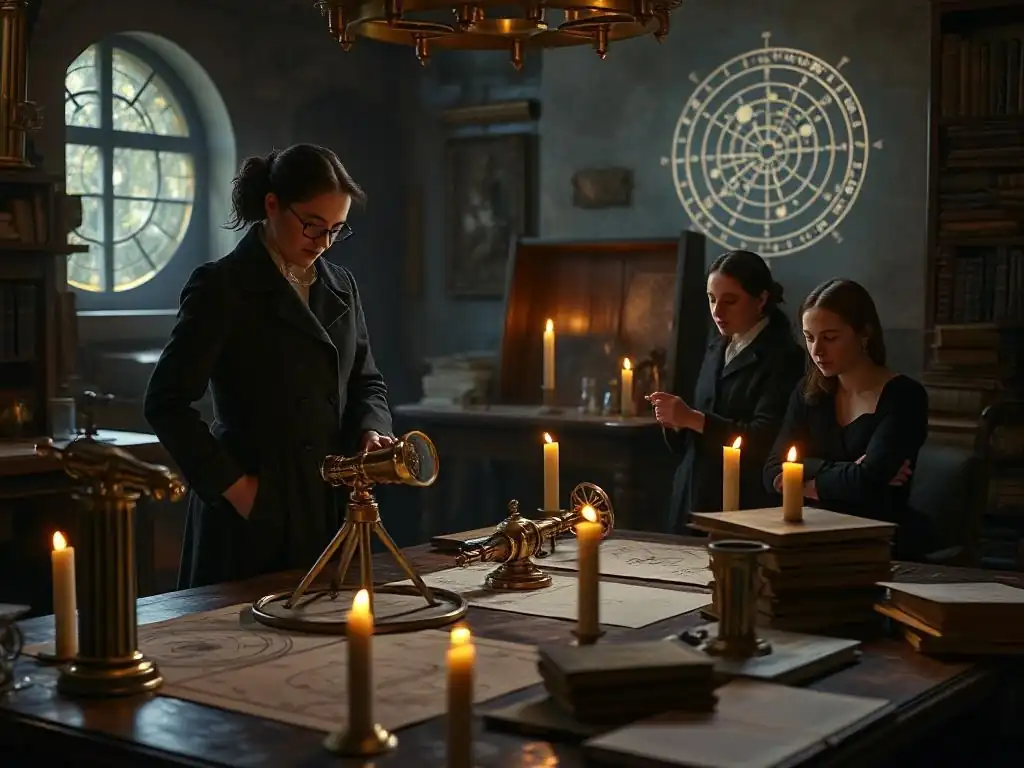
Welcome to WomenInScienceHistory.com!
Dive into a world where groundbreaking discoveries meet untold stories. We're thrilled to bring you Rewriting History: Placing 18th Century Women at the Forefront of Physics, a crucial exploration of the often-overlooked contributions of women who defied societal norms to advance our understanding of the universe. Prepare to be amazed as we uncover their ingenuity, resilience, and the profound impact they had on a field historically dominated by men. What secrets did these pioneering physicists hold, and how did their work shape the scientific landscape? Let's find out...
- Introduction: Unveiling the Untold Stories of Women in 18th Century Physics
- The Landscape of 18th Century Science: A Male-Dominated World
- Pioneering Figures: 18th Century Women Physicists and Their Contributions
- The Influence of Salons and Intellectual Circles
- Challenging the Narrative: Reassessing Historical Accounts
- Rediscovering Lost Works and Archives
- Legacy and Inspiration: Why 18th Century Women Physicists Matter Today
- Conclusion: A More Complete Picture of 18th Century Physics
-
Frequently Asked Questions
- What were some of the biggest challenges faced by 18th-century women in physics?
- Can you name a prominent 18th-century woman who made contributions to physics?
- Why is it important to highlight the contributions of 18th-century women in physics?
- How did women contribute to scientific knowledge in the 18th century if they were often excluded from formal education?
- What kind of legacy did 18th-century women in physics leave behind?
- Final Reflection: Illuminating Forgotten Pioneers
- Unveil the Untold Stories: Champion Women in Physics!
Introduction: Unveiling the Untold Stories of Women in 18th Century Physics
The 18th century, often hailed as the Age of Enlightenment, witnessed profound shifts in scientific thought, laying the groundwork for modern physics. Yet, traditional historical accounts predominantly spotlight male figures, creating an incomplete narrative of scientific progress. This article aims to challenge that limited perspective by illuminating the remarkable contributions of 18th Century Women Physics, whose ingenuity and perseverance often defied the formidable societal barriers of their time.
By delving into their lives and groundbreaking work, we can begin to rewrite history, offering a more comprehensive and accurate portrayal of scientific development in the 1700s. Understanding the roles of these pioneering women is not just an academic exercise; it is essential for inspiring future generations and recognizing the diverse sources of innovation that have shaped our world.
The Landscape of 18th Century Science: A Male-Dominated World
The scientific landscape of the 18th century was characterized by the establishment of formal academies and universities, which became the primary centers for research and dissemination of knowledge. These institutions, such as the Royal Society in London and the Académie Royale des Sciences in Paris, were exclusively male domains, solidifying a structure that largely excluded women from recognized scientific participation.
Despite the burgeoning intellectual curiosity of the era, the prevailing societal norms ensured that women's engagement with rigorous scientific pursuits, especially in fields like physics, was often relegated to the private sphere or overlooked entirely. This created a challenging environment for any woman aspiring to contribute to the scientific advancements of the 1700s.
Barriers Faced by Women Pursuing Physics in the 1700s
Women in the 18th century faced pervasive systemic exclusion from the formal scientific institutions that defined the era. Universities, royal academies, and learned societies were almost exclusively male, preventing women from accessing critical resources such as well-equipped laboratories, extensive libraries, and the crucial networks of peer review and collaboration essential for scientific advancement in 18th Century Women Physics. This institutional segregation meant that even highly talented women were denied the official platforms necessary for their work to gain widespread recognition and validation.
Beyond institutional barriers, prevailing patriarchal attitudes deemed scientific pursuits, particularly in demanding fields like physics, unfitting for women. Society largely confined women to domestic roles, emphasizing their duties as wives and mothers. Engaging in intellectual endeavors, especially those requiring public discourse or extensive study, was often seen as an unnatural deviation from these prescribed gender roles, creating immense societal pressure against any woman who dared to pursue a career as an 18th Century Woman Physics.
Limited Access to Education and Scientific Resources
Educational opportunities for women in the 18th century were severely restricted and largely confined to private tutoring or self-study, primarily accessible only to those from wealthy or aristocratic families. Unlike their male counterparts who could attend prestigious universities like Oxford, Cambridge, or the Sorbonne, women had no comparable formal avenues for comprehensive scientific training. This meant that the foundational knowledge required for advanced physics was often acquired through personal initiative rather than structured academic programs.
Furthermore, access to essential scientific instruments and up-to-date texts was incredibly scarce for women. While men could utilize university laboratories and extensive collections of scientific literature, women often relied on personal libraries, private collections, or the generosity of male relatives and mentors. This limited access to practical experimentation and the latest scientific discourse severely hampered the ability of aspiring 18th Century Women Physics to conduct independent research and contribute meaningfully to the field.
Societal Expectations and Gender Roles
The prevailing societal belief in the 18th century held that women's intellectual capacities were inherently inferior to men's, or that rigorous intellectual study, particularly in demanding fields like physics, could harm their reproductive health or render them unfeminine. These deeply ingrained cultural norms acted as powerful deterrents, discouraging women from pursuing intellectual careers and reinforcing their prescribed roles within the domestic sphere, making it exceptionally difficult for any woman to be taken seriously as an 18th Century Woman Physics.
Moreover, women who defied these expectations and engaged in scientific pursuits often faced ridicule, skepticism, or outright dismissal from their male contemporaries. Their work was frequently minimized, attributed to male mentors or family members, or simply not given the same intellectual weight as that of men. This systemic prejudice meant that even groundbreaking contributions by 18th Century Women Physics struggled to gain independent recognition, further diminishing their visibility in historical records.
Pioneering Figures: 18th Century Women Physicists and Their Contributions
Despite the immense obstacles, several remarkable women emerged in the 18th century who not only engaged with physics but made significant, lasting contributions. These pioneering figures often leveraged their unique positions, intellect, and resilience to carve out spaces for scientific inquiry, challenging the conventions of their time and laying crucial groundwork for future generations of scientists.
Their stories underscore the fact that scientific brilliance is not confined by gender, even in eras when societal structures actively sought to limit women's intellectual reach. These 18th Century Women Physics stand as testaments to the enduring human drive for knowledge and understanding, leaving a legacy that continues to inspire.
Émilie du Châtelet: A Champion of Newtonian Physics
Gabrielle Émilie Le Tonnelier de Breteuil, Marquise du Châtelet, was an extraordinary French natural philosopher and mathematician, widely regarded as one of the most intellectually formidable 18th Century Women Physics. Born in 1706, she was a polymath who excelled in mathematics, physics, and philosophy, famously forming a close intellectual partnership with Voltaire at her Château de Cirey, which became a vibrant hub for scientific and philosophical discourse.
Her most significant original scientific work, Institutions de Physique (Foundations of Physics), published in 1740, was a groundbreaking text that synthesized the metaphysical ideas of Leibniz with the empirical mechanics of Newton. In this work, she explored complex concepts such as the principle of sufficient reason and the nature of force, demonstrating her profound understanding of both theoretical and experimental physics and firmly establishing her as a leading voice among 18th Century Women Physics.
Du Châtelet's Translation and Commentary on Newton's Principia
Émilie du Châtelet's most enduring legacy is her monumental translation of Isaac Newton's Philosophiæ Naturalis Principia Mathematica into French. This was not merely a linguistic translation; it was a comprehensive reinterpretation and expansion of Newton's work, including her own extensive commentary, detailed derivations, and crucial algebraic elaborations that made Newton's complex geometric arguments more accessible to a wider European audience.
Published posthumously in 1759, Du Châtelet's translation remains the standard French version of the Principia to this day. Her meticulous work was instrumental in disseminating Newtonian physics throughout continental Europe, significantly influencing the trajectory of scientific thought and firmly cementing her place as a pivotal figure in the history of 18th Century Women Physics.
Contributions to Energy and Conservation Laws
Beyond her translation, Du Châtelet made crucial original contributions to the understanding of energy, particularly in the realm of kinetic energy. She was a staunch advocate for the concept of "vis viva" (living force), arguing that it was proportional to the mass of an object multiplied by the square of its velocity ( mv²), rather than Newton's mv. This idea, rooted in the work of Leibniz and Huygens, was a significant departure from prevailing Newtonian thought.
Her arguments in Institutions de Physique helped to lay the theoretical groundwork for the modern understanding of kinetic energy and the principle of the conservation of energy, even though the formal concept of energy conservation would not be fully developed until the 19th century. Her insights demonstrate her profound grasp of physical principles and her ability to advance fundamental theories, marking her as a truly innovative 18th Century Woman Physics.
Laura Bassi: Italy's First Female University Professor
Laura Maria Caterina Bassi was an extraordinary Italian scholar from Bologna who shattered academic barriers in the 18th century. Born in 1711, her exceptional intellect was evident from a young age, leading her to master several languages and delve deeply into philosophy and science. Her public disputations in philosophy and physics, where she defended 49 theses in Latin, captivated the intellectual world and showcased her profound knowledge.
In 1732, at the age of 21, Bassi was awarded a doctorate in philosophy from the University of Bologna and, crucially, was appointed Professor of Philosophy. This made her the first woman to hold a professorial chair at a European university, a truly revolutionary achievement for an 18th Century Woman Physics. While her public lecturing was initially restricted, she soon leveraged her position to establish her own private laboratory and conduct extensive experimental research.
Bassi's Lectures and Experiments in Experimental Physics
Despite initial limitations on her public teaching, Laura Bassi established a highly regarded private school in her home, where she conducted innovative courses in experimental physics. These courses, open to a select group of students, were characterized by hands-on demonstrations of physical phenomena, a rarity for the time. She actively engaged with the latest scientific developments, particularly in the burgeoning field of electricity.
Bassi performed an astounding number of experiments throughout her career, estimated to be over 500, focusing on topics such as Newtonian physics, electricity, and galvanism. She was known for her meticulous approach and her ability to clearly explain complex physical concepts through practical demonstration, solidifying her reputation as a leading experimental 18th Century Woman Physics.
Overcoming Institutional Obstacles
Laura Bassi's appointment as a professor was groundbreaking, yet she still faced significant institutional obstacles. Initially, her public teaching at the university was limited to a few ceremonial lectures each year, primarily due to prevailing prejudices against women lecturing publicly to mixed audiences. However, Bassi shrewdly navigated these restrictions.
She utilized her unique position and the patronage of influential figures, including Pope Benedict XIV, to gain permission to conduct her own private lectures and establish her own laboratory. This autonomy allowed her to bypass the male-dominated academic structure and continue her rigorous scientific work, proving that her intellectual contributions as an 18th Century Woman Physics could not be contained by traditional boundaries.
Maria Gaetana Agnesi: Mathematical Foundations for Physics
Maria Gaetana Agnesi, another brilliant Italian polymath from Milan, was a child prodigy born in 1718, renowned for her exceptional command of languages, philosophy, and mathematics. While often celebrated primarily as a mathematician, her profound contributions to calculus and analytical geometry laid critical mathematical foundations that were indispensable for the advancement of 18th-century physics. Her work provided the rigorous tools necessary for understanding and describing physical phenomena.
Her most famous work, Instituzioni analitiche ad uso della gioventù italiana (Analytical Institutions for the Use of Italian Youth), published in 1748, was a monumental two-volume treatise. This comprehensive textbook covered the entirety of differential and integral calculus, along with analytical geometry, presenting these complex mathematical concepts with unprecedented clarity and accessibility. It quickly became a standard text across Europe, empowering a generation of scholars, including aspiring 18th Century Women Physics, to engage with advanced mathematical reasoning.
Agnesi's "Analytical Institutions": A Bridge to Physics
Agnesi's Analytical Institutions was revolutionary for its time, serving as the first comprehensive textbook that systematically integrated differential and integral calculus. Before her work, these branches of mathematics were often taught separately or in a less unified manner. Her clear, didactic approach made advanced mathematical analysis accessible to a broader audience, including those interested in its applications to the natural sciences.
The utility of this textbook for physicists was immense. As the 18th century progressed, calculus became increasingly indispensable for understanding and formulating theories in mechanics, optics, fluid dynamics, and other branches of physics. Agnesi's meticulous explanations provided the essential mathematical framework that allowed scientists, including burgeoning 18th Century Women Physics, to tackle more complex physical problems with greater precision and theoretical depth.
Agnesi's Work on Curves and Their Properties Relevant to Physics
Within her Analytical Institutions, Maria Gaetana Agnesi famously analyzed various curves, including the cubic curve known as the "Witch of Agnesi" (versiera). While seemingly abstract mathematical constructs, the study of such curves held significant relevance for 18th-century physics. The shapes and properties of these curves could be used to model and understand a wide range of physical phenomena.
For instance, curves and their mathematical descriptions are fundamental in fields like optics (describing light paths), mechanics (trajectory of projectiles), and wave propagation (modeling wave forms). Agnesi's rigorous mathematical treatment of these geometric entities provided precise tools that physicists could employ to describe, predict, and analyze the behavior of physical systems, further demonstrating the profound interconnectedness of mathematics and the work of 18th Century Women Physics.
The Influence of Salons and Intellectual Circles
In an era where formal institutions largely excluded women, informal intellectual gatherings known as salons became vital alternative spaces for scientific discourse and learning. Predominantly hosted by aristocratic women, these salons transformed private homes into vibrant centers where leading philosophers, writers, and scientists converged to discuss the latest ideas, present new findings, and engage in lively debates.
These intellectual circles fostered an environment where women, otherwise marginalized from academic life, could actively participate in the scientific community. They facilitated the exchange of scientific papers, allowed for the discussion of theories, and provided crucial networking opportunities, enabling many 18th Century Women Physics to contribute to and influence the scientific dialogue of their time.
Women's Role in Disseminating Scientific Knowledge
Salons, particularly prominent in Paris, served as crucial intellectual hubs where scientific ideas were discussed, debated, and disseminated beyond the confines of formal academies. Women, often the hostesses or "salonnières," played a pivotal role in curating these environments, inviting leading scientific minds, and facilitating intellectual exchange. This active involvement allowed 18th Century Women Physics to engage directly with cutting-edge research and contribute to the broader intellectual currents.
These informal settings provided an indispensable avenue for women, otherwise systematically excluded from universities and royal academies, to participate meaningfully in the scientific community. They enabled networking, allowed for the exchange of scientific papers and findings, and empowered women to build reputations and influence, becoming active participants in the scientific discourse and thus playing a significant role in the communication of knowledge among 18th Century Women Physics.
The Importance of Correspondence and Collaboration
In the 18th century, before widespread scientific journals, extensive letter-writing networks served as a primary means of scientific communication and collaboration. Women like Émilie du Châtelet corresponded regularly with leading European intellectuals and scientists such as Pierre Louis Maupertuis and Leonhard Euler, exchanging ideas, debating theories, and sharing experimental findings. This epistolary exchange was vital for their scientific development and for staying abreast of new discoveries.
These informal collaborations, though less formalized than those within academies, were crucial for women to gain access to information, receive critical feedback on their theories, and even collaborate on experiments remotely. This robust yet informal network helped sustain the intellectual pursuits of 18th Century Women Physics, allowing them to overcome geographical and institutional barriers to participate in the Republic of Letters.
Challenging the Narrative: Reassessing Historical Accounts
For too long, the history of science has been told through a predominantly male lens, resulting in a distorted and incomplete understanding of past scientific achievements. Reassessing historical accounts is a critical endeavor, essential for acknowledging the full scope of human endeavor and correcting the biases that have overshadowed the contributions of countless individuals, particularly 18th Century Women Physics.
This process involves a deliberate effort to unearth hidden narratives, scrutinize traditional interpretations, and recognize the systemic factors that led to the underrepresentation of women. By challenging the established narrative, we can build a more accurate and inclusive history of science, one that truly reflects the diversity of its contributors.
Addressing the Underrepresentation of Women in Physics History
Traditional historical accounts of 18th-century physics have largely focused on the achievements of male figures, leading to a significant and pervasive underrepresentation of the contributions made by women. This historical bias has created a skewed and incomplete picture of scientific activity during the Enlightenment, obscuring the true breadth of innovation and the diverse intellectual forces, including those of 18th Century Women Physics, that shaped the period.
This omission is not a reflection of a lack of engagement or accomplishment by women, but rather a consequence of their systemic exclusion from formal academic records, publications, and the prevailing tendency of later historians to overlook or minimize their roles. Addressing this underrepresentation requires a deliberate and ongoing effort to re-examine primary sources, amplify their voices, and integrate their stories into the mainstream narrative of physics history.
The Impact of Gender Bias on Recognition and Attribution
Gender bias in the 18th century profoundly impacted the recognition and attribution of women's scientific work. It was not uncommon for brilliant ideas or meticulous observations made by 18th Century Women Physics to be either presented under a male relative's name, published anonymously, or simply not given the independent credit they deserved. This practice effectively erased their individual contributions from public view and historical record.
Furthermore, women's roles were frequently relegated to "assisting" or "supporting" capacities, even when their intellectual input was substantial or even primary. For instance, a woman might have conducted the majority of experiments or calculations, only for the results to be attributed solely to her male mentor or husband. This systemic bias meant that even groundbreaking work by 18th Century Women Physics struggled to gain independent recognition, diminishing their public legacy and historical visibility.
Rediscovering Lost Works and Archives
The ongoing effort to rediscover lost works and delve into overlooked archives is crucial for reconstructing a more accurate and inclusive history of science. Many contributions by 18th Century Women Physics lie hidden in forgotten correspondence, unpublished manuscripts, or obscure publications that were not widely circulated or preserved in mainstream collections.
Modern scholarship, aided by digital humanities and interdisciplinary approaches, is actively working to unearth these invaluable resources. This meticulous research is not just about adding names to a list; it's about understanding the full context of scientific discovery and recognizing the diverse pathways through which knowledge was generated and disseminated in the 18th century.
Caroline Herschel's Astronomical Catalog and Discoveries
While primarily known as an astronomer, Caroline Herschel (born 1750) made profound contributions that fall under the umbrella of observational physics, with her significant work beginning in the latter half of the 18th century. Working alongside her brother William Herschel, she was not merely an assistant but a meticulous observer and skilled calculator in her own right. She played a crucial role in constructing and using powerful telescopes, meticulously recording astronomical data.
Caroline Herschel's independent discoveries are remarkable, including eight comets, the first of which she discovered in 1786. She also compiled a comprehensive catalogue of nebulae and star clusters, which significantly expanded the known universe and improved astronomical mapping. Her dedication to systematic observation and her precise data collection exemplify the rigorous scientific method embraced by many 18th Century Women Physics in their pursuit of knowledge.
The Ongoing Effort to Unearth Women's Contributions to 18th Century Physics
Contemporary academic research is increasingly dedicated to delving into historical archives, personal letters, and obscure publications to uncover and re-evaluate the roles of women in 18th-century science. This includes scrutinizing the papers of prominent male scientists for references to female collaborators, students, or family members whose contributions might have been overlooked or minimized in formal accounts.
Digital humanities projects and interdisciplinary studies are making it easier to identify previously hidden or marginalized contributions. By digitizing old manuscripts, creating searchable databases, and fostering collaborative research across fields, scholars are systematically building a more complete picture of who contributed to physics in the 1700s. This persistent scholarly work is crucial for building a more accurate and inclusive history of 18th Century Women Physics, ensuring their legacies are finally acknowledged.
Legacy and Inspiration: Why 18th Century Women Physicists Matter Today
The stories of 18th Century Women Physics are far more than historical footnotes; they are powerful narratives of resilience, intellectual courage, and groundbreaking innovation. Their achievements, often accomplished against immense odds, continue to resonate today, offering invaluable lessons and inspiration for contemporary society.
Understanding their struggles and triumphs is crucial for challenging persistent stereotypes and fostering a more inclusive scientific community. These pioneering female scientists demonstrate that passion for knowledge and scientific aptitude transcend gender, providing compelling role models for future generations aspiring to careers in STEM.
Inspiring Future Generations of Women in STEM
The stories of 18th Century Women Physics provide crucial and compelling role models for young girls and women considering careers in STEM fields today. Learning about figures like Émilie du Châtelet and Laura Bassi, who pursued physics with unwavering dedication despite immense societal and institutional barriers, demonstrates remarkable resilience, intellectual courage, and a deep commitment to scientific inquiry.
By celebrating these historical figures, we can actively challenge contemporary stereotypes about who can be a scientist and encourage greater diversity in physics and other scientific disciplines. Their legacies serve as a powerful reminder that curiosity and brilliance are not gender-specific, fostering a more inclusive and welcoming environment for future innovators and scientists.
Celebrating the Resilience and Ingenuity of Female Scientists
The achievements of these 18th Century Women Physics, often accomplished with limited resources, minimal formal training, and against significant societal opposition, underscore their remarkable ingenuity and unwavering dedication. Their ability to contribute meaningfully to complex fields like physics despite systemic disadvantages is a profound testament to their intellectual brilliance and perseverance.
Their stories are not just historical footnotes, but powerful narratives of human endeavor and the enduring spirit of inquiry. Recognizing their contributions is vital for a complete and accurate understanding of scientific progress throughout history, and it serves as a powerful reminder of the remarkable resilience and ingenuity of female scientists across all eras.
Conclusion: A More Complete Picture of 18th Century Physics
The re-examination of 18th-century scientific history to include the contributions of women is not merely an act of historical correction; it is an essential step towards a more complete and accurate understanding of the Enlightenment era's intellectual landscape. By shining a light on figures like Émilie du Châtelet, Laura Bassi, and Maria Gaetana Agnesi, we move beyond a narrow, male-centric view to reveal a far more dynamic, diverse, and robust scientific community.
This expanded perspective acknowledges that scientific progress is a collective human endeavor, shaped by a multitude of voices and experiences. It highlights the often-invisible labor and intellectual prowess of women who, despite profound limitations, pushed the boundaries of knowledge and laid crucial groundwork for future discoveries in physics and beyond.
The Enduring Significance of Recognizing Women's Contributions
The enduring significance of recognizing the contributions of 18th Century Women Physics lies in its profound impact on both our historical understanding and our contemporary aspirations. It enriches our appreciation of the complexity and richness of scientific development during a pivotal period, revealing that innovation flourished in unexpected places and through unconventional means.
Furthermore, acknowledging these forgotten pioneers is not just about rectifying past injustices; it is a vital step towards fostering a more equitable and representative scientific community in the present and future. Their legacy continues to inspire and challenge us to seek out overlooked brilliance, ensuring that no talent is marginalized and that the full spectrum of human intellect is celebrated in the pursuit of scientific advancement.
Frequently Asked Questions
What were some of the biggest challenges faced by 18th-century women in physics?
Women faced significant social barriers and limited access to education. They were often excluded from formal scientific institutions and faced prejudice in a male-dominated field.
Can you name a prominent 18th-century woman who made contributions to physics?
While finding specific women solely dedicated to "physics" as we understand it today can be tricky, Émilie du Châtelet is a vital figure. She translated and commented on Newton's Principia Mathematica, making Newtonian physics more accessible.
Why is it important to highlight the contributions of 18th-century women in physics?
It's crucial to rewrite history and acknowledge the contributions of all scientists, regardless of gender. Highlighting these women helps to inspire future generations and provide a more accurate representation of scientific progress.
How did women contribute to scientific knowledge in the 18th century if they were often excluded from formal education?
Some women gained knowledge through private tutoring, collaborations with male relatives (fathers, husbands, brothers), and independent study. They also participated in scientific debates through salons and correspondence.
What kind of legacy did 18th-century women in physics leave behind?
Their work helped pave the way for future generations of female scientists. They challenged gender norms within academia and demonstrated the intellectual capabilities of women in science, despite societal opposition.
Final Reflection: Illuminating Forgotten Pioneers
The journey through the lives and contributions of 18th-century women in physics reveals a profound truth: history is not a fixed narrative, but a constantly evolving understanding shaped by who tells the story. By placing these forgotten pioneers at the forefront, we not only correct historical omissions but also challenge the very foundations of how we perceive scientific progress and gender roles.
This excavation of the past has deeply resonated with me, highlighting the persistent struggle for recognition faced by women in STEM fields. It underscores the importance of actively seeking out and amplifying marginalized voices, ensuring that their contributions are not lost to the sands of time. The most common way people give up their power is by thinking they don't have any.
- Alice Walker. This quote perfectly encapsulates the systemic barriers these women faced and the enduring power of reclaiming their narratives.
Now, I invite you to consider the implications of this rediscovered history. How can we, in our own lives, challenge ingrained biases and actively seek out the untold stories that enrich our understanding of the world? Let us commit to rewriting the narratives around us, ensuring that future generations inherit a more complete and equitable vision of the past, present, and future of science.
Unveil the Untold Stories: Champion Women in Physics!
Thank you for diving into the hidden world of 18th-century women in physics. We hope you've discovered a newfound appreciation for their invaluable contributions. Now, let's amplify their voices!
Here's how you can continue to champion these remarkable women:
- Dive deeper: Explore the biographies of Émilie du Châtelet and Laura Bassi online at WomenInScienceHistory.com, and share your favorite facts with a friend. This is the first step to bringing their stories to light.
- Contribute to their legacy: Share this article on your social media platforms to spread awareness and ignite conversations about their impact.
- Become a modern-day muse: Research current women leading in Physics and mentor a young woman that is interested in the field.
Which of these untold stories surprised you the most, and how will you help ensure these pioneering women receive the recognition they deserve?