
Vera Rubin: The Astronomer Who Uncovered the Compelling Evidence for Dark Matter

Welcome to WomenInScienceHistory.com!
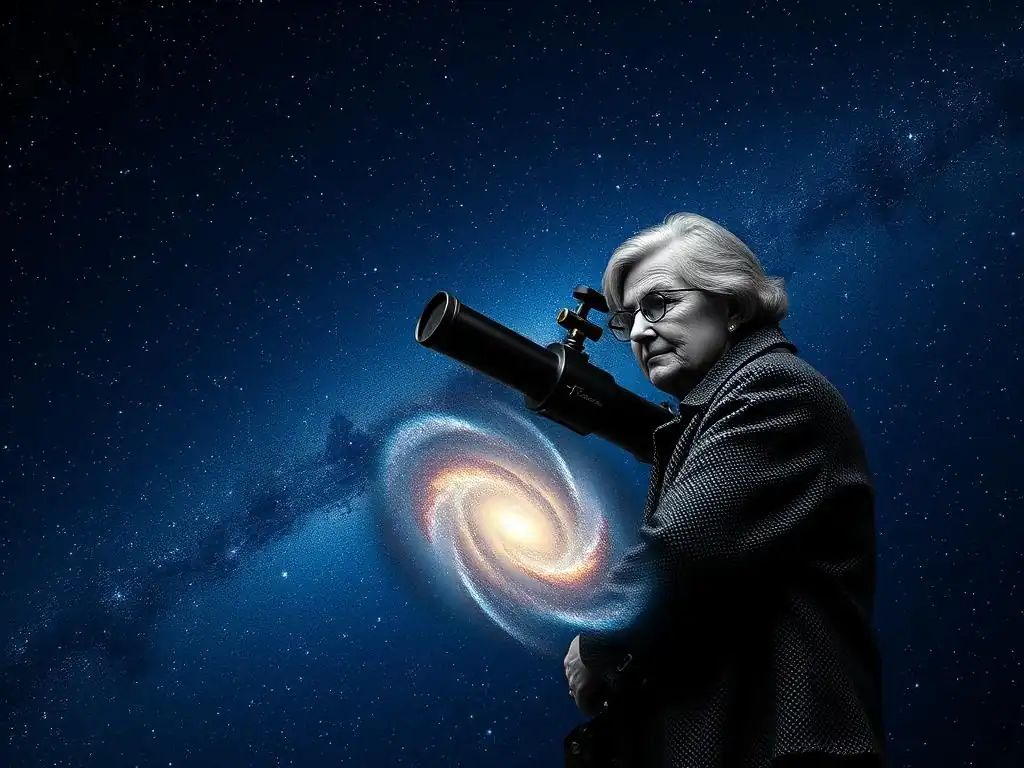
Prepare to be inspired by the remarkable journey of Vera Rubin, the brilliant astronomer whose groundbreaking work provided compelling evidence for the existence of dark matter. But how did one woman challenge established scientific norms and revolutionize our understanding of the universe? Uncover the fascinating story of her life, her relentless pursuit of knowledge, and the obstacles she overcame in a male-dominated field. Dive in to learn more about this pivotal figure and the mysteries she helped unravel.
- Vera Rubin: The Astronomer Who Uncovered Compelling Evidence for Dark Matter
- Introduction: Honoring Vera Rubin's Legacy in Astronomy
- Early Life and Education: Shaping a Future Astronomer
- Research on Galaxy Rotation Curves: The Dark Matter Discovery
- Compelling Evidence for Dark Matter: Unveiling the Invisible Universe
- Challenges and Recognition: Navigating a Male-Dominated Field
- Vera Rubin's Influence on Modern Astronomy
- The Ongoing Search for Dark Matter: Where Do We Stand Today?
- Conclusion: Vera Rubin's Enduring Impact on Science and Women in STEM
-
Frequently Asked Questions
- What was Vera Rubin's most significant contribution to science?
- What challenges did Vera Rubin face as a woman in science?
- How did Vera Rubin's work change our understanding of the universe?
- What is dark matter, and why is it important?
- How does WomenInScienceHistory.com celebrate Vera Rubin's legacy?
- Final Reflection: Illuminating the Invisible Universe
- Unveil the Mysteries of the Universe!
Vera Rubin: The Astronomer Who Uncovered Compelling Evidence for Dark Matter
Introduction: Honoring Vera Rubin's Legacy in Astronomy
Women in Astronomy: Vera Rubin's Pioneering Contributions
Vera Rubin stands as a monumental figure in the history of astronomy, whose relentless pursuit of knowledge fundamentally reshaped our understanding of the cosmos. In an era where women faced significant barriers in scientific fields, Rubin's unwavering dedication to observing and interpreting the universe led to one of the most profound discoveries of the 20th century. Her work not only provided the strongest empirical evidence for the existence of dark matter but also paved the way for future generations of women in STEM. Her story is a testament to intellectual courage and perseverance against societal odds.
Rubin's contributions extend far beyond her scientific findings; she was a trailblazer who opened doors for others. Her meticulous observations and rigorous analysis challenged long-held assumptions about how galaxies behaved, forcing the scientific community to confront the reality of an invisible, pervasive substance governing cosmic dynamics. The groundbreaking nature of the Vera Rubin dark matter research positioned her as one of the most influential astronomers of her time, forever altering the landscape of astrophysics and cosmology.
Early Life and Education: Shaping a Future Astronomer
Overcoming Obstacles: Rubin's Pursuit of Science
Born in Philadelphia in 1928, Vera Cooper Rubin developed an early fascination with the night sky, often staying up late to watch meteors from her bedroom window. Despite this keen interest, she encountered significant discouragement from male figures in authority regarding her aspirations in astronomy. For instance, upon expressing her desire to attend Princeton for graduate studies, she was informed that Princeton did not accept women into its astronomy program, a policy that remained in place until 1975. Such overt biases were common throughout her early academic journey, reflecting the pervasive gender discrimination of the era.
Rubin, however, refused to be deterred by these obstacles. Her determination to pursue a scientific career was formidable, driven by an innate curiosity about the universe. She often recounted how her father, a supportive and encouraging figure, helped her build a telescope from a cardboard tube, grinding the lenses herself. This early hands-on experience, coupled with her intrinsic drive, allowed her to navigate the challenging landscape of a male-dominated scientific community, setting the stage for her future groundbreaking discoveries.
Academic Journey: From Vassar to Cornell and Georgetown
Vera Rubin's formal academic journey began at Vassar College, where she was the only astronomy major in her graduating class of 1948. Her undergraduate experience provided a strong foundation in observational astronomy and celestial mechanics. After graduating, she married Robert Rubin and immediately sought to continue her education, recognizing the need for advanced study to realize her scientific ambitions.
She went on to earn her Master's degree from Cornell University in 1951, where she studied under notable physicists like Philip Morrison and Richard Feynman. Her thesis explored the motions of galaxies, an early indication of her future research focus. Subsequently, she pursued her Ph.D. at Georgetown University, completing her doctoral work in 1954 under the guidance of renowned cosmologist George Gamow. Her dissertation, which proposed that galaxies were not randomly distributed but rather clustered together, was met with skepticism at the time but later proved to be remarkably prescient, foreshadowing the modern understanding of large-scale cosmic structures.
Research on Galaxy Rotation Curves: The Dark Matter Discovery
The Puzzle of Galaxy Rotation: Challenging Newtonian Physics
Before Vera Rubin's pivotal work, astronomical models of galaxy rotation were largely based on the observable luminous matter within them—stars, gas, and dust. According to classical Newtonian physics, stars and gas clouds at the outer edges of a spiral galaxy should orbit the galactic center at slower speeds than those closer to the center, much like planets further from the Sun orbit more slowly. This expected decrease in orbital velocity with increasing distance is known as a Keplerian rotation curve. However, existing observations, though less precise, had hinted at some inconsistencies.
The prevailing understanding suggested that the visible mass alone should dictate the gravitational pull and thus the orbital velocities of galactic components. If a galaxy's mass was concentrated at its center, the outer regions would experience a weaker gravitational force. The challenge lay in reconciling theoretical predictions with the burgeoning observational data, which subtly suggested that something was amiss with the standard model of galactic dynamics. This persistent discrepancy between theoretical expectation and early observations set the stage for Rubin's critical investigations.
Measuring Galactic Rotation: Rubin's Groundbreaking Observations
In the 1970s, working extensively with her colleague Kent Ford at the Carnegie Institution of Washington, Vera Rubin embarked on a meticulous study of galaxy rotation curves. They used a sensitive spectrograph to measure the Doppler shift of light from stars and gas at varying distances from the centers of spiral galaxies. Their primary target was the Andromeda galaxy (M31), a close galactic neighbor. By analyzing the shift in spectral lines, they could determine the precise velocities of stars and gas as they orbited the galaxy's core.
Their observations yielded a truly astonishing and unexpected result: the orbital velocities of stars and gas clouds in the outer regions of spiral galaxies did not decrease with distance from the galactic center, as predicted by Newtonian mechanics based on visible mass. Instead, the rotation curves remained remarkably flat, meaning that objects far from the center were orbiting just as quickly as those closer in.
For example, in many spiral galaxies, stars 50,000 light-years from the center orbited at roughly the same speed as those 10,000 light-years away, implying a significant amount of unseen mass extending far beyond the visible galactic disk. This consistent flatness across numerous observed galaxies provided the first robust and compelling evidence for dark matter.
Compelling Evidence for Dark Matter: Unveiling the Invisible Universe
What is Dark Matter? Understanding the Concept
Dark matter is a hypothetical form of matter that is believed to account for approximately 27% of the mass-energy content of the observable universe, dwarfing the ordinary baryonic matter (protons, neutrons, and electrons) that makes up stars, planets, and ourselves, which constitutes only about 5%. The term "dark" refers to its elusive nature: it does not emit, absorb, or reflect light or any other form of electromagnetic radiation, making it impossible to observe directly with telescopes. Its presence is inferred solely through its gravitational effects on visible matter and light.
Unlike ordinary matter, dark matter is thought to interact very weakly with the electromagnetic force, meaning it doesn't collide with light particles or other forms of radiation. This fundamental difference explains why it is so difficult to detect. While its exact composition remains one of the greatest mysteries in modern physics, leading candidates include Weakly Interacting Massive Particles (WIMPs) and axions, exotic particles that are not part of the Standard Model of particle physics. Understanding what dark matter is composed of is a primary goal of contemporary astrophysics and particle physics.
Rubin's Data: Strong Evidence for Dark Matter Halos
Vera Rubin's meticulous measurements of galactic rotation curves provided the most persuasive and quantitative evidence for the existence of dark matter. Her data, consistently showing flat rotation curves for over 200 spiral galaxies, could only be explained if there was significantly more mass present than could be accounted for by the visible stars and gas.
This "missing mass" had to be distributed in a vast, spherical halo extending far beyond the luminous disk of the galaxy, exerting a gravitational pull that kept the outer stars orbiting at high speeds. The Vera Rubin dark matter findings demonstrated that the visible components of galaxies are merely the tip of an enormous gravitational iceberg.
For instance, in the Andromeda galaxy, Rubin and Ford found that stars at 50,000 light-years from the center were orbiting at speeds of about 200-250 kilometers per second, nearly identical to stars much closer to the core. This implied that the total mass of the galaxy was at least five to ten times greater than the mass of its visible components.
The only plausible explanation was the presence of a vast, invisible halo of dark matter encompassing the galaxy, providing the additional gravitational force necessary to maintain these high orbital velocities. This consistent pattern across numerous galaxies solidified the case for dark matter as a fundamental component of galactic structure.
Implications of Dark Matter: Reshaping Our Understanding of the Universe
The discovery of dark matter, largely driven by Vera Rubin's empirical evidence, profoundly reshaped the field of cosmology. It moved dark matter from a speculative concept to a central pillar of the Lambda-CDM (Lambda-Cold Dark Matter) model, which is the current standard model of cosmology. This model posits that the universe is composed of approximately 5% ordinary matter, 27% dark matter, and 68% dark energy. The existence of dark matter explains several previously puzzling cosmic phenomena, providing a coherent framework for understanding the universe's large-scale structure and evolution.
Beyond explaining galaxy rotation curves, dark matter is crucial for understanding how galaxies formed and clustered together. Without its gravitational scaffolding, the early universe would not have had sufficient gravitational pull to form the vast structures we observe today.
Furthermore, observations of gravitational lensing—the bending of light by massive objects—and anisotropies in the cosmic microwave background radiation provide independent corroboration for dark matter's existence and distribution. Rubin's work on Vera Rubin dark matter thus initiated a paradigm shift, leading to a more complete and accurate picture of the universe, where the invisible plays a far greater role than the visible.
Facing Gender Bias in Science: Rubin's Experiences
Throughout her distinguished career, Vera Rubin encountered pervasive gender bias and systemic barriers, which were unfortunately common for women in science during her era. One notable instance involved her attempts to use the Palomar Observatory in the 1960s, a premier astronomical facility. Despite her qualifications, she faced initial resistance because the observatory lacked women's restrooms and sleeping quarters, reflecting an institutionalized exclusion of female researchers. Rubin famously drew a skirt on a male figure on a restroom door to highlight the absurdity of the situation, ultimately leading to the installation of women's facilities.
She also frequently found herself as the only woman at scientific conferences or on prestigious committees. The lack of female peers and mentors was a constant challenge, making her journey more solitary than it might have been for her male counterparts. Despite these formidable obstacles, Rubin consistently advocated for other women in science, encouraging them to pursue their passions and challenging the deeply ingrained biases that sought to limit their potential. Her resilience in the face of such discrimination serves as an inspiring example for all aspiring scientists.
Recognition and Awards: Acknowledging Rubin's Scientific Achievements
Despite the gender bias she faced, Vera Rubin received numerous prestigious awards and accolades for her groundbreaking Vera Rubin dark matter research and her overall contributions to astronomy. In 1981, she was elected to the National Academy of Sciences, becoming only the second female astronomer to achieve this honor. Perhaps her most significant recognition came in 1993 when President Bill Clinton awarded her the National Medal of Science, the highest scientific honor in the United States. The citation specifically acknowledged her "pioneering research programs on dark matter in the universe."
In 1996, she was awarded the Gold Medal of the Royal Astronomical Society, making her only the second woman, after Caroline Herschel in 1828, to receive this esteemed international award. While her contributions were widely celebrated within the scientific community, a notable omission from her long list of honors was the Nobel Prize in Physics. Many scientists and commentators have argued that her empirical evidence for dark matter was profound enough to warrant a Nobel, making her lack of the award a frequently cited example of a significant oversight by the Nobel Committee.
Vera Rubin's Influence on Modern Astronomy
Inspiring Future Generations of Women in Science
Vera Rubin's life and career serve as a powerful beacon of inspiration for future generations, particularly for women aspiring to careers in science, technology, engineering, and mathematics (STEM). Her story demonstrates that groundbreaking scientific discoveries are possible even when confronted with significant societal and institutional barriers. She not only excelled in a male-dominated field but actively championed the cause of other women, advocating for their inclusion and recognition. Rubin often spoke about the importance of girls pursuing their scientific interests, famously stating, "Science is for everyone."
Her legacy extends beyond her scientific output; it is deeply rooted in her role as a mentor and advocate. She tirelessly encouraged young women to enter physics and astronomy, sharing her experiences and offering invaluable guidance. By breaking through glass ceilings and demonstrating extraordinary intellectual prowess, Rubin provided a tangible role model, showing that women could not only participate in but also lead fundamental scientific advancements. Her unwavering commitment to both science and gender equality continues to motivate countless individuals to pursue their dreams in STEM.
Legacy of Dark Matter Research: Building on Rubin's Foundations
The profound impact of Vera Rubin's work on Vera Rubin dark matter cannot be overstated; it laid the empirical foundation for an entire subfield of modern astrophysics and particle physics. Before her meticulous observations, dark matter was largely a theoretical curiosity. Her compelling evidence, derived from the flat rotation curves of galaxies, transformed it into a concrete, observable problem that demanded explanation. Her findings were the primary catalyst for the widespread acceptance of dark matter as a fundamental component of the universe.
Today, the search for dark matter is one of the most active and exciting areas of scientific inquiry, directly building upon the observational bedrock established by Rubin. Her work spurred numerous subsequent investigations, including studies of gravitational lensing, the cosmic microwave background, and large-scale structure formation, all of which independently corroborate the existence of dark matter.
Every experiment designed to detect dark matter particles, every simulation modeling the universe's evolution, and every new theory attempting to explain its nature owes a profound debt to Rubin's pioneering observations. Her legacy ensures that the quest to understand the invisible universe continues with relentless vigor.
The Ongoing Search for Dark Matter: Where Do We Stand Today?
Current Research and Experiments in Dark Matter Detection
The quest to directly detect and identify dark matter particles is one of the most significant challenges in modern physics, with numerous international collaborations working on various experimental approaches. One primary strategy involves "direct detection" experiments, typically located deep underground to shield them from cosmic rays. These experiments, such as LUX-ZEPLIN (LZ) in South Dakota and XENONnT in Italy, aim to observe the incredibly rare instances where a dark matter particle might collide with an atomic nucleus in a detector, producing a faint flash of light or ionization. Despite significant advancements in sensitivity, a definitive detection remains elusive.
Another approach is "indirect detection," which involves searching for the annihilation or decay products of dark matter particles in space. Telescopes like the Fermi Gamma-ray Space Telescope search for excesses of gamma rays, positrons, or antiprotons that could originate from dark matter interactions in dense regions of the universe, such as the galactic center or dwarf galaxies.
Additionally, particle accelerators like the Large Hadron Collider (LHC) at CERN attempt to produce dark matter particles in high-energy collisions, looking for "missing energy" signatures that would indicate their creation. These diverse experimental avenues highlight the global scientific commitment to unraveling the mystery of Vera Rubin dark matter.
Dark Matter Candidates and Detection Strategies
The theoretical landscape for dark matter is rich with various candidate particles, each with its own unique properties and corresponding detection strategies. The most widely studied candidate is the Weakly Interacting Massive Particle (WIMP). WIMPs are hypothesized to be massive, slow-moving particles that interact with normal matter only through gravity and the weak nuclear force. Direct detection experiments are primarily designed to search for WIMPs, hoping to catch one interacting with detector nuclei.
Another prominent candidate is the axion, a much lighter particle proposed to solve a different problem in particle physics (the strong CP problem). Axion detection experiments, such as the Axion Dark Matter Experiment (ADMX), use strong magnetic fields to convert axions into detectable microwave photons. Other, more exotic candidates include sterile neutrinos, primordial black holes, and "fuzzy" dark matter.
Each candidate particle dictates a specific experimental approach, ranging from ultra-cold atom interferometers to astronomical observations of galaxy dynamics and gravitational lensing. The ongoing search for Vera Rubin dark matter continues to push the boundaries of experimental physics and astronomy, driven by the profound implications of finally identifying this invisible cosmic constituent.
Conclusion: Vera Rubin's Enduring Impact on Science and Women in STEM
Frequently Asked Questions
What was Vera Rubin's most significant contribution to science?
Vera Rubin is best known for her groundbreaking work providing compelling evidence for dark matter's existence. She observed that galaxies rotate at speeds inconsistent with visible matter, implying unseen mass holding them together.
What challenges did Vera Rubin face as a woman in science?
Rubin faced significant gender discrimination throughout her career. She was often denied access to facilities and opportunities, simply because she was a woman in a male-dominated field.
How did Vera Rubin's work change our understanding of the universe?
Rubin's research dramatically altered our understanding of the universe by demonstrating that visible matter only accounts for a small portion of its total mass. This led to the widespread acceptance of dark matter as a crucial component of the cosmos.
What is dark matter, and why is it important?
Dark matter is a hypothetical form of matter that does not interact with light, making it invisible to telescopes. It's crucial because it accounts for a significant portion of the universe's mass and plays a vital role in galaxy formation and structure.
How does WomenInScienceHistory.com celebrate Vera Rubin's legacy?
WomenInScienceHistory.com celebrates Vera Rubin's legacy by highlighting her scientific achievements and the obstacles she overcame. The site aims to inspire future generations by showcasing her story as a pioneering woman in astronomy.
Final Reflection: Illuminating the Invisible Universe
The journey through Vera Rubin's groundbreaking work reveals not just the existence of dark matter, but also the power of challenging established paradigms. Her unwavering dedication to observation and her refusal to dismiss anomalies have forever altered our understanding of the cosmos, a legacy that resonates profoundly in today's scientific landscape, where questioning assumptions is paramount to progress.
The impact of Rubin's discovery extends far beyond the realm of astrophysics. Her story serves as a potent reminder of the importance of perseverance and the courage to pursue unconventional paths, especially for women in STEM. It underscores the vital role of diverse perspectives in scientific advancement. Science progresses best when observations force us to alter our preconceptions.
This quote, often attributed to Rubin herself, encapsulates the essence of her approach and its enduring relevance.
Now, consider the vastness of the universe and the humbling realization that much of it remains unseen. Just as Vera Rubin peered into the darkness and revealed hidden truths, we too must cultivate a spirit of inquiry and embrace the unknown. Let her legacy inspire you to question, to explore, and to never shy away from challenging the boundaries of your own understanding. The universe, and your own potential, are far more expansive than you might imagine.
Unveil the Mysteries of the Universe!
Thanks for diving into the incredible story of Vera Rubin and her groundbreaking work. You've now seen how one woman's relentless curiosity changed our understanding of the cosmos. Ready to continue exploring?
Here are a few ways you can take action:
- Dive deeper: Research a current scientist: who is building on Vera Rubin's legacy in dark matter research. Share your findings with a friend!
- Advocate for increased representation of women and minorities in STEM fields. Even small actions can make a big difference!
- Explore our website at WomenInScienceHistory.com and discover other fascinating women who shaped our world.
What other hidden secrets of the universe are you curious to explore next?