
Grace Chisholm Young: Collaborator and Trailblazer in Set Theory

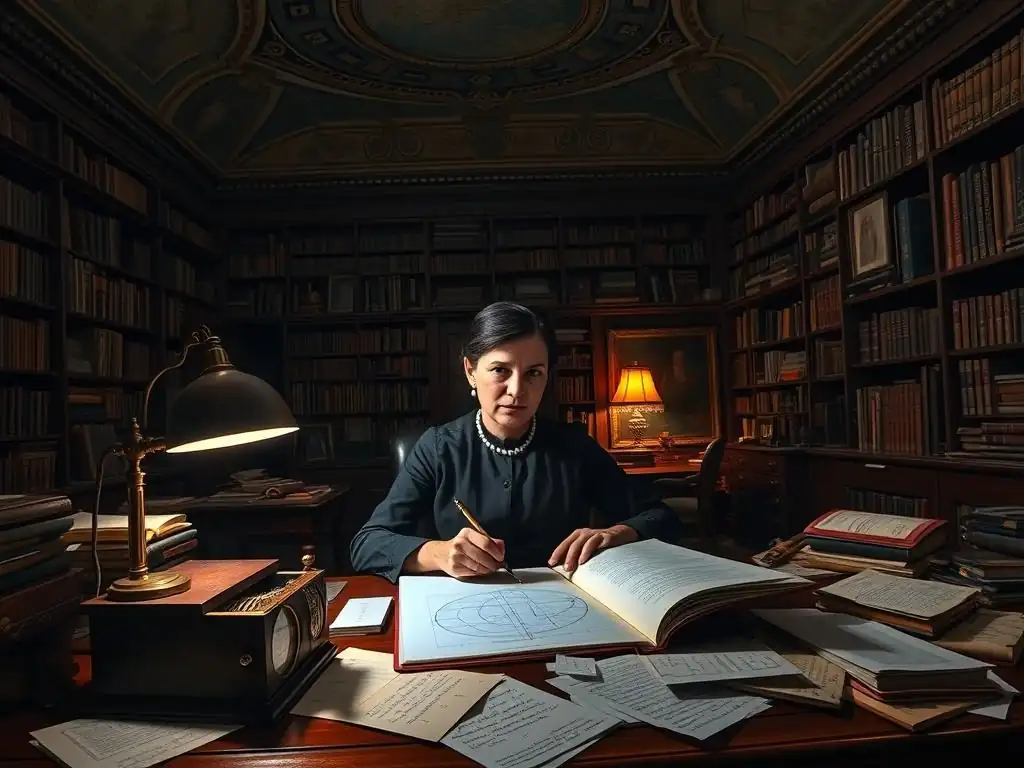
Welcome to WomenInScienceHistory.com!
Delve into the fascinating world of scientific discovery and uncover the remarkable stories of women who shaped our understanding of the universe. Ever heard of Grace Chisholm Young? Prepare to be captivated by her pivotal, yet often overshadowed, contributions to Set Theory and the broader landscape of mathematics. Her story is one of collaboration, perseverance, and groundbreaking insights in a field dominated by men. Intrigued? Read on to discover the remarkable life and work of this unsung mathematical trailblazer and the challenges she overcame.
- Introduction: Unveiling Grace Chisholm Young's Mathematical Legacy
- Early Life and Education: Shaping a Mathematician
- Marriage and Collaboration with William Henry Young
- Grace Chisholm Young's Contributions to Set Theory
- Beyond Set Theory: Grace Chisholm Young's Other Mathematical Pursuits
- The Recognition Problem: Attributing Work in Joint Publications
- Grace Chisholm Young's Impact and Legacy
- Conclusion: Celebrating Grace Chisholm Young's Mathematical Brilliance
-
Frequently Asked Questions
- What is Grace Chisholm Young best known for in the field of mathematics?
- What were some of the challenges Grace Chisholm Young faced as a woman in science?
- How did Grace Chisholm Young collaborate with her husband, William Henry Young?
- What is Set Theory, and why was Grace Chisholm Young's work in this area important?
- How does WomenInScienceHistory.com aim to inspire future generations?
- Final Reflection: The Enduring Legacy of Collaboration
- Ignite Your Inner Mathematician: Explore, Connect, Contribute!
Introduction: Unveiling Grace Chisholm Young's Mathematical Legacy
The Underappreciated Genius of Grace Chisholm Young
Grace Chisholm Young stands as a monumental figure in the history of mathematics, yet her profound contributions have often been overshadowed or attributed primarily to her husband and collaborator, William Henry Young. Born in 1868, Grace navigated a male-dominated academic landscape, not only achieving remarkable scholarly milestones but also pioneering significant work in nascent fields such as set theory.
Her journey exemplifies the intellectual prowess and unwavering dedication required to thrive in an era largely unreceptive to women in advanced scientific pursuits, making her story crucial for understanding the true breadth of mathematical development. Her work in Grace Chisholm Young Set Theory, in particular, represents a significant chapter in the evolution of modern mathematics.
Despite her prolific output and undeniable intellect, the narrative surrounding Grace Chisholm Young often diminishes her individual brilliance, frequently lumping her achievements into a joint 'Young' legacy without fully dissecting her specific, often primary, role. Historical analysis reveals that many of the groundbreaking ideas and the meticulous development of concepts, especially concerning Grace Chisholm Young Set Theory, originated from her. Unveiling her underappreciated genius means acknowledging her as a driving force behind numerous theorems and publications that shaped early 20th-century mathematics.
Women in Mathematics: Recognizing Grace Chisholm Young's Contributions
The late 19th and early 20th centuries presented formidable barriers for women aspiring to careers in mathematics. Universities often denied them formal degrees, and academic positions were virtually nonexistent. Within this challenging context, Grace Chisholm Young not only excelled but became a trailblazer, earning a doctorate from the University of Göttingen in 1895—a rare achievement for a woman at the time. Her steadfast pursuit of mathematical knowledge and her subsequent contributions serve as a powerful testament to her resilience and the intellectual capabilities of women who were historically marginalized.
Recognizing Grace Chisholm Young's contributions is essential for a complete and accurate historical record of women in mathematics. Her work, particularly in the foundational areas of set theory, real analysis, and point-set topology, was instrumental in shaping these fields. By highlighting her specific achievements in Grace Chisholm Young Set Theory and beyond, we not only correct historical oversights but also provide inspiring role models for future generations of female mathematicians. Her legacy underscores the importance of acknowledging individual brilliance, irrespective of the societal constraints of the past.
Early Life and Education: Shaping a Mathematician
Grace Chisholm's Academic Beginnings: From Girton College to Göttingen
Grace Chisholm's academic journey began with exceptional promise. She initially pursued medicine but soon gravitated towards mathematics, a field in which her prodigious talent quickly became apparent. In 1889, she enrolled at Girton College, Cambridge, one of the few institutions open to women seeking higher education. There, she excelled, achieving a First Class in the Mathematical Tripos examination in 1892. This was a remarkable feat, placing her academically on par with male students who received formal degrees, even though women at Cambridge were not officially awarded degrees until 1948.
Driven by a profound intellectual curiosity and a desire for advanced mathematical study, Grace Chisholm sought opportunities beyond the limitations of British universities. She chose to pursue postgraduate work at the University of Göttingen in Germany, a leading center for mathematics globally, known for its progressive stance towards admitting women for doctoral studies. Her decision to study abroad was a bold step, reflecting her determination to delve deeper into complex mathematical concepts and establish herself as a serious scholar.
Studying with Felix Klein: Influences on Her Mathematical Thinking
At the University of Göttingen, Grace Chisholm had the privilege of studying under some of the most prominent mathematicians of her era, most notably Felix Klein. Klein, a towering figure in geometry and group theory, significantly influenced her mathematical thinking. His lectures introduced her to cutting-edge research and provided a rigorous intellectual framework, emphasizing the interconnectedness of different mathematical disciplines. This exposure broadened her perspective and honed her analytical skills, pushing her towards more abstract and foundational areas.
Klein's mentorship was pivotal in shaping Grace Chisholm's approach to mathematical problems. He encouraged a deep understanding of underlying principles and the exploration of new frontiers, a philosophy that would later characterize her extensive work in Grace Chisholm Young Set Theory and other fields. The vibrant academic environment at Göttingen, fostered by luminaries like Klein, allowed her to flourish intellectually and develop the robust foundational knowledge necessary for her later groundbreaking research.
Earning a Doctorate: Grace Chisholm Young's Groundbreaking Dissertation
Grace Chisholm's time at Göttingen culminated in a truly historic achievement: in 1895, she became the first woman to officially receive a doctorate in any subject from the University of Göttingen. This milestone was not merely personal but a significant step forward for women in academia worldwide. Her dissertation, titled "Algebraisch-gruppentheoretische Untersuchungen zur Differentialgleichungen erster Ordnung" (Algebraic-group-theoretic investigations of differential equations of the first order), showcased her exceptional grasp of advanced algebraic and group-theoretic concepts.
The dissertation was a testament to her profound understanding of differential equations, a complex area of mathematics, and demonstrated her capacity for original research. Earning this doctorate from such a prestigious institution solidified her standing as a serious and capable mathematician. It provided her with the formal credentials that were often denied to women of her time and laid a strong foundation for her subsequent, extensive contributions to mathematics, particularly her pioneering efforts in Grace Chisholm Young Set Theory.
Marriage and Collaboration with William Henry Young
A Unique Partnership: Grace and William Young's Joint Mathematical Work
In 1896, Grace Chisholm married William Henry Young, a fellow mathematician whom she had met at Cambridge. Their marriage blossomed into an extraordinary intellectual partnership, one of the most prolific in the history of mathematics. Over the next four decades, they co-authored an estimated over two hundred papers and several influential books, covering a vast spectrum of mathematical topics. Their collaboration was unique, often involving Grace developing the initial ideas and conducting the foundational research, which William would then help refine and prepare for publication.
This symbiotic relationship allowed them to produce a remarkable volume of work, far exceeding what either might have achieved individually. While William often acted as the public face of their joint endeavors, Grace was the intellectual engine behind many of their most significant contributions, particularly in the burgeoning field of set theory. Their collaborative approach extended to a shared passion for exploring new mathematical frontiers, making their partnership a cornerstone of early 20th-century mathematical development.
Despite their prolific output, the Youngs faced significant challenges, particularly concerning Grace's individual recognition within a deeply male-dominated academic world. Societal norms of the era often dictated that a married woman's intellectual achievements be subsumed under her husband's name, or simply attributed to "Mr. and Mrs. Young." This practice, while seemingly innocuous, frequently obscured Grace's primary authorship and intellectual leadership in many of their joint works, especially those related to Grace Chisholm Young Set Theory.
Furthermore, Grace Chisholm Young juggled her rigorous research schedule with the responsibilities of raising six children, a formidable task that would have deterred many from pursuing an academic career. Her dedication to mathematics despite these domestic demands highlights her extraordinary resilience and commitment. The struggle for proper attribution and the balancing of professional and personal life underscore the systemic biases women faced, making her achievements all the more remarkable in their historical context.
The Young's Collaborative Approach to Mathematical Research
The working dynamic between Grace and William Young was complex and highly effective. While William often traveled and lectured, Grace typically remained at home, immersed in detailed research and writing. Correspondence between them reveals Grace's role as the primary researcher, developing new concepts, proving theorems, and drafting manuscripts. William would then review, edit, and often present these findings to the broader mathematical community, sometimes under his name alone, especially in the early years.
This division of labor, while practical, inadvertently led to Grace's contributions being underestimated. However, it also allowed for continuous intellectual output. For instance, much of the groundbreaking work on functions of a real variable and point-set topology, which forms the core of Grace Chisholm Young Set Theory, originated from Grace's rigorous analytical thinking and meticulous calculations. Their partnership, though imperfect in terms of equitable recognition, was a testament to their shared intellectual curiosity and mutual dedication to advancing mathematical knowledge.
Grace Chisholm Young's Contributions to Set Theory
Pioneering Work in Set Theory: Exploring New Mathematical Frontiers
Grace Chisholm Young made profound and pioneering contributions to set theory, a field that was still in its infancy during her active research years. Building upon the foundational work of Georg Cantor, she, often in collaboration with William, delved into the intricacies of point-set topology and the theory of functions of a real variable. Her work was instrumental in formalizing and extending the nascent concepts of sets, particularly in relation to continuity, differentiability, and the properties of functions.
She explored the properties of sets of points on a line or in higher dimensions, introducing concepts such as derived sets and perfect sets, which are fundamental to modern topology and real analysis. Her rigorous approach helped establish the logical underpinnings of these fields, providing a solid framework for future mathematical inquiry. The depth and breadth of her investigations in Grace Chisholm Young Set Theory pushed the boundaries of mathematical understanding, opening new avenues for research.
Key Publications on Set Theory: "The Theory of Sets of Points" and Its Impact
One of Grace Chisholm Young's most significant contributions to Grace Chisholm Young Set Theory was the co-authorship of "The Theory of Sets of Points" (1906) with William Henry Young. This seminal work was the first comprehensive textbook on set theory published in English, playing a crucial role in disseminating Cantor's revolutionary ideas to a wider audience. The book systematically presented the theory of infinite sets, transfinite numbers, and the topological properties of sets of points, making complex concepts accessible and understandable.
"The Theory of Sets of Points" became a standard reference for mathematicians for decades, influencing generations of scholars. It not only summarized existing knowledge but also included original research, much of which is attributed to Grace's insights. The clarity and rigor of its exposition helped solidify set theory as a legitimate and essential branch of mathematics, underscoring the profound impact of Grace Chisholm Young's work in shaping the discipline.
The Significance of Her Research in Set Theory's Development
Grace Chisholm Young's research significantly advanced the development of set theory by applying its principles to real analysis and topology. She meticulously investigated properties of functions, such as continuity, oscillation, and limits, using set-theoretic methods. For instance, her work on the classification of discontinuities and the properties of derived sets provided a more rigorous foundation for understanding the behavior of functions. This analytical approach was critical in moving beyond intuitive notions to precise, set-theoretic definitions.
Her contributions extended to the concept of measure and integration, laying groundwork that would later be formalized by Lebesgue and others. By demonstrating the utility of set theory in solving problems in other areas of mathematics, Grace Chisholm Young helped establish its central importance. Her rigorous and innovative work in Grace Chisholm Young Set Theory not only expanded the field itself but also provided essential tools and perspectives that continue to underpin modern analysis and topology.
Beyond Set Theory: Grace Chisholm Young's Other Mathematical Pursuits

Contributions to Calculus and Geometry: Expanding Her Mathematical Scope
While Grace Chisholm Young is most renowned for her contributions to Grace Chisholm Young Set Theory, her mathematical interests and expertise extended far beyond this single field. She made significant advancements in various areas of calculus, particularly in the theory of functions of a real variable. Her work included rigorous investigations into mean value theorems, properties of derivatives, and the concept of integration, contributing to the foundational understanding of real analysis.
Furthermore, her insights into geometry were profound, often intertwining with her set-theoretic investigations. Her ability to visualize abstract concepts and connect them to geometric intuition was a hallmark of her approach. This multidisciplinary perspective allowed her to tackle complex problems from various angles, demonstrating a remarkable versatility that transcended the boundaries of specific mathematical disciplines.
Educational Writings: Young's Contributions to Mathematics Education
Grace Chisholm Young's commitment to mathematics also manifested in her dedication to mathematics education, particularly for younger learners. She authored "The First Book of Geometry" (1905), a pioneering text designed to introduce geometrical concepts to children in an engaging and accessible manner. The book emphasized hands-on learning and intuitive understanding, moving away from rote memorization and towards a more experiential approach to mathematics.
This educational endeavor showcased her pedagogical philosophy: that mathematics should be presented in a way that fosters curiosity and logical thinking from an early age. Her efforts to make complex ideas digestible for new learners highlighted her belief in the importance of foundational education and her desire to inspire a love for mathematics in future generations. Her educational writings, though distinct from her theoretical research, reflect her comprehensive engagement with the field.
A Multifaceted Mathematician: Grace Chisholm Young's Diverse Expertise
Grace Chisholm Young was truly a multifaceted mathematician whose expertise spanned a wide array of fields, underscoring her exceptional intellectual breadth. From the abstract rigor of Grace Chisholm Young Set Theory to the practical application of calculus and the innovative pedagogy of geometry, her contributions were diverse and impactful. She engaged with problems that required deep theoretical insight as well as those that demanded clarity in exposition for educational purposes.
Her ability to seamlessly transition between different mathematical domains, making significant contributions in each, demonstrates a rare intellectual agility. This diverse expertise allowed her to see connections where others saw divisions, enriching her research and providing a holistic perspective on mathematical inquiry. Her legacy is not just as a specialist in Grace Chisholm Young Set Theory, but as a comprehensive scholar who significantly advanced multiple facets of mathematical knowledge.
The Recognition Problem: Attributing Work in Joint Publications
The Attribution Debate: Separating Individual Contributions in Collaborative Work
The extensive collaborative output of Grace and William Henry Young presents a complex challenge for historians of mathematics: accurately attributing individual contributions. Many of their over two hundred joint papers were published under both their names or, especially in earlier years, solely under William's. This practice has led to an ongoing debate about the extent of Grace's individual authorship and intellectual leadership, particularly given the societal norms that often favored male academics.
Historical analysis, including the examination of private correspondence, notes, and preliminary drafts, strongly suggests that Grace was often the primary author and intellectual driver behind many of their most significant theoretical works. Scholars have meticulously worked to disentangle their contributions, revealing that much of the foundational work, especially in Grace Chisholm Young Set Theory, originated from her rigorous research and innovative ideas. This ongoing attribution debate highlights the importance of re-evaluating historical records to ensure fair recognition.
Overlooked Contributions: Addressing the Imbalance in Recognition
For decades, Grace Chisholm Young's profound contributions were largely overlooked or minimized within the broader mathematical community. This imbalance in recognition was a direct consequence of the prevailing gender biases of the era, where women's intellectual work was frequently undervalued or implicitly credited to their male counterparts. Despite her undeniable intellectual prowess and prolific output, she rarely held formal academic positions or received the same accolades as male mathematicians of comparable stature.
For instance, while "The Theory of Sets of Points" (1906) was a landmark publication in Grace Chisholm Young Set Theory, its success often bolstered William's reputation more prominently than Grace's, despite her significant, if not primary, role in its creation. Correcting this historical oversight is crucial not only for Grace Chisholm Young's legacy but also for a more accurate portrayal of the history of science, ensuring that the achievements of pioneering women are fully acknowledged and celebrated.
Reassessing Grace Chisholm Young's Individual Achievements
Recent scholarship has made significant strides in reassessing Grace Chisholm Young's individual achievements, firmly establishing her as a major force in early 20th-century mathematics. Historians like Ivor Grattan-Guinness have meticulously analyzed the Youngs' correspondence and working methods, concluding that Grace was the primary initiator and developer of many of the mathematical ideas published under their joint names. Her detailed notebooks and letters reveal her as the intellectual architect behind much of their work in real analysis and Grace Chisholm Young Set Theory.
This re-evaluation underscores that Grace Chisholm Young was not merely a capable assistant but a brilliant mathematician in her own right, often providing the original insights and rigorous proofs. Her individual achievements include groundbreaking work on the theory of functions of a real variable, point-set topology, and the foundations of measure theory. Reassessing her contributions is vital to ensuring that her pioneering spirit and intellectual brilliance receive the recognition they unequivocally deserve, cementing her place as a central figure in the history of mathematics.
Grace Chisholm Young's Impact and Legacy
Inspiring Future Generations of Women in Mathematics
Grace Chisholm Young's life and career serve as a powerful source of inspiration for future generations of women in mathematics and STEM fields. Her journey from being denied a formal degree at Cambridge to earning a doctorate from Göttingen and subsequently becoming a prolific mathematician in a male-dominated era showcases immense resilience and intellectual courage. Her story demonstrates that with determination and brilliance, women can overcome significant societal and institutional barriers to achieve groundbreaking scientific contributions.
By highlighting her groundbreaking work, particularly in Grace Chisholm Young Set Theory and real analysis, we provide tangible proof of women's historical capacity for advanced mathematical thought. Her legacy encourages young women to pursue their passions in STEM, reminding them that their intellectual contributions are valuable and can shape the future of scientific discovery. Her journey stands as a beacon, illuminating the path for those who follow.
Overcoming Obstacles: Grace Chisholm Young's Resilience and Determination
Grace Chisholm Young's life was marked by remarkable resilience and determination in the face of numerous obstacles. Beyond the academic prejudices she faced as a woman, she also managed the demanding responsibilities of raising six children while maintaining an exceptionally prolific research career. She often worked from home, meticulously developing complex mathematical theories and writing extensive manuscripts, proving that intellectual pursuits could thrive alongside domestic life, albeit with immense personal effort.
Her unwavering commitment to mathematics, despite the lack of formal academic positions for much of her career and the frequent underestimation of her work, is a testament to her profound passion for the subject. She continued to publish significant papers well into her later years, demonstrating a lifelong dedication to scientific inquiry. Her ability to navigate these multifaceted challenges while producing pioneering work makes her an enduring symbol of perseverance in the history of science.
A Lasting Influence: The Enduring Relevance of Her Work
The mathematical contributions of Grace Chisholm Young, particularly in Grace Chisholm Young Set Theory and real analysis, possess an enduring relevance that continues to influence contemporary mathematics. Her rigorous approach to the theory of functions of a real variable, her foundational work in point-set topology, and her insights into measure theory laid crucial groundwork for subsequent developments in these fields. Concepts she explored, such as derived sets and properties of continuity, remain fundamental to advanced analysis.
Her collaborative spirit, even with its historical recognition challenges, also highlights a model of intellectual partnership that, when properly attributed, can accelerate scientific progress. Her work is regularly cited in historical accounts of mathematics and continues to be studied for its conceptual depth and historical significance. The lasting influence of Grace Chisholm Young's mathematical brilliance ensures her place as a pivotal figure whose ideas continue to resonate within the mathematical community.
Conclusion: Celebrating Grace Chisholm Young's Mathematical Brilliance
A Trailblazing Figure: Remembering Grace Chisholm Young's Achievements in Mathematics
Grace Chisholm Young stands as an undeniable trailblazing figure in the history of mathematics. Her journey from being a woman denied a formal degree in Cambridge to earning a groundbreaking doctorate from Göttingen and becoming a prolific author of over two hundred mathematical papers and several books is a testament to her extraordinary intellect and relentless determination. She not only excelled in an era largely unreceptive to women in science but actively shaped the landscape of modern mathematics, particularly through her pioneering work in Grace Chisholm Young Set Theory and real analysis.
Remembering Grace Chisholm Young's achievements means acknowledging her as an independent and profound thinker whose ideas were often the driving force behind the collaborative 'Young' output. Her contributions to the theory of functions, point-set topology, and the very foundations of set theory were instrumental in moving these fields forward. Her story compels us to look beyond conventional narratives and recognize the full spectrum of talent that has contributed to scientific progress.
The Importance of Recognizing Women's Contributions in STEM Fields
Grace Chisholm Young's story powerfully underscores the critical importance of recognizing women's contributions in STEM fields, both historically and in the present day. For too long, the achievements of brilliant female scientists, mathematicians, and engineers have been overlooked, minimized, or misattributed, leading to an incomplete and often misleading historical record. This oversight not only deprives these women of their rightful place in history but also denies future generations diverse role models who can inspire them to pursue careers in science and technology.
By actively seeking out and celebrating figures like Grace Chisholm Young, we correct historical injustices and enrich our understanding of scientific development. Recognizing their intellectual prowess and the unique challenges they overcame provides invaluable lessons about perseverance, innovation, and the enduring impact of diverse perspectives in scientific discovery. It is an ongoing effort to ensure that all who contribute to human knowledge receive the recognition they deserve.
Grace Chisholm Young: A Pioneer in Set Theory and Beyond
Grace Chisholm Young was far more than just a collaborator; she was a true pioneer whose intellectual independence and profound insights left an indelible mark on mathematics. Her foundational work in Grace Chisholm Young Set Theory, particularly with "The Theory of Sets of Points," established a new standard for rigor and accessibility in the field. Beyond set theory, her contributions to calculus, geometry, and mathematics education demonstrated a remarkable breadth of expertise and a deep commitment to advancing knowledge.
Her legacy is not merely in the theorems and concepts she helped develop but also in the barriers she broke and the path she paved for future generations of women in science. Grace Chisholm Young's life stands as a powerful reminder of the hidden histories of scientific achievement and the enduring importance of ensuring that every brilliant mind, regardless of gender, receives its rightful recognition in the annals of scientific progress. She remains a beacon of mathematical brilliance and a testament to the power of unwavering intellectual pursuit.
Frequently Asked Questions
What is Grace Chisholm Young best known for in the field of mathematics?
Grace Chisholm Young is primarily known for her significant contributions to set theory, particularly her work on point sets and her collaboration with her husband, William Henry Young.
What were some of the challenges Grace Chisholm Young faced as a woman in science?
As a woman in the late 19th and early 20th centuries, Grace Chisholm Young faced significant gender discrimination that limited her access to academic positions and recognition for her mathematical contributions.
How did Grace Chisholm Young collaborate with her husband, William Henry Young?
Grace Chisholm Young collaborated extensively with her husband, William Henry Young, on mathematical research. The exact extent of her contributions is debated, but it's clear she played a crucial role in developing and publishing many mathematical papers under his name.
What is Set Theory, and why was Grace Chisholm Young's work in this area important?
Set theory is a branch of mathematical logic that studies sets, which are collections of objects. Her work, specifically in point set topology, helped further the understanding of complex mathematical spaces.
How does WomenInScienceHistory.com aim to inspire future generations?
WomenInScienceHistory.com aims to inspire future generations by highlighting the achievements and struggles of pioneering women in science, showcasing their often-overlooked contributions and encouraging more women to pursue STEM fields.
Final Reflection: The Enduring Legacy of Collaboration
The exploration of Grace Chisholm Young's contributions to set theory reveals a narrative far more profound than just mathematical theorems; it highlights the persistent struggle for recognition and the power of collaborative spirit in the face of societal barriers. Her story resonates deeply today, reminding us that progress often relies on acknowledging the unsung heroes and challenging systemic inequalities that hinder innovation.
The impact of Grace Chisholm Young's work, though often overshadowed, continues to subtly shape our understanding of set theory and, more broadly, mathematical analysis. Her dedication and intellectual rigor, even when facing significant obstacles, serve as a powerful reminder of the importance of perseverance and the value of diverse perspectives in scientific advancement. The history of mathematics is a mirror of the history of civilization.
This quote underscores the vital role of recognizing all contributors to that history, ensuring a more complete and accurate reflection of our collective intellectual journey.
As we conclude this exploration of Grace Chisholm Young's life and work, let us not simply admire her achievements from afar. Instead, let us actively seek out and champion the voices that are often marginalized, fostering a more inclusive and collaborative environment where all individuals can contribute their unique talents to the advancement of knowledge. Embrace the spirit of collaboration, challenge the status quo, and strive to create a future where brilliance is recognized and celebrated, regardless of gender or background.
Ignite Your Inner Mathematician: Explore, Connect, Contribute!
Thank you for delving into the inspiring story of Grace Chisholm Young! We hope you’ve gained a new appreciation for her groundbreaking work and the challenges she overcame. Now, let's build on this knowledge and honor her legacy.
Here's how you can take the next step:
- Dive Deeper into Set Theory: Grace Chisholm Young made significant contributions. Use her as inspiration to explore set theory, perhaps starting with introductory resources or online courses to understand its fundamentals and applications in modern mathematics.
- Share Grace's Story: Help us spread the word about Grace Chisholm Young's incredible contributions. Share this article with your friends, family, or on social media to inspire others with her story.
- Explore Other Pioneers: Discover more unsung heroes in mathematics and science. Visit other sections of WomenInScienceHistory.com and share your favorite story in the comments below.
What discoveries will you make as you explore the world of mathematics inspired by Grace Chisholm Young's legacy?