
Ada Lovelace & Babbage's Engine: Did the 19th Century See the Genesis of AI?

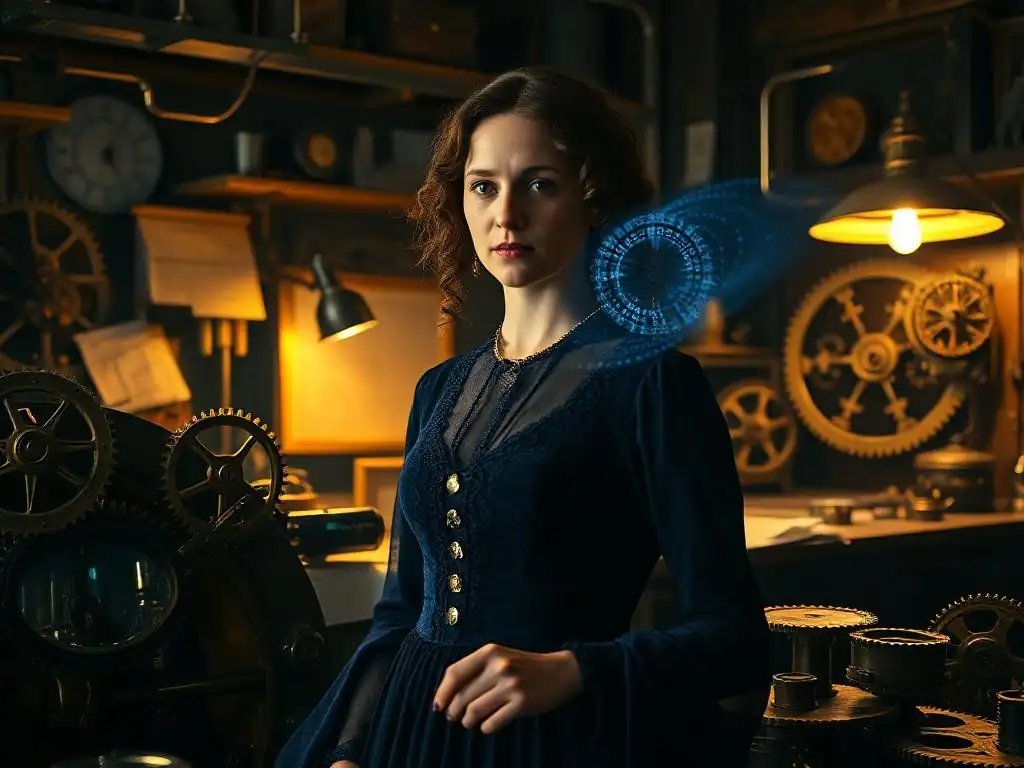
Welcome to WomenInScienceHistory.com, where we unearth the stories of remarkable women who shaped the scientific landscape. Ever wondered if the seeds of Artificial Intelligence were sown much earlier than we think? Dive into our latest exploration of Ada Lovelace AI history as we delve into her groundbreaking work with Babbage's Analytical Engine and question whether the 19th century truly witnessed the dawn of AI. Prepare to be surprised by the insights that await!
- Introduction: Ada Lovelace, Babbage's Engine, and the Dawn of Artificial Intelligence
- Charles Babbage and the Analytical Engine: A Visionary Machine
- Ada Lovelace's Notes: Beyond Calculation to Computation
- Ada Lovelace's Vision of Algorithmic Potential: The Birth of AI Concepts?
- Analyzing Lovelace's Claims: A Modern Perspective on Early AI History
- The Legacy of Ada Lovelace and the Analytical Engine in AI History
- Conclusion: Ada Lovelace, a Visionary of the Digital Age
-
Frequently Asked Questions
- What is Ada Lovelace best known for in the context of Babbage's Engine?
- How does Ada Lovelace's work relate to the history of Artificial Intelligence (AI)?
- What challenges did Ada Lovelace face as a woman in science during the 19th century?
- Was Charles Babbage's Analytical Engine actually built and used in Ada Lovelace's lifetime?
- Why is it important to study the stories of women in science history, like Ada Lovelace?
- Final Reflection: Seeds of Intelligence
- Unleash Your Inner Pioneer: Code the Future!
Introduction: Ada Lovelace, Babbage's Engine, and the Dawn of Artificial Intelligence
Women in Mathematics: Ada Lovelace's Pioneering Role
In the annals of scientific history, few figures shine as brightly and uniquely as Augusta Ada King, Countess of Lovelace, born Ada Byron. The only legitimate child of the poet Lord Byron, Ada Lovelace's journey into the world of mathematics and nascent computing was extraordinary, especially for a woman in the 19th century.
Her mother, Anne Isabella Milbanke, herself a mathematician, ensured Ada received a rigorous education in science and mathematics, a stark contrast to the typical accomplishments expected of aristocratic young women of her era. This unconventional upbringing nurtured a mind predisposed to logic, abstract thought, and a profound curiosity for the mechanisms of the universe, laying the foundation for her later groundbreaking work.
Lovelace’s intellect flourished under the tutelage of notable scholars, including Mary Somerville, a prominent scientific writer and polymath, who became a crucial mentor and introduced her to Charles Babbage. This introduction was pivotal, as it connected Lovelace with Babbage's revolutionary ideas about mechanical computation.
Her early exposure to advanced mathematical concepts, coupled with her imaginative and analytical spirit, allowed her to grasp the profound implications of Babbage's Analytical Engine in a way few of her contemporaries could, positioning her as a vital figure in the early history of computing and setting the stage for discussions on Ada Lovelace AI history.
The Analytical Engine: A 19th-Century Precursor to Modern Computers
The mid-19th century witnessed the conceptual birth of what many consider the mechanical ancestor of modern computers: Charles Babbage's Analytical Engine. Conceived by the eccentric and brilliant British mathematician Charles Babbage in the 1830s, this colossal machine was envisioned as a general-purpose, programmable calculating device, far more sophisticated than any mechanical calculator that preceded it. Unlike his earlier Difference Engine, which was designed for specific mathematical tasks like generating polynomial tables, the Analytical Engine was intended to perform any mathematical operation, given the correct instructions.
Babbage's design incorporated many elements now fundamental to digital computers, including a "Mill" (the central processing unit), a "Store" (memory), and a system for input and output using punched cards, inspired by the Jacquard loom. While the Analytical Engine remained largely a theoretical construct due to the technological limitations and immense costs of the era, its conceptual blueprint was remarkably prescient. It laid the groundwork for the very idea of a programmable machine, a concept that would profoundly influence the trajectory of computing and ultimately spark discussions about artificial intelligence, making its connection to Ada Lovelace AI history undeniable.
Charles Babbage and the Analytical Engine: A Visionary Machine
Understanding the Analytical Engine's Design and Functionality
Charles Babbage's Analytical Engine was a marvel of conceptual engineering, designed with an architecture that strikingly prefigured modern computers. At its core, the machine consisted of several interconnected components: the "Mill," which was the arithmetic logic unit (ALU) responsible for performing calculations; the "Store," acting as memory to hold numbers and intermediate results; and an input/output system primarily relying on punched cards. These cards, similar to those used in Jacquard looms for weaving complex patterns, would dictate both the numerical data and the sequence of operations (the program) the engine was to execute.
The engine was intended to be driven by steam, a common power source in the 19th century, and its intricate system of gears, levers, and shafts would mechanically process the instructions. Its design allowed for conditional branching (if-then statements), looping, and parallel processing, capabilities that are standard in today's software but were revolutionary concepts for a mechanical device. Babbage's detailed drawings and notes for the Analytical Engine, spanning thousands of pages, reveal a machine of incredible complexity and foresight, a testament to his visionary genius in defining the fundamental elements of a programmable computer.
Babbage's Unfinished Dream: The Engine's Limitations and Potential
Despite Babbage's meticulous designs and relentless dedication, the Analytical Engine was never fully constructed during his lifetime. The primary hurdles were multifaceted: the sheer scale and precision required for its mechanical components surpassed the manufacturing capabilities of the mid-19th century, leading to exorbitant costs. Furthermore, Babbage himself was known for constantly refining his designs, a perfectionist tendency that often led to "design creep" and made it difficult to finalize construction. His ambitious vision often outpaced the technological realities and funding available to him.
Nevertheless, the potential of the Analytical Engine, even in its theoretical form, was immense. Had it been built, it would have been capable of performing complex mathematical calculations, automating tedious tasks, and even manipulating symbolic logic.
Its conceptual design demonstrated the feasibility of a general-purpose computer, laying the groundwork for future generations of computer scientists and engineers. The Analytical Engine's legacy lies not in its physical realization, but in its profound conceptual influence, offering a blueprint for the information age and igniting the very first thoughts on how machines could process more than just numbers, a crucial step in Ada Lovelace AI history.
Ada Lovelace's Notes: Beyond Calculation to Computation
Translating and Expanding: Lovelace's Contribution to Babbage's Work
Ada Lovelace's most significant contribution to the world of computing came through her extensive "Notes" on Charles Babbage's Analytical Engine. In 1842, she was tasked with translating an article by Italian mathematician Luigi Menabrea about the Analytical Engine from French into English for publication in a British journal. However, Lovelace did not merely translate; she significantly expanded the original text, adding her own detailed annotations, which ultimately proved to be nearly three times longer than Menabrea's original memoir. These "Notes A-G" are where her profound insights into the machine's capabilities truly shone.
Lovelace's annotations went far beyond technical explanations of the engine's mechanics. She delved into its potential, envisioning it as a machine that could process more than just numerical calculations. Her notes explored the abstract nature of the engine's operations, recognizing its capacity for symbolic manipulation and its ability to follow complex sequences of instructions. This intellectual leap from a mere calculating machine to a general-purpose manipulator of symbols is a cornerstone of modern computing and firmly places her at the heart of early Ada Lovelace AI history.
The Lovelace Algorithm: A Program for Calculating Bernoulli Numbers
Among Lovelace's most famous contributions within her notes is what is widely regarded as the first computer program. In "Note G," she detailed a step-by-step sequence of operations for the Analytical Engine to calculate Bernoulli numbers, a complex mathematical sequence. This detailed algorithm demonstrated how the machine could execute a series of instructions, including looping and conditional statements, to perform a non-trivial computation. It was a concrete example of how the abstract concept of a programmable machine could be put into practice.
This "Lovelace Algorithm" was not merely a theoretical exercise; it illustrated the Analytical Engine's capacity to go beyond simple arithmetic and perform complex computational tasks. It showcased the machine's ability to be "programmed" to solve problems that required iterative processes and intricate logical steps. Her meticulous explanation of this program solidified her understanding of the machine's true potential as a general-purpose processor, capable of carrying out any well-defined set of instructions, thereby establishing a fundamental principle of computer programming.
Ada Lovelace's Vision of Algorithmic Potential: The Birth of AI Concepts?
Lovelace's Observations on the Engine's Creative Capacity
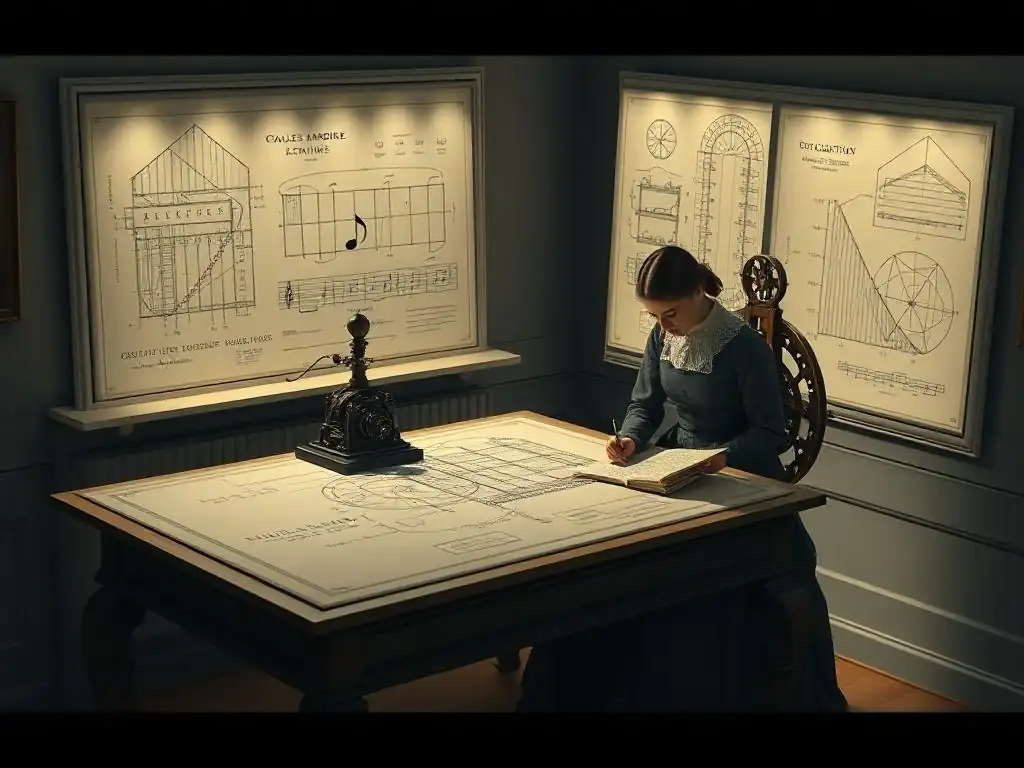
Ada Lovelace's most forward-thinking insights emerged from her contemplation of the Analytical Engine's potential beyond mere numerical computation. She famously posited that the Engine "might act upon things other than number," provided that "these things could be made susceptible of the abstract relations of operations, which could be expressed by the science of operations." Her imaginative leap suggested that if musical notes, logical propositions, or even images could be translated into a mathematical form, the Engine could theoretically compose elaborate pieces of music, create intricate graphical patterns, or even generate complex scientific theories.
This visionary statement is often cited as an early glimmer of the concept of artificial intelligence, or at least of general-purpose computation. Lovelace understood that the Engine was not just a calculator but a machine capable of manipulating symbols according to rules. This marked a profound shift from viewing machines as mere tools for arithmetic to seeing them as potential engines for processing any form of information that could be formalized, opening doors to the idea of machine intelligence and the potential for machines to "create" or "reason."
The "Lovelace Objection": Evaluating Machine Creativity and Intelligence
Despite her expansive vision, Lovelace also articulated a crucial limitation of the Analytical Engine, which has come to be known as the "Lovelace Objection" or "Lady Lovelace's Objection." She argued that "The Analytical Engine has no pretensions whatever to originate anything. It can do whatever we know how to order it to perform." This statement highlights her belief that the machine could only execute predefined instructions; it could not spontaneously generate new ideas, learn independently, or truly "think" in a human sense.
This objection has become a pivotal point of discussion in the philosophy of artificial intelligence. It raises fundamental questions about the nature of machine creativity and intelligence: can a machine truly be considered intelligent if its actions are ultimately derived from human programming? Lovelace's foresight in posing this question, even before the concept of AI existed, demonstrates her deep understanding of the philosophical implications of algorithmic machines. Her careful distinction between computation and true originality remains a cornerstone of debates in Ada Lovelace AI history.
Analyzing Lovelace's Claims: A Modern Perspective on Early AI History
Did Lovelace Truly Foresee Artificial Intelligence? [Discuss differing viewpoints]
The question of whether Ada Lovelace truly foresaw artificial intelligence is complex, prompting varied interpretations among historians and AI theorists. On one hand, proponents argue that her recognition of the Analytical Engine's capacity to manipulate symbols beyond numbers, her vision of it composing music or generating graphics, and her understanding of its general-purpose programmability were remarkably prescient.
Her conceptualization of algorithms as sequences of operations that could govern non-numerical processes aligns with the foundational principles of modern AI, particularly in areas like natural language processing or expert systems. She recognized the abstract nature of computation, a key insight that transcends Babbage's more utilitarian focus on numerical tables.
Conversely, the "Lovelace Objection" forms the basis of arguments against her having foreseen AI as we understand it today. Her assertion that the machine could only do "whatever we know how to order it to perform" suggests a limitation that contrasts with contemporary AI's emergent behaviors, machine learning, and neural networks, which can discover patterns and generate outputs not explicitly programmed.
While she understood the power of algorithms, she did not anticipate machines that could learn from data or develop novel solutions without direct human instruction. This distinction is crucial when discussing Ada Lovelace AI history, as it highlights the evolution of AI concepts over nearly two centuries.
The Limits of the Analytical Engine and the Definition of "Thinking" Machines
To fully assess Lovelace's foresight, it's essential to consider the inherent limitations of the Analytical Engine itself. As a purely mechanical device, it lacked the electronic components, vast memory, and processing speed necessary for genuine self-modification or learning. It was designed to execute deterministic instructions, not to adapt, evolve its own code, or engage in the kind of complex pattern recognition that characterizes modern machine learning. The engine was a powerful, programmable calculator, but not a "thinking" machine in the sense of possessing consciousness, intuition, or genuine creativity.
The philosophical debate surrounding "thinking" machines, implicitly touched upon by Lovelace, continues to this day. While modern AI can simulate aspects of human intelligence, the core question of whether machines truly "think" or "understand" remains contentious. Lovelace's objection, therefore, wasn't just about the Analytical Engine's capabilities but a deeper philosophical inquiry into the nature of intelligence and the boundaries between human cognition and mechanical operation. Her insights provided an early framework for this ongoing discussion, solidifying her place in the intellectual origins of Ada Lovelace AI history.
The Legacy of Ada Lovelace and the Analytical Engine in AI History
Lovelace's Influence on Computer Science and Artificial Intelligence
Ada Lovelace's profound insights, particularly her "Notes" on the Analytical Engine, although largely unappreciated in her own time, proved foundational for the burgeoning fields of computer science and artificial intelligence. Her detailed explanation of the Bernoulli numbers algorithm is widely recognized as the first computer program, establishing the very concept of software. More significantly, her vision of the Engine's potential beyond mere arithmetic—its capacity to manipulate symbols and process non-numerical data—laid conceptual groundwork for general-purpose computing and, indirectly, for AI.
Her work directly influenced later pioneers. For instance, Alan Turing, a century later, grappled with Lovelace's Objection in his seminal paper "Computing Machinery and Intelligence" (1950), which introduced the Turing Test. He acknowledged her argument while seeking to challenge its implications for truly intelligent machines.
The fact that her ideas were still being debated by the architects of modern computing underscores her enduring intellectual legacy. Furthermore, the programming language "Ada," developed by the U.S. Department of Defense in the 1970s, was named in her honor, a fitting tribute to her role as the "Enchantress of Number" and a key figure in Ada Lovelace AI history.
Commemorating Ada Lovelace: A Lasting Impact on STEM
Today, Ada Lovelace is widely celebrated as a visionary pioneer in computer science and a symbol for women in STEM (Science, Technology, Engineering, and Mathematics). Her story serves as a powerful reminder of the often-overlooked contributions of women to scientific and technological advancements throughout history. Ada Lovelace Day, observed annually on the second Tuesday of October, is a global initiative dedicated to raising the profile of women in STEM and encouraging young girls to pursue careers in these fields.
Her legacy extends beyond historical recognition; it actively inspires contemporary efforts to promote diversity and inclusion in technology. Universities, technology companies, and educational organizations frequently reference her work to illustrate the long lineage of computing and to champion the vital role of women in shaping our digital world. Lovelace's intellectual courage and foresight continue to resonate, proving that even in the 19th century, a mind unconstrained by conventional expectations could glimpse the future of computation and hint at the complex questions surrounding artificial intelligence, firmly establishing her as a foundational figure in Ada Lovelace AI history.
Conclusion: Ada Lovelace, a Visionary of the Digital Age
Reassessing Lovelace's Contributions to the History of AI
Ada Lovelace's unique position at the intersection of mathematics, engineering, and philosophical inquiry makes her an unparalleled figure in the early history of computing. While she did not use the term "artificial intelligence," her "Notes" on Babbage's Analytical Engine contain conceptual seeds remarkably aligned with later AI development. Her ability to abstract the machine's operations beyond mere number crunching to the manipulation of symbols, envisioning its potential for creative outputs like music, demonstrates an extraordinary foresight into general-purpose computation. This comprehensive understanding of algorithmic potential distinguishes her from her contemporaries, including Babbage himself, who primarily focused on numerical applications.
Her "Lovelace Objection," far from diminishing her vision, actually elevates it by introducing a crucial philosophical debate about machine autonomy and creativity that remains central to AI discussions today. It shows a nuanced understanding of the difference between complex computation and genuine intelligence, a distinction that continues to challenge researchers. Thus, reassessing her contributions reveals not just a brilliant mathematician, but a true visionary whose insights provide a critical early chapter in the complex narrative of Ada Lovelace AI history.
The Enduring Relevance of Lovelace's Work in the 21st Century
In an age dominated by artificial intelligence, machine learning, and pervasive digital technology, Ada Lovelace's work retains profound relevance. Her foundational concepts of algorithms, programmability, and the symbolic manipulation of data are the bedrock upon which our modern digital world is built.
Every line of code, every AI model, and every piece of software owes a conceptual debt to the principles she articulated nearly two centuries ago. Her understanding that machines could process more than just numbers—that they could be instructed to operate on any formalized data—was a monumental leap that underpins everything from natural language processing to generative AI.
Moreover, the philosophical questions she raised about machine creativity and the limits of automated processes continue to fuel ethical and theoretical discussions in the AI community. As AI systems become increasingly sophisticated, the "Lovelace Objection" serves as a timeless reminder to critically evaluate the nature of machine intelligence. Ada Lovelace's legacy is therefore not just historical; it is a living inspiration, reminding us of the visionary power of human intellect and the enduring impact of those who dare to imagine the future of technology, securing her place as a pivotal figure in Ada Lovelace AI history.
Frequently Asked Questions
What is Ada Lovelace best known for in the context of Babbage's Engine?
Ada Lovelace is best known for her notes on the Analytical Engine, which are considered by some to contain the first algorithm intended to be processed by a machine. This is why she's often called the first computer programmer.
How does Ada Lovelace's work relate to the history of Artificial Intelligence (AI)?
Although the Analytical Engine was never fully built in her lifetime, Lovelace's notes explored the potential of such a machine to do more than just calculate numbers. This foresight into machine capabilities beyond calculation is seen by many as a precursor to the concept of AI.
What challenges did Ada Lovelace face as a woman in science during the 19th century?
Lovelace faced significant social and gender barriers common to women during the Victorian era. Limited access to education and the prevailing societal expectations hindered her full participation in scientific endeavors.
Was Charles Babbage's Analytical Engine actually built and used in Ada Lovelace's lifetime?
No, Babbage's Analytical Engine was never fully constructed during his or Lovelace's lifetime due to funding and technological limitations. Modern reconstructions have proven the design's theoretical viability.
Why is it important to study the stories of women in science history, like Ada Lovelace?
Studying women in science history is crucial to recognizing their contributions, which have often been overlooked. It also inspires future generations of scientists and promotes greater diversity and inclusivity in STEM fields.
Final Reflection: Seeds of Intelligence
The exploration of Ada Lovelace and Charles Babbage's Analytical Engine reveals more than just a historical footnote; it underscores the profound and enduring question of artificial intelligence's origins. What began as a theoretical machine in the 19th century has blossomed into a technological revolution reshaping our world today, forcing us to confront the very definition of intelligence and its potential.
The legacy of Lovelace and Babbage continues to resonate, shaping our understanding of computation and its possibilities. Their visionary work, often overlooked, laid the groundwork for the digital age we inhabit, prompting us to consider the ethical and societal implications of increasingly sophisticated AI systems. The Analytical Engine has no pretensions whatever to originate anything. It can do whatever we know how to order it to perform.
- Ada Lovelace's notes on the Analytical Engine, a statement that continues to fuel debate about the nature of creativity and intelligence in machines.
As we stand on the precipice of further AI advancements, let us remember the pioneering spirit of Ada Lovelace and Charles Babbage. Their intellectual curiosity and unwavering belief in the power of computation serve as a beacon, guiding us to approach the future of AI with both excitement and responsibility. Consider how their vision, born in a time of gears and steam, can inform our choices today as we shape a world increasingly defined by algorithms and artificial minds.
Unleash Your Inner Pioneer: Code the Future!
Thank you for diving into the groundbreaking story of Ada Lovelace and Charles Babbage! We hope you’ve gained a newfound appreciation for their visionary work and its impact on the dawn of computing. Now, let's translate that inspiration into action!
- Commit to learning a new programming language this month. Ada Lovelace paved the way; now it's your turn to explore the digital landscape.
- Share this article with three friends or colleagues who would be inspired by Ada’s story and challenge them to join you in your coding adventure!
- Visit a local science museum or attend a tech-related event to deepen your understanding of computer science history and its modern applications.
What small step will you take today to honor Ada Lovelace's legacy and push the boundaries of what's possible in the world of science and technology?