
When Women Ran the Lab: Exploring FemaleLed Science Departments in University History

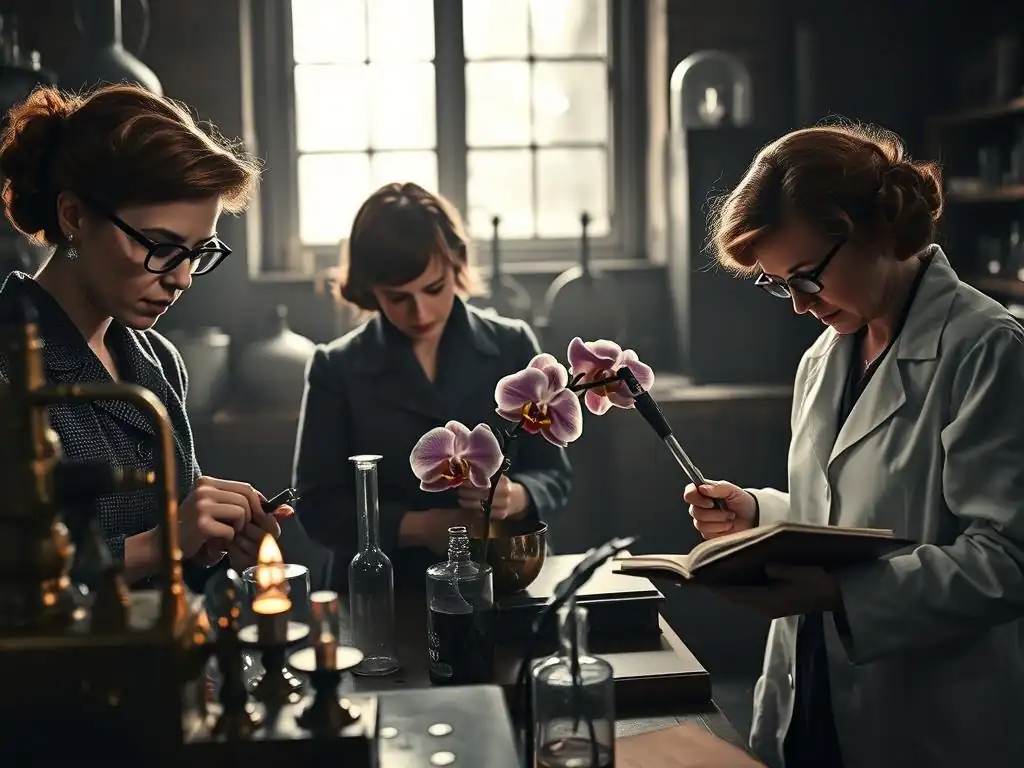
Welcome to WomenInScienceHistory.com, where we unearth the untold stories of women who shaped the scientific landscape! Dive into a realm of groundbreaking discoveries and unwavering perseverance. Ever wondered when women truly ran the lab? This time, we focus on femaleled university science departments in history. Join us as we explore these pivotal moments and the exceptional women who dared to lead, defying conventions and paving the way for future generations. Prepare to be inspired by their legacy.
Case Studies: Universities with Notable Female-Led Science Departments
Bryn Mawr College: A Model of Female Leadership in Mathematics
Bryn Mawr College, a women's liberal arts institution founded in 1885, stands out as an early and exceptional example of a university where a female-led university science department flourished. From its inception, the college was committed to providing women with an education equivalent to that offered at leading male universities, actively recruiting distinguished female scholars to its faculty. This progressive ethos created fertile ground for women to not only pursue scientific studies but also to assume leadership roles, particularly within its mathematics department.
The college’s commitment to academic excellence for women was evident in its early faculty appointments. This environment fostered a unique opportunity for women to excel in fields often considered male domains, such as mathematics, and to establish departments that were truly female-led university science departments in practice and spirit. The institutional support for women in science was foundational to the department's pioneering achievements and its lasting influence.
Charlotte Angas Scott: Shaping Mathematical Education for Women
Charlotte Angas Scott, an English mathematician and one of the first women to achieve a First-Class Honours degree from Cambridge University, was appointed professor of mathematics at Bryn Mawr College in 1885, becoming the first female professor of mathematics in the United States. Scott swiftly established a rigorous graduate program in mathematics, attracting talented female students from across the nation. Her leadership was instrumental in shaping the curriculum, which emphasized pure mathematics, including advanced topics like modern algebra and differential geometry, then uncommon in American universities.
Under Scott's formidable intellectual direction, the Bryn Mawr mathematics department became a beacon for women aspiring to careers in mathematics. She was known for her demanding yet supportive teaching style, fostering an environment where critical thinking and original research were highly valued. Her tenure marked a significant departure from the typical "finishing school" approach to women's education, instead promoting genuine scholarly pursuit within a female-led university science department.
Key Achievements of the Bryn Mawr Mathematics Department Under Scott's Leadership
The mathematics department at Bryn Mawr, under Charlotte Angas Scott's leadership, achieved remarkable milestones. It became the first American institution to offer a Ph.D. in mathematics to a woman, graduating Annie Louise Macleod in 1888. By 1910, the department had awarded approximately one-third of all Ph.D.s in mathematics granted to women in the United States. This impressive output underscored its role as a leading center for advanced mathematical education for women.
Beyond doctoral degrees, the department produced numerous female scholars who went on to hold academic positions at other colleges and universities, influencing mathematical education nationally. Scott herself was a prolific researcher, publishing over 30 papers, primarily in algebraic geometry, and was a founding member of the American Mathematical Society, serving on its council from 1891 to 1894. The department's focus on foundational research and rigorous training solidified its reputation as a premier female-led university science department.
Lasting Impact on Mathematics and the College
The legacy of Charlotte Angas Scott and the Bryn Mawr mathematics department is profound. It demonstrated unequivocally that women could not only excel in complex scientific fields but also lead and build highly successful academic departments. The department served as a powerful counter-narrative to the prevailing skepticism about women's intellectual capabilities in science. Its graduates populated mathematics faculties across the country, disseminating a rigorous standard of education and research.
For Bryn Mawr College, the mathematics department became a symbol of its commitment to academic excellence and gender equality in education. It set a precedent for other female-led university science departments within the college and beyond, illustrating the transformative power of female leadership in fostering scientific innovation and education. The standards of scholarship and mentorship established by Scott continue to resonate, inspiring future generations of female mathematicians.
Mount Holyoke College: Fostering a Supportive Environment for Women in Astronomy
Mount Holyoke College, founded in 1837 as a seminary and later transitioning into a women's college, cultivated a strong tradition in science education, particularly in astronomy. This institution, like Bryn Mawr, provided a unique setting where women could not only pursue scientific interests but also take on significant leadership roles, culminating in the establishment of a prominent female-led university science department in astronomy. The college's early emphasis on practical, hands-on scientific training laid the groundwork for its future successes.
The supportive and nurturing environment at Mount Holyoke was crucial for the development of its science programs. The college actively encouraged its female students to engage with scientific inquiry, providing resources and faculty dedicated to promoting women's participation in STEM. This institutional support was a critical factor in enabling the astronomy department to thrive under female leadership, fostering an atmosphere of intellectual curiosity and collaborative discovery.
Sarah Frances Whiting: Pioneering Astronomical Research and Education
Sarah Frances Whiting, a physicist and astronomer, joined Mount Holyoke College in 1876 and was instrumental in establishing its physics and astronomy departments. She became the first director of the Mount Holyoke College Observatory, which opened in 1881. Under her leadership, the astronomy department became a hub of innovative teaching and research, making it a truly female-led university science department. Whiting was a visionary educator who believed in hands-on learning, integrating direct observation and practical application into her curriculum.
Whiting's influence extended beyond the classroom; she introduced students to cutting-edge technologies like spectroscopy and photography, which were relatively new to astronomical research at the time. Her dedication to providing comprehensive scientific training ensured that her students were well-prepared for advanced studies or careers in science. She fostered an environment where women were empowered to conduct original research and contribute meaningfully to the field of astronomy.
Innovative Research and Educational Programs Developed
Under Sarah Frances Whiting’s direction, the Mount Holyoke astronomy department pioneered several innovative research and educational programs. The establishment of the observatory itself was a significant achievement, providing students with access to state-of-the-art equipment, including an 8-inch equatorial telescope. Whiting was among the first educators to incorporate celestial photography into the astronomy curriculum, teaching students how to capture and analyze astronomical images.
One notable achievement was the department's participation in the Harvard College Observatory's photographic sky surveys, where Mount Holyoke students contributed to the systematic cataloging of stars. This collaborative research provided invaluable practical experience, preparing students for careers in professional astronomy. The department also focused on stellar spectroscopy, analyzing the chemical composition of stars, a field in which Whiting herself conducted research. These programs solidified Mount Holyoke's reputation as a leading female-led university science department in astronomy.
Creating a Legacy of Women in Science at Mount Holyoke
The impact of Sarah Frances Whiting and the astronomy department at Mount Holyoke College was far-reaching. The department produced a remarkable number of women who went on to achieve prominence in astronomy and related fields, including Annie Jump Cannon, a renowned astronomer at Harvard College Observatory, who graduated from Mount Holyoke in 1884. Cannon later became famous for her work in stellar classification, classifying over 300,000 stars.
The legacy of the Mount Holyoke astronomy department under Whiting's leadership was one of empowering women to become leaders and innovators in science. It demonstrated that a female-led university science department could not only maintain high academic standards but also foster groundbreaking research and inspire future generations of female scientists. The college's continued strength in science fields today can be traced back to these foundational efforts, proving the enduring influence of early female scientific leadership.
Vassar College: Pioneering Women in Astronomy
Vassar College, founded in 1861 as one of the first women's colleges in the United States, made a groundbreaking commitment to scientific education for women from its very beginning. Its charter explicitly stated that "the course of study shall be of a higher order, and shall be as thorough as any in the country." This dedication to rigorous academic training, particularly in the sciences, set the stage for its astronomy program to become a notable female-led university science department under the guidance of its most prominent early scientist.
The college's founder, Matthew Vassar, ensured that the campus included a fully equipped observatory, demonstrating an early and significant investment in scientific infrastructure for women. This commitment signaled that Vassar was serious about providing women with the resources necessary to engage in cutting-edge scientific inquiry. The supportive atmosphere, coupled with state-of-the-art facilities for its time, created an ideal environment for a pioneering female scientist to establish a robust and influential department.
Maria Mitchell: Leading the Way in Astronomical Research and Education
Maria Mitchell, America's first professional female astronomer and the first woman elected to the American Academy of Arts and Sciences, was appointed Professor of Astronomy and Director of the Vassar College Observatory in 1865. Her appointment was revolutionary, placing a woman in a position of significant scientific leadership at a time when such opportunities were virtually nonexistent for women. Mitchell effectively led Vassar's astronomy program, making it a premier female-led university science department.
Mitchell's teaching philosophy was radical for its era. She emphasized hands-on observation, critical thinking, and independent research, often taking her students on scientific expeditions. She believed in fostering intellectual curiosity and encouraged her students to challenge existing theories and make their own discoveries. Her leadership transformed the observatory into a living laboratory where students were active participants in scientific inquiry rather than passive learners.
The Vassar Observatory: A Hub of Female-Driven Discovery
Under Maria Mitchell's direction, the Vassar College Observatory became a vibrant center for astronomical research and education, driven predominantly by women. The observatory, equipped with a 12-inch refractor telescope (one of the largest in the U.S. at the time), allowed students to conduct original research. Mitchell and her students regularly observed sunspots, nebulae, comets, and double stars, meticulously recording their findings. This observational work contributed significantly to the astronomical knowledge base of the era.
Mitchell famously involved her students in her own research, a practice uncommon at the time, empowering them to contribute directly to scientific discovery. For example, her students were actively engaged in observing and calculating the orbits of comets and asteroids. This hands-on, collaborative approach ensured that the Vassar astronomy department was not just teaching science but actively doing science, all under the direct guidance of a prominent female leader in the field, solidifying its status as a female-driven scientific hub.
Inspiring Generations of Women in Science at Vassar
The legacy of Maria Mitchell and the astronomy department at Vassar College is one of profound inspiration and empowerment for women in science. Mitchell's tenure produced a generation of highly capable female astronomers and educators who went on to make their own contributions to the scientific community. Her students included figures like Mary Watson Whitney, who succeeded Mitchell as professor and director of the observatory, continuing the tradition of female leadership in the department.
Mitchell's unwavering belief in women's intellectual capabilities and her commitment to providing them with rigorous scientific training created a powerful precedent. The Vassar astronomy department under her leadership demonstrated that female-led university science departments could achieve excellence in research and education, challenging societal norms and opening doors for countless women in STEM. Her pioneering work continues to be celebrated as a testament to the transformative power of female leadership in scientific academia.
- What exactly is a female-led university science department, as discussed in this context?
- Why is it important to explore the history of female-led university science departments?
- What were some of the biggest challenges faced by women leading university science departments historically?
- How did these female-led departments contribute to their respective scientific fields?
- Where can I find more in-depth information about specific female-led university science departments and the women who led them?
Frequently Asked Questions
What exactly is a female-led university science department, as discussed in this context?
It refers to a science department within a university where a woman held a leadership position, such as head of department or principal investigator, significantly shaping its direction and research. These departments represent a departure from the historical norm.
Why is it important to explore the history of female-led university science departments?
It's crucial to recognize and celebrate the often-overlooked contributions of women in science. Understanding their historical presence helps to challenge existing biases and inspire future generations of female scientists.
What were some of the biggest challenges faced by women leading university science departments historically?
Women faced significant barriers, including gender discrimination, limited access to funding and resources, and societal expectations that often prioritized domestic roles over professional pursuits.
How did these female-led departments contribute to their respective scientific fields?
Many female-led departments made groundbreaking discoveries and fostered innovative research environments. Their contributions often had a lasting impact, even when their work was initially marginalized or ignored.
Where can I find more in-depth information about specific female-led university science departments and the women who led them?
Resources like WomenInScienceHistory.com offer biographies, articles, and discussions that delve into the lives and work of pioneering female scientists and the departments they shaped. Further research can be done in academic archives and libraries.
Final Reflection: Echoes of Innovation
The narratives unearthed in this exploration of female-led university science departments resonate powerfully today, reminding us that progress is not a linear ascent, but a constant negotiation with historical biases. The stories of these pioneering women, often obscured by the dominant narratives of their time, serve as a crucial reminder of the untapped potential that lies dormant when talent is overlooked due to gender.
The impact of these women extends far beyond the confines of their laboratories; they reshaped the very landscape of scientific inquiry, paving the way for future generations of female scientists. Their struggles and triumphs underscore the enduring importance of creating inclusive environments where diverse perspectives can flourish. You educate a man; you educate a man. You educate a woman; you educate a generation.
This African proverb encapsulates the profound ripple effect of empowering women in science, fostering innovation and inspiring countless others to pursue their passions, regardless of societal expectations.
As we reflect on the legacies of these remarkable women, let us commit to actively dismantling the barriers that continue to hinder gender equity in STEM fields. Consider how you can contribute to creating a more inclusive and supportive environment, whether through mentorship, advocacy, or simply by amplifying the voices of women in science. The future of scientific discovery depends on our collective willingness to learn from the past and build a more equitable present.
Unveil Your Inner Scientist: Support Future Female Pioneers!
Thank you for diving into the inspiring history of female-led science departments! Now it’s time to translate that inspiration into tangible action. Let's build a future where women thrive in STEM.
- Donate to a scholarship fund specifically dedicated to supporting women pursuing degrees in science and engineering. Even a small contribution can make a big difference!
- Share this article with your network to spread awareness and spark conversations about the importance of female leadership in science.
- Explore our website's archives to discover more untold stories of pioneering women in STEM and consider highlighting one on social media.
What small step will you take today to help level the playing field for women in science?