
Predicting Celestial Drama: The Forgotten Women Calculators of 18th & 19th Century Eclipses and Transits

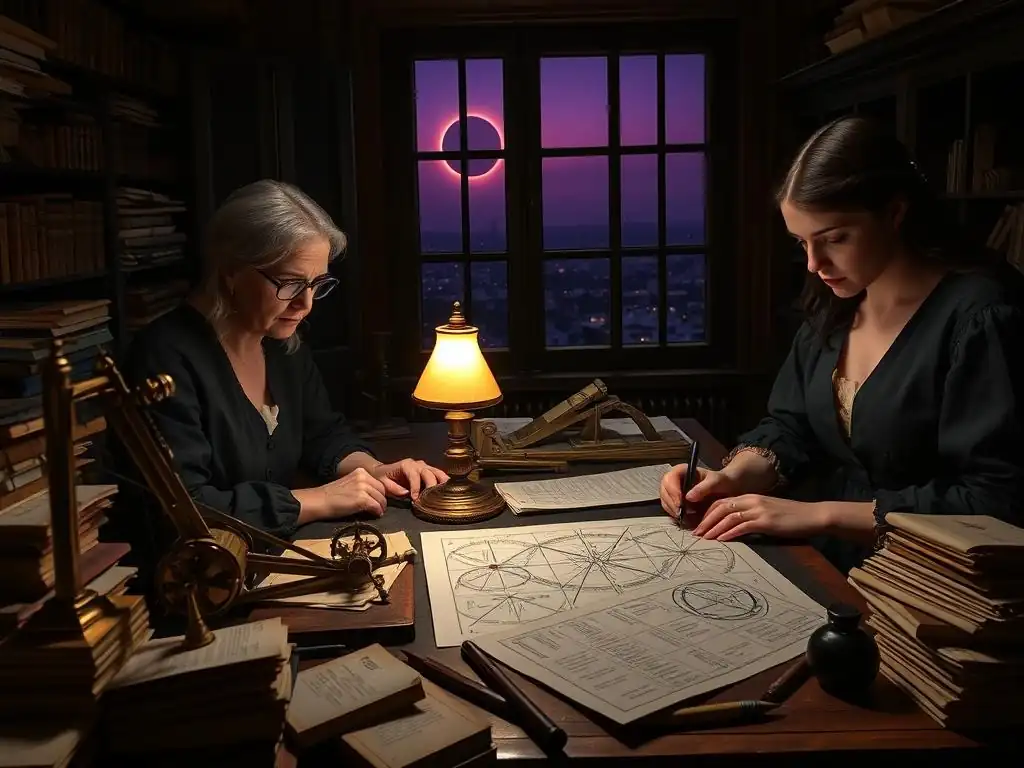
Welcome! Ever wondered who meticulously charted the heavens, predicting the celestial dance of eclipses and transits? Dive into the untold stories of the women calculating eclipses transit tables in the 18th and 19th centuries. These unsung heroines of space science played a vital role in astronomy, facing unique challenges in a world that often overlooked their brilliance. Uncover their groundbreaking contributions and discover how they helped illuminate the cosmos. Ready to explore their fascinating journey?
- Introduction: Unveiling the Untold Stories of Women in Astronomy
- The Crucial Role of Women in Calculating Eclipses and Transits
- Profiles of Pioneering Women Calculators
- The Mathematical Skills and Techniques Employed by Women Calculators
- The Societal Context: Barriers and Opportunities for Women in Science
- Examples of Significant Eclipse and Transit Calculations
- The Legacy of Women Calculators: Inspiring Future Generations
- Rediscovering and Preserving the History of Women in Astronomy
- Conclusion: Celebrating the Enduring Impact of Women Calculating Eclipses and Transits
-
Frequently Asked Questions
- What was the primary role of women "calculators" in 18th and 19th century astronomy, specifically regarding eclipses and transits?
- Why were women often relegated to the role of "calculators" rather than recognized as astronomers in their own right?
- What challenges did women "calculators" face in a male-dominated field like astronomy?
- How did the work of women "calculators" contribute to our understanding of eclipses and transits?
- Where can I find more information about women who contributed to calculating eclipses and transit tables?
- Final Reflection: Illuminating the Shadows of Calculation
- Unleash Your Inner Astronomer!
Introduction: Unveiling the Untold Stories of Women in Astronomy
Highlighting the Contributions of Women to Astronomy
Throughout history, women have made profound, yet often unacknowledged, contributions to the field of astronomy. From ancient stargazers to modern astrophysicists, their intellectual curiosity and rigorous dedication have consistently pushed the boundaries of human understanding of the cosmos. In the 18th and 19th centuries, a pivotal era for observational astronomy, the meticulous work of women was particularly crucial in the painstaking process of data analysis and prediction, laying foundational groundwork for major discoveries.
These women, often referred to as "human computers" or "calculators," engaged in the demanding, detailed work that underpinned astronomical research. Their efforts involved processing vast amounts of raw observational data, performing complex mathematical computations, and meticulously verifying results. Without their tireless precision, many groundbreaking astronomical predictions and discoveries of the period, including those by prominent male astronomers, would have been significantly delayed or simply impossible to achieve.
The Underrepresentation of Women Calculators in Historical Accounts
Despite their indispensable role, the contributions of these women calculators have been largely marginalized or entirely omitted from conventional historical accounts of science. Societal norms of the 18th and 19th centuries often relegated women to domestic spheres, limiting their formal access to education, scientific institutions, and public recognition. Consequently, their intellectual labor was frequently viewed as supportive clerical work rather than primary scientific endeavor.
This historical oversight has resulted in a skewed narrative where the accomplishments of male astronomers are celebrated in isolation, while the women who performed the critical calculations remain largely anonymous. Their names rarely appeared on published papers, and their efforts were seldom formally acknowledged by scientific societies or academies. This underrepresentation obscures a vital part of scientific heritage, making it imperative to rediscover and highlight the pivotal role of these women calculating eclipses transit tables and other celestial phenomena.
The Crucial Role of Women in Calculating Eclipses and Transits
18th & 19th Century Astronomy: A Landscape of Calculation
The 18th and 19th centuries marked a transformative period in astronomy, characterized by increasingly precise observations and the burgeoning application of Newtonian mechanics to celestial phenomena. Astronomers were not just observing; they were also striving to predict the movements of planets, comets, and the precise timing of events like solar and lunar eclipses, as well as the rare transits of Venus and Mercury across the Sun's disk. This era predated electronic computers, meaning every single calculation, no matter how complex, had to be performed by hand.
The accuracy of these predictions was paramount, not only for scientific validation of theories but also for practical applications such as navigation and timekeeping. The mathematical rigor required to account for the gravitational perturbations of multiple celestial bodies was immense. It necessitated a workforce capable of sustained, meticulous arithmetic, making the role of skilled human calculators, many of whom were women, absolutely critical to the advancement of astronomical knowledge.
The Laborious Task of Predicting Celestial Events
Predicting celestial events like eclipses and transits involved an extraordinary amount of laborious calculation. Astronomers had to apply complex equations derived from celestial mechanics, often incorporating dozens of variables and requiring iterative solutions. This meant hours, days, and even months of working with logarithms, trigonometric tables, and vast sheets of numbers, all without the aid of modern computational tools.
The task of women calculating eclipses transit tables was not merely repetitive; it demanded a high degree of mathematical proficiency, extreme precision, and unwavering patience to avoid errors that could invalidate an entire prediction. Their work was fundamental to creating accurate ephemerides – tables that give the positions of celestial bodies at specific times – which were indispensable for observatories, navigators, and explorers around the globe. The accuracy of these tables directly impacted the success of scientific expeditions and the safety of maritime travel.
Profiles of Pioneering Women Calculators
Nicole-Reine Lepaute: Her Contributions to Halley's Comet Prediction
Nicole-Reine Lepaute (1723–1788) was a French mathematician and astronomer whose contributions to the prediction of Halley's Comet's 1759 return were monumental, though often understated. Collaborating with Alexis Clairaut and Joseph Lalande, Lepaute undertook the incredibly arduous task of calculating the gravitational perturbations on the comet's orbit caused by Jupiter and Saturn. This involved tracking the comet's path over 150 years, considering the influence of these giant planets.
The team worked tirelessly for six months, performing millions of calculations, with Lepaute reportedly responsible for a significant portion of this immense computational burden. Their final prediction for the comet's perihelion (closest approach to the Sun) was April 13, 1759, remarkably close to the actual date of March 13, 1759. Despite her critical role in this triumph of Newtonian mechanics, Lepaute's name was often omitted or downplayed in subsequent publications, overshadowing her pivotal role among women calculating eclipses transit tables and comet returns.
Maria Gaetana Agnesi: Calculating Curves and Mathematical Contributions
Maria Gaetana Agnesi (1718–1799) was an Italian mathematician and philosopher, renowned for her comprehensive textbook "Instituzioni analitiche ad uso della gioventù italiana" (Analytical Institutions for the Use of Italian Youth), published in 1748. This two-volume work was one of the first and most complete treatises on calculus, covering algebra, analytic geometry, differential, and integral calculus. It was widely praised for its clarity and became a foundational text for students across Europe.
While Agnesi did not directly perform celestial predictions like women calculating eclipses transit tables, her work provided the essential mathematical framework for such endeavors. Her ability to synthesize and explain complex mathematical concepts made calculus accessible to a broader audience, including aspiring astronomers. The "Witch of Agnesi," a cubic curve she analyzed, remains a notable contribution to mathematics, underscoring her profound intellectual capabilities and her indirect but significant impact on the tools available for astronomical computation.
Caroline Herschel: Discovering Comets and Nebulae
Caroline Herschel (1750–1848) was a German-born British astronomer, famous for her independent discoveries and meticulous astronomical work. Initially assisting her brother, William Herschel, in grinding mirrors and recording observations, she quickly became an accomplished astronomer in her own right. She systematically swept the night sky, discovering eight comets between 1786 and 1797, including the periodic comet 35P/Herschel-Rigollet.
Herschel was also the first woman in England to receive a salary as a scientist, granted by King George III in 1787 for her astronomical services. Her work extended to compiling and correcting her brother's star catalogs, and she published a "General Catalogue of Nebulae and Clusters" in 1798, adding 2,500 new entries. Her meticulous observations, precise calculations of celestial positions, and systematic approach to cataloging exemplify the dedicated computational work performed by women calculating eclipses transit tables and other astronomical data of lasting value.
The Mathematical Skills and Techniques Employed by Women Calculators
Logarithms, Trigonometry, and Celestial Mechanics
The foundational mathematical tools for 18th and 19th-century astronomers, including women calculating eclipses transit tables, were logarithms and trigonometry. Logarithms vastly simplified complex multiplication and division operations, transforming multi-digit calculations into simpler additions and subtractions, which was crucial for handling the large numbers involved in astronomical distances and times. Trigonometry was essential for working with spherical coordinates to pinpoint celestial objects' positions on the celestial sphere and to understand their apparent movements.
These tools were applied within the framework of celestial mechanics, primarily Newton's laws of motion and universal gravitation. Predicting the precise paths of planets, comets, and the interactions causing eclipses and transits required solving intricate differential equations and accounting for the gravitational pull of multiple bodies. This demanded a deep understanding of physics and an exceptional aptitude for rigorous, error-free computation.
Using Ephemeris Data for Accurate Predictions
Ephemerides were, and still are, tables providing the calculated positions of celestial bodies at specific times, essentially astronomical timetables. Women calculators played a vital role in both utilizing existing ephemeris data and contributing to its refinement and expansion. They would take observational data from telescopes, reduce it through complex calculations, and then use these refined figures to predict future positions or verify past ones.
This process was often iterative: initial observations would lead to preliminary calculations, which in turn would inform more precise observations, leading to further refined calculations. The goal was to continuously improve the accuracy of predictions for events like solar and lunar eclipses, or the rare transits of Venus across the Sun, which were critical for determining the astronomical unit. The precision of women calculating eclipses transit tables directly impacted the reliability of these invaluable astronomical resources.
Challenges in Obtaining and Utilizing Resources
Despite their considerable mathematical prowess, women calculators often faced significant challenges in accessing the necessary resources. Formal educational institutions, such as universities and observatories, were largely closed to women, limiting their access to specialized training, extensive libraries of mathematical and astronomical texts, and the latest scientific instruments. Access to expensive tools like large telescopes or even sophisticated calculating machines (which were rudimentary at the time) was rare.
Many women had to rely on private instruction, family connections, or their own self-study to acquire the advanced knowledge required. They often worked in domestic settings, using hand-copied tables and personal notes, rather than in well-equipped observatories. The sheer mental fortitude required to perform complex calculations under such conditions, often without the intellectual camaraderie or institutional support enjoyed by their male counterparts, underscores their extraordinary dedication and resilience.
The Societal Context: Barriers and Opportunities for Women in Science
Limited Access to Education and Resources
The 18th and 19th centuries were characterized by deeply entrenched societal norms that severely restricted women's access to formal education, particularly in scientific disciplines like mathematics and astronomy. Universities were almost exclusively male domains, and opportunities for women to pursue advanced studies were virtually nonexistent. This systemic exclusion meant that women interested in science often had to rely on informal, self-directed learning.
They typically gained knowledge through private tutors, family members (often fathers or brothers who were scholars), or by diligently studying texts in private libraries. This lack of institutional support and formal training meant that women often had to overcome immense obstacles just to acquire the foundational knowledge necessary to begin contributing to fields like celestial mechanics, much less the specialized skills for women calculating eclipses transit tables.
The Importance of Patronage and Mentorship
For many women in science during this era, the patronage of influential individuals or the mentorship of male relatives was crucial for their ability to pursue intellectual work. For instance, Caroline Herschel's career was enabled by the support and collaboration of her astronomer brother, William Herschel, and later by a salary directly from King George III. Similarly, Maria Gaetana Agnesi's scholarly pursuits were fostered by her wealthy and intellectually inclined father.
These patrons and mentors provided not only financial support but also access to books, instruments, and, crucially, a degree of social legitimacy in a scientific world largely unwelcoming to independent female scholars. While these relationships sometimes came with their own complexities, they were often the only pathway for talented women to engage in serious scientific work, including the demanding task of women calculating eclipses transit tables and other astronomical data.
The Gendered Division of Labor: Women as "Computers"
As scientific endeavors became more complex and data-intensive, the role of "human computer" emerged, particularly in the late 19th and early 20th centuries, to handle the explosion of numerical data. This role, which involved meticulous and often repetitive calculations, was disproportionately filled by women. They were seen as well-suited for such detailed work, often due to societal perceptions of their patience and meticulousness, and also because they could be paid significantly less than men.
While this provided some women with a rare opportunity for paid employment in science, it also often reinforced a gendered division of labor. Women were frequently relegated to the computational "back office," performing the essential but often uncredited calculations, while men received recognition for theoretical breakthroughs or observational discoveries. This dynamic meant that even when women were performing the crucial work of women calculating eclipses transit tables, their direct contributions were often subsumed under the names of male colleagues or institutions.
Examples of Significant Eclipse and Transit Calculations
Lepaute's Calculation of the 1759 Return of Halley's Comet
Nicole-Reine Lepaute's work on the 1759 return of Halley's Comet stands as a monumental achievement in the history of astronomical prediction. The comet's orbit is highly elliptical, and its return date is significantly affected by the gravitational pull of the gas giants, Jupiter and Saturn. To predict its precise perihelion, Lepaute, Clairaut, and Lalande undertook a six-month, round-the-clock computational marathon. Lepaute was specifically tasked with calculating the perturbations for every day of the comet's 150-year orbit, a truly staggering number of individual computations.
Their collective effort resulted in a prediction accurate to within roughly a month of the comet's actual arrival on March 13, 1759. This feat not only validated Newton's law of gravitation but also demonstrated the immense power of meticulous calculation. Lepaute's contribution was crucial, enabling the astronomical community to anticipate and observe this significant celestial event, solidifying her place among the pioneering women calculating eclipses transit tables, even if her specific work focused on a comet.
Herschel's Catalog of Nebulae and Star Clusters
While Caroline Herschel's primary focus was on discovering comets, her broader work involved extensive positional astronomy and data organization, similar in rigor to women calculating eclipses transit tables. Her most significant contribution beyond comet discoveries was the compilation and correction of astronomical catalogs. In 1798, she published a "General Catalogue of Nebulae and Clusters" that significantly expanded upon her brother William's initial work, adding 2,500 new entries.
This undertaking required immense precision in recording observations, calculating celestial coordinates, and cross-referencing existing data. Her meticulous attention to detail and systematic approach were vital for creating accurate and comprehensive maps of the night sky. She also published a "Catalogue of 500 new Nebulae" and produced a comprehensive index to her brother's observations, demonstrating the same level of computational dedication and accuracy required for precise celestial predictions.
Agnesi's work on Analytical Institutions
Maria Gaetana Agnesi's "Instituzioni analitiche ad uso della gioventù italiana" (Analytical Institutions for the Use of Italian Youth), published in 1748, was not a direct calculation of a specific celestial event but rather a foundational mathematical treatise that profoundly impacted the tools available for such calculations. This two-volume work was groundbreaking as one of the first comprehensive textbooks on calculus, covering differential and integral calculus, as well as analytical geometry.
Its clarity and systematic approach made complex mathematical concepts accessible to a wider audience, including future astronomers and those engaged in celestial mechanics. The mathematical principles and techniques meticulously explained by Agnesi were indispensable for anyone, including women calculating eclipses transit tables, who needed to understand and apply the complex equations governing celestial motion. Her work provided the essential theoretical bedrock upon which practical astronomical predictions could be built.
The Legacy of Women Calculators: Inspiring Future Generations
Recognizing the Importance of Women's Contributions
The ongoing effort to recognize the historical contributions of women calculators is not merely an academic exercise; it is crucial for a complete and accurate understanding of scientific progress. By acknowledging the significant work of figures like Nicole-Reine Lepaute, Maria Gaetana Agnesi, and Caroline Herschel, we correct historical omissions and give credit where it is long overdue. This process validates their intellectual labor and the often-overlooked challenges they overcame in male-dominated fields.
Furthermore, highlighting the vital role of these women calculating eclipses transit tables and other astronomical data provides powerful role models for contemporary and future generations. It demonstrates that women have always been active, capable, and indispensable participants in scientific discovery, challenging outdated stereotypes and inspiring young women to pursue careers in STEM (Science, Technology, Engineering, and Mathematics).
Promoting Inclusivity and Diversity in STEM
Understanding the historical barriers faced by women in science offers valuable lessons for promoting greater inclusivity and diversity in STEM fields today. The struggles of women calculators in the 18th and 19th centuries—limited access to education, lack of recognition, and societal biases—resonate with ongoing challenges for underrepresented groups in science. Recognizing these historical patterns can inform strategies to dismantle systemic obstacles that persist in modern scientific environments.
A diverse scientific workforce, encompassing individuals from various backgrounds and perspectives, has been shown to foster more innovative problem-solving and richer scientific outcomes. By celebrating the legacy of women calculating eclipses transit tables, we reinforce the message that talent knows no gender and that scientific progress thrives when all individuals, regardless of their background, are given equitable opportunities to contribute their full potential.
Continuing the Pursuit of Knowledge in Astronomy
The spirit of meticulous inquiry and dedication exemplified by early women calculators continues to drive astronomical research today. While modern astronomers benefit from sophisticated computational tools and vast digital datasets, the fundamental pursuit of understanding the cosmos remains rooted in rigorous observation, precise data analysis, and the application of complex mathematical models. The legacy of these pioneering women underscores a continuous thread of human endeavor in unraveling celestial mysteries.
Their work reminds us that every grand astronomical discovery is built upon countless hours of painstaking, often unglamorous, foundational work. By honoring the women who meticulously calculated celestial positions and predicted dramatic events centuries ago, we celebrate the enduring human desire to explore, understand, and predict the workings of the universe, inspiring ongoing scientific exploration and discovery for generations to come.
Rediscovering and Preserving the History of Women in Astronomy
Archival Research and the Unearthing of Forgotten Documents
The rediscovery of the contributions of women in astronomy, particularly those like the women calculating eclipses transit tables, is an ongoing and often painstaking process. It relies heavily on meticulous archival research. Historians and scholars delve into forgotten observatory logs, personal letters, private diaries, obscure scientific publications, and institutional records, painstakingly piecing together fragments of information.
This dedicated effort often involves cross-referencing seemingly minor mentions or anonymous entries to identify the individuals behind crucial calculations and observations. Many of these women's contributions were either uncredited or attributed to male colleagues, making the detective work challenging but essential. Each unearthed document helps to reconstruct a more complete and accurate historical narrative, shedding light on figures previously lost to time.
Digital Humanities and the Visualization of Women's Contributions
Modern digital humanities tools are revolutionizing the way we rediscover and present the history of women in science. The digitization of vast archives, including astronomical records, makes primary source materials globally accessible to researchers. Beyond simple access, digital tools enable sophisticated analysis, such as text mining to identify patterns of authorship or collaboration, and network analysis to map intellectual connections between scientists.
Furthermore, data visualization techniques allow for the creation of interactive timelines, maps, and relationship diagrams that can vividly illustrate the scope and impact of women's contributions, making their work more visible and understandable to a wider audience. These innovative approaches help to bring the stories of women calculating eclipses transit tables and other scientific pioneers out of the obscurity of physical archives and into the digital public sphere.
The Ongoing Effort to Acknowledge Women's Role
The process of acknowledging and integrating women's historical roles into the mainstream narrative of science is a continuous effort. As new archival materials are discovered and digital tools advance, our understanding of their multifaceted contributions deepens. This ongoing commitment involves not just academic research but also public outreach, educational initiatives, and the creation of platforms dedicated to sharing these stories.
Websites like WomenInScienceHistory.com play a crucial role in disseminating this vital research, ensuring that the legacy of women calculating eclipses transit tables and other significant scientific figures is not only preserved but actively celebrated. By consistently highlighting these narratives, we challenge historical biases and ensure that future generations have a more inclusive and accurate understanding of who contributed to our scientific heritage.
Conclusion: Celebrating the Enduring Impact of Women Calculating Eclipses and Transits
The history of 18th and 19th-century astronomy is incomplete without acknowledging the profound, often uncredited, contributions of women calculators. These pioneering individuals, including figures like Nicole-Reine Lepaute, Maria Gaetana Agnesi, and Caroline Herschel, performed the painstaking, complex mathematical computations that were absolutely essential for predicting celestial events like eclipses and planetary transits. Their meticulous work, carried out amidst significant societal barriers and with limited resources, formed the bedrock of astronomical progress during a pivotal era.
Their legacy extends far beyond the specific calculations they performed. By recognizing the women calculating eclipses transit tables and other astronomical data, we not only correct historical omissions but also gain a deeper appreciation for the diverse talents and unwavering dedication that have always driven scientific discovery.
Their stories serve as powerful inspirations, highlighting the importance of inclusivity in STEM fields and reminding us that intellectual curiosity and rigorous pursuit of knowledge know no gender boundaries. As we continue to explore the cosmos, the foundational work of these forgotten women calculators remains an enduring testament to their invaluable and lasting impact on our understanding of the universe.
Frequently Asked Questions
What was the primary role of women "calculators" in 18th and 19th century astronomy, specifically regarding eclipses and transits?
Their main role was the laborious and crucial task of calculating eclipse predictions and transit tables. These calculations were essential for astronomical observations and navigation.
Why were women often relegated to the role of "calculators" rather than recognized as astronomers in their own right?
Societal norms often confined women to tasks deemed less intellectual, even if those tasks were computationally demanding. This limited their opportunities for recognition and advancement in astronomy.
What challenges did women "calculators" face in a male-dominated field like astronomy?
They faced challenges like lack of access to education, limited recognition for their contributions, and societal biases that undervalued their work.
How did the work of women "calculators" contribute to our understanding of eclipses and transits?
Their meticulous calculations provided accurate predictions, which were vital for verifying astronomical theories and planning observational expeditions.
Where can I find more information about women who contributed to calculating eclipses and transit tables?
Websites like WomenInScienceHistory.com offer biographies and articles that shed light on the contributions of these often-overlooked figures in science.
Final Reflection: Illuminating the Shadows of Calculation
The meticulous work of these forgotten women, painstakingly calculating eclipses and transits, resonates profoundly today. Their dedication to precision and their contribution to scientific advancement, often unacknowledged, serves as a powerful reminder of the hidden figures who shaped our understanding of the cosmos. Their story is not just a historical footnote; it's a testament to the enduring power of human intellect and the importance of recognizing contributions regardless of gender or social standing.
The impact of these women extends far beyond the astronomical tables they produced. Their perseverance in a field dominated by men underscores the ongoing struggle for equity and representation in STEM. Their story inspires us to challenge preconceived notions and actively seek out the untold narratives that enrich our understanding of history. The best and most beautiful things in the world cannot be seen or even touched - they must be felt with the heart.
- Helen Keller, a sentiment that captures the unseen dedication and passion these women poured into their work.
Let us remember the women who calculated eclipses and transit tables, not just as historical figures, but as beacons of resilience and intellectual curiosity. Their story challenges us to look beyond the surface, to acknowledge the contributions of those who have been marginalized, and to create a future where every mind has the opportunity to shine. Consider how you can champion inclusivity and celebrate the unsung heroes in your own field, ensuring that their stories are not forgotten, but rather, illuminate the path forward.
Unleash Your Inner Astronomer!
Thank you for exploring the hidden stories of these remarkable women! Now that you’ve uncovered their contributions, it’s time to connect with their legacy and continue the quest for knowledge.
Here’s how you can take action:
- Calculate your own sunrise, sunset or notable event like an eclipse for your location. Find an online calculator, input your coordinates, and be amazed at the precision!
- Share this article with friends, family, and educators to ensure these women get the recognition they deserve. Let's amplify their impact!
- Delve deeper! Research other unsung heroes in STEM fields and share their stories on social media using #WomenInScienceHistory.
What celestial event will you be calculating next?