
Unveiling Ada Lovelace's Notes: The 19th Century Birth of Algorithmic Thinking


Welcome to WomenInScienceHistory.com!
Dive into the fascinating world of Ada Lovelace and her revolutionary notes. Did you know that her work on Charles Babbage's Analytical Engine is considered by many to be the dawn of algorithmic thinking? Explore our deep dive into Lovelace's groundbreaking contributions, uncovering the insights that cemented her legacy in mathematics and computer science, and discover the challenges she overcame to leave such a significant mark on history. Ready to unravel the secrets within her notes?
- Introduction: Ada Lovelace - A Visionary of the Algorithmic Age
- The Context: Charles Babbage, the Analytical Engine, and Early Computing
- Ada Lovelace's Notes: Decoding the Algorithm
- Algorithmic Thinking Before Algorithms: Lovelace's Conceptual Leap
- The Impact of Ada Lovelace's Notes on the History of Computing
- Ada Lovelace: Challenging Gender Norms in 19th-Century Science
- Further Exploration: Resources and Contemporary Relevance
- Conclusion: Ada Lovelace, a Pioneer of Algorithmic Thought
-
Frequently Asked Questions
- What is Ada Lovelace most known for in the realm of science history?
- Why are Ada Lovelace's notes on the Analytical Engine considered so significant?
- What challenges did Ada Lovelace face in pursuing her scientific interests during the 19th century?
- What is "algorithmic thinking" and how did Ada Lovelace demonstrate it in her work?
- How does WomenInScienceHistory.com aim to promote the legacy of women like Ada Lovelace?
- Final Reflection: The Enduring Legacy of Algorithmic Vision
- Ignite Your Inner Lovelace: Decode, Create, Inspire!
Introduction: Ada Lovelace - A Visionary of the Algorithmic Age
Ada Lovelace stands as a towering figure in the annals of computing history, a visionary whose profound insights into the Analytical Engine laid the conceptual groundwork for modern programming. Born Augusta Ada Byron in 1815, the only legitimate child of the poet Lord Byron, she inherited a sharp intellect and a keen interest in mathematics and logic, nurtured by her mother, Lady Annabella Milbanke Byron. It was through her rigorous education and subsequent collaboration with Charles Babbage that Lovelace would transcend the limitations of her era and etch her name into the very fabric of algorithmic thinking.
Her most significant contribution, widely recognized as the first algorithm intended for a machine, was detailed in her extensive notes accompanying her translation of an article on Babbage's Analytical Engine. These "Ada Lovelace algorithmic thinking notes" reveal a mind that grasped not just the mechanics of computation but its abstract potential, foreshadowing the versatility of computers far beyond mere arithmetic. Her work serves as a foundational text in the narrative of how humans began to conceptualize instructions for machines, moving from simple calculations to complex, programmable processes.
The Context: Charles Babbage, the Analytical Engine, and Early Computing
Charles Babbage's Analytical Engine: A Machine Ahead of Its Time
Charles Babbage, a brilliant English polymath, conceived the Analytical Engine in the 1830s, a design that represented a monumental leap beyond any calculating machine of its time. Unlike his earlier Difference Engine, which was designed for specific mathematical tables, the Analytical Engine was intended to be a general-purpose mechanical computer, capable of performing a wide range of calculations. Its conceptual design included an arithmetic logic unit (the "mill"), control flow in the form of conditional branching and loops, and integrated memory (the "store"), all operated by punched cards, a concept borrowed from the Jacquard loom.
Despite its revolutionary design, the Analytical Engine was never fully constructed in Babbage's lifetime, primarily due to the immense engineering challenges of the era and insufficient funding. Nevertheless, its detailed blueprints and Babbage's tireless advocacy laid the theoretical groundwork for future computing machines. It was Babbage's vision for a programmable machine that provided the fertile ground upon which Ada Lovelace's unique algorithmic insights would flourish, transforming a mechanical concept into a philosophical one.
Ada Lovelace's Encounter with the Analytical Engine
Ada Lovelace's intellectual journey into the world of computing began in 1833 when, at the age of 17, she was introduced to Charles Babbage by her tutor, Mary Somerville, a prominent mathematician and astronomer. Lovelace was immediately captivated by Babbage's Difference Engine, and later, his more ambitious Analytical Engine. Their intellectual camaraderie blossomed, with Bbage referring to Lovelace as "the Enchantress of Number," a testament to her exceptional mathematical abilities and her profound grasp of his complex machinery.
Her pivotal involvement came in 1843 when she undertook the translation of an article by Italian mathematician Luigi Menabrea, titled "Notions sur la machine analytique de Charles Babbage." This memoir, originally published in French, described the Analytical Engine's design and capabilities. Lovelace’s translation was not a mere linguistic exercise; she appended extensive notes, labeled A through G, which were three times the length of the original article. It is within these "Ada Lovelace algorithmic thinking notes" that her extraordinary contributions to the theory of computing are vividly demonstrated, revealing her capacity for abstract thought regarding machine operations.
Ada Lovelace's Notes: Decoding the Algorithm
The Significance of Lovelace's Annotations
Lovelace's annotations to Menabrea's memoir are arguably her most significant contribution to the field of computing. These notes, published in 1843, went far beyond a simple explanation of the Analytical Engine's mechanics; they explored its potential applications and fundamental principles. Her insights revealed a deep understanding of how a machine could be programmed to perform sequences of operations, not just individual calculations. She foresaw the machine's capacity to manipulate symbols beyond mere numbers, a conceptual leap that underpins modern computing.
Her detailed analysis in these "Ada Lovelace algorithmic thinking notes" provided the first clear articulation of what we now understand as software. She not only described the machine's ability to process data but also theorized about its capacity for iterative processes and conditional logic. Her work distinguished the Analytical Engine from a simple calculator, elevating it to a device capable of executing complex instructions, effectively a prototype for a general-purpose computer.
Note G: The Bernoulli Number Algorithm Explained
Among Lovelace's most celebrated contributions is Note G, contained within her voluminous annotations. This particular note provides a step-by-step method for the Analytical Engine to calculate a sequence of Bernoulli numbers, which are a series of rational numbers that arise in the summation of powers of integers and in the Taylor series expansions of trigonometric functions. This detailed procedure is widely regarded as the world's first computer program or algorithm.
The algorithm outlined in Note G demonstrates how the Analytical Engine would manage variables, perform a sequence of operations (multiplication, division, addition, subtraction), and store intermediate results. It shows a clear sequence of instructions, including loops and conditional statements, illustrating how the machine could perform complex, non-trivial computations beyond basic arithmetic. This specific example within her "Ada Lovelace algorithmic thinking notes" concretely demonstrated the Analytical Engine's theoretical programmability and its potential for sequential, iterative processing, marking a foundational moment in the history of programming.
Algorithmic Thinking Before Algorithms: Lovelace's Conceptual Leap
Beyond Calculation: Lovelace's Understanding of Algorithmic Processes
Ada Lovelace's genius lay in her ability to see beyond the Analytical Engine's immediate function as a calculator. While Babbage primarily focused on its capacity for numerical computation, Lovelace envisioned a machine that could manipulate any kind of data, provided it could be expressed in a symbolic form.
She famously wrote that the Engine "might act upon things other than number, were objects found whose mutual fundamental relations could be expressed by those of the abstract science of operations, and which should be also susceptible of adaptations to the action of the operating notation and mechanism of the engine." This profound insight was a precursor to the modern concept of universal computation.
She speculated that the Analytical Engine could compose elaborate pieces of music, create intricate graphical designs, or even generate scientific models, if the underlying principles could be translated into its operational language. This vision, captured in her "Ada Lovelace algorithmic thinking notes," transcended the mechanical limitations of Babbage's design and spoke to the abstract power of symbolic manipulation, anticipating areas like artificial intelligence and digital art centuries before their realization.
Distinguishing Calculation from Algorithmic Thinking: Lovelace's Innovation
A critical aspect of Lovelace's contribution was her clear distinction between mere calculation and what we now term algorithmic thinking. Calculation involves performing specific mathematical operations to arrive at a result. Algorithmic thinking, however, is the process of defining a structured, step-by-step procedure or set of rules that can be followed to solve a class of problems, often involving iteration, decision-making, and data management. Lovelace grasped that the Analytical Engine was not just a tool for performing sums but a machine capable of executing a plan or algorithm.
Her detailed explanation of the Bernoulli number sequence in Note G is a prime example of this distinction. She didn't just show how to calculate a single Bernoulli number; she provided a general method for the machine to generate an entire sequence. This involved breaking down the problem into discrete, logical steps that the Engine could follow sequentially, demonstrating a true understanding of a programmable process. This conceptual leap, documented meticulously in her "Ada Lovelace algorithmic thinking notes," was instrumental in shifting the perception of computing from a numerical task to a symbolic and logical one.
The Impact of Ada Lovelace's Notes on the History of Computing
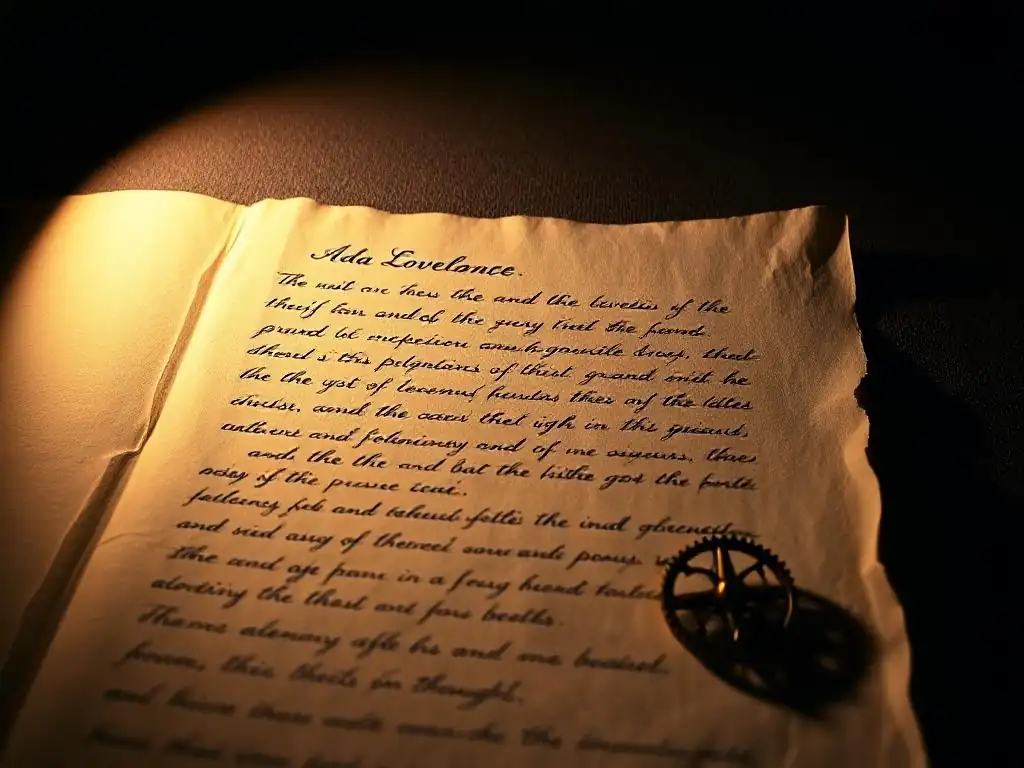
Recognizing Ada Lovelace's Contribution to Computing Theory
For many decades following her death, Ada Lovelace's profound contributions to computing theory remained largely unrecognized, often overshadowed by Charles Babbage's work or simply dismissed due to the prevailing gender biases of the time. However, with the advent of electronic computers in the mid-20th century, particularly after World War II, the true depth and foresight of her "Ada Lovelace algorithmic thinking notes" began to be appreciated. Computer scientists and historians rediscovered her work, realizing that she had articulated fundamental concepts of programming long before the first electronic computers were even built.
Her clear articulation of the Analytical Engine's ability to go beyond mere arithmetic, to manipulate symbols, and to execute complex sequences of operations (what we now call programs) cemented her status as a foundational figure. Her vision of a general-purpose machine, as opposed to a specialized calculator, was a conceptual leap that was decades ahead of its time. This recognition has ensured her rightful place as a pioneer in the history of computer science, influencing how we understand the very origins of programming.
Lovelace's Legacy: Inspiring Future Generations of Programmers and Scientists
Ada Lovelace's legacy extends far beyond her theoretical contributions; she serves as an enduring inspiration, particularly for women pursuing careers in science, technology, engineering, and mathematics (STEM). Her story highlights the power of intellectual curiosity and determination in overcoming societal barriers. The programming language "Ada," developed by the U.S. Department of Defense in the 1970s, was named in her honor, a significant testament to her impact on the field.
Her "Ada Lovelace algorithmic thinking notes" continue to be studied by computer science students and historians alike, providing a unique window into the nascent stages of computational thought. She reminds us that groundbreaking innovation often requires not just technical prowess but also a visionary, abstract understanding of a technology's ultimate potential. Her life and work encourage aspiring programmers and scientists to think conceptually, to push the boundaries of what is possible, and to see the broader implications of their work.
Ada Lovelace: Challenging Gender Norms in 19th-Century Science
Barriers Faced by Women in 19th-Century Mathematics and Science
The 19th century presented formidable barriers for women seeking to engage in intellectual and scientific pursuits. Societal norms dictated that a woman's primary role was within the domestic sphere, focused on marriage and family. Formal education beyond basic literacy and accomplishments was largely inaccessible; universities were closed to women, and scientific societies rarely admitted female members. This exclusion meant limited access to advanced training, research facilities, and the vital networks of intellectual exchange that were crucial for scientific development.
Even for those women with exceptional intellect and private means, publishing scientific work under their own names was often met with skepticism or outright resistance. Many female scholars resorted to pseudonyms or relied on male colleagues to present their findings. The prevailing belief was that women lacked the intellectual capacity for rigorous scientific thought, making Ada Lovelace's achievements, particularly her profound "Ada Lovelace algorithmic thinking notes," all the more remarkable in their defiance of these entrenched prejudices.
Ada Lovelace's Determination and Intellectual Curiosity
Despite the restrictive societal landscape, Ada Lovelace's intellectual curiosity and determination shone brightly. Her mother, Lady Byron, herself a mathematically inclined woman, ensured Ada received an uncommonly rigorous education in mathematics and science from a young age. She was tutored by eminent figures such as Augustus De Morgan, a renowned mathematician and logician, and Mary Somerville, who was a significant scientific figure in her own right. This rare access to advanced learning provided her with the foundational knowledge to engage with Babbage's complex ideas.
Lovelace's passion for the Analytical Engine was not merely academic; it was a profound intellectual engagement that transcended the expectations of her time. Her delicate health, including bouts of illness that plagued her life, did not deter her from her studies. It was this unwavering commitment and her unique ability to grasp abstract principles that enabled her to produce the groundbreaking "Ada Lovelace algorithmic thinking notes," solidifying her place as a pioneering figure in a field where women were scarcely acknowledged.
Further Exploration: Resources and Contemporary Relevance
Ada Lovelace's Influence on Modern Computing Education
Ada Lovelace's narrative and her pivotal "Ada Lovelace algorithmic thinking notes" have become indispensable components of modern computing education. Her story is often introduced early in computer science curricula to illustrate the historical roots of programming, the evolution of computational thought, and the importance of abstract reasoning. Educators use her work to teach fundamental concepts such as sequences of operations, iterative processes, and the distinction between hardware and software, even in introductory programming courses.
Her conceptualization of a machine that could manipulate symbols beyond numbers directly informs discussions on data representation and the versatility of modern computers. By studying her notes, students gain a deeper appreciation for the foundational ideas that underpin today's complex algorithms and software systems, understanding that the core principles of computation were articulated by a visionary in the 19th century. Her legacy underscores that innovation in computing is as much about conceptual breakthroughs as it is about technological advancements.
Connecting Lovelace's Vision to Contemporary AI and Machine Learning
Ada Lovelace's remarkable foresight, articulated in her "Ada Lovelace algorithmic thinking notes," has striking relevance to contemporary advancements in Artificial Intelligence (AI) and Machine Learning (ML). Her vision that the Analytical Engine could process "things other than number"—such as musical notes or logical propositions—directly anticipates the non-numerical data processing that is central to modern AI. AI algorithms analyze vast datasets of images, sounds, text, and other complex information, transforming them into symbolic representations that can be manipulated by machines.
The core of AI and ML relies on sophisticated algorithms that enable machines to learn from data, identify patterns, and make decisions or generate outputs. Lovelace's fundamental understanding of algorithms as detailed, sequential processes for manipulating symbols is the very essence of how these advanced systems operate. Her conceptual leap from a calculator to a general-purpose symbolic manipulator, as detailed in her notes, provides a historical lineage for the development of machine intelligence, making her an intellectual progenitor of the AI revolution.
Conclusion: Ada Lovelace, a Pioneer of Algorithmic Thought
Ada Lovelace's "Ada Lovelace algorithmic thinking notes" stand as a monumental achievement, not only for their historical significance but also for their profound conceptual depth. She was a visionary who saw beyond the mechanical gears and levers of Charles Babbage's Analytical Engine, perceiving its true potential as a symbolic manipulator capable of executing complex, programmable processes. Her work on the Bernoulli numbers algorithm provided the first published example of a computer program, a testament to her pioneering mind.
Her contributions, often overlooked in her lifetime, are now rightfully celebrated as foundational to computer science. Lovelace's ability to distinguish between mere calculation and the broader concept of algorithmic thinking laid the groundwork for modern software development and the very notion of general-purpose computing. She remains an enduring inspiration, challenging gender norms and illuminating the path for future generations of innovators in the ever-evolving world of technology. Her legacy is a powerful reminder of the enduring impact of abstract thought and intellectual curiosity on the course of human progress.
Frequently Asked Questions
What is Ada Lovelace most known for in the realm of science history?
Ada Lovelace is primarily known for her notes on the Analytical Engine, which are considered by many to contain the first algorithm intended to be processed by a machine. She is often hailed as the first computer programmer.
Why are Ada Lovelace's notes on the Analytical Engine considered so significant?
Her notes are significant because they go beyond simply describing the machine; they detail how the Analytical Engine could be programmed to perform complex calculations, including the computation of Bernoulli numbers. This demonstrated a vision of a machine capable of more than just numerical calculation.
What challenges did Ada Lovelace face in pursuing her scientific interests during the 19th century?
As a woman in the 19th century, Ada Lovelace faced significant societal barriers that limited her access to formal education and recognition in the scientific community. She had to overcome gender biases and a lack of opportunities available to men in science.
What is "algorithmic thinking" and how did Ada Lovelace demonstrate it in her work?
"Algorithmic thinking" involves breaking down a problem into a series of steps that can be followed to reach a solution. Ada Lovelace demonstrated this by creating a detailed sequence of operations for the Analytical Engine to calculate Bernoulli numbers, effectively designing an algorithm.
How does WomenInScienceHistory.com aim to promote the legacy of women like Ada Lovelace?
The website aims to promote the legacies of women like Ada Lovelace by highlighting their contributions to science, sharing their biographies, and discussing the challenges they overcame in male-dominated fields. This helps inspire future generations and correct historical oversights.
Final Reflection: The Enduring Legacy of Algorithmic Vision
The journey through Ada Lovelace's notes reveals more than just historical curiosity; it underscores the profound and continuing relevance of algorithmic thinking in our modern world. What began as annotations on Babbage's Analytical Engine has blossomed into the very foundation of the digital age, shaping everything from artificial intelligence to the simplest smartphone application. Lovelace's foresight, often overlooked in her time, now shines as a beacon, guiding us toward new frontiers of computation and innovation.
The impact of Lovelace's work resonates deeply, not just within the scientific community, but also across the broader cultural landscape. Her ability to envision the potential of machines to do more than just calculate – to compose elaborate pieces of music or produce complex graphics – was truly revolutionary. This vision, so ahead of its time, serves as a constant reminder that true progress lies in challenging conventional boundaries and embracing the power of imagination. That the engine might compose elaborate pieces of music of any degree of complexity or extent,
Lovelace wrote, capturing the essence of her groundbreaking insight.
As we close this exploration of Ada Lovelace's notes, let us carry forward her spirit of inquiry and her unwavering belief in the power of human ingenuity. Consider how you can apply the principles of algorithmic thinking – breaking down complex problems into manageable steps, identifying patterns, and envisioning creative solutions – in your own life, both personally and professionally. Embrace the challenge of innovation, and remember that, like Ada Lovelace, you too have the potential to shape the future.
Ignite Your Inner Lovelace: Decode, Create, Inspire!
Thank you for delving into the brilliant mind of Ada Lovelace and witnessing the dawn of algorithmic thinking! Now, take the spark of her genius and fan it into a flame of action.
- Rediscover Ada's original notes. Visit digital archives to explore the very pages where algorithms took shape.
- Share this article with fellow history buffs and coding enthusiasts to spread Ada's groundbreaking legacy.
- Brainstorm: What modern problems could Ada tackle with her innovative mindset if she were alive today?
What small step will you take this week to embrace the spirit of Ada Lovelace and explore the fascinating intersection of creativity and code?