
Caroline Herschel: From Singer to StarFinder, The Mathematics of the Cosmos

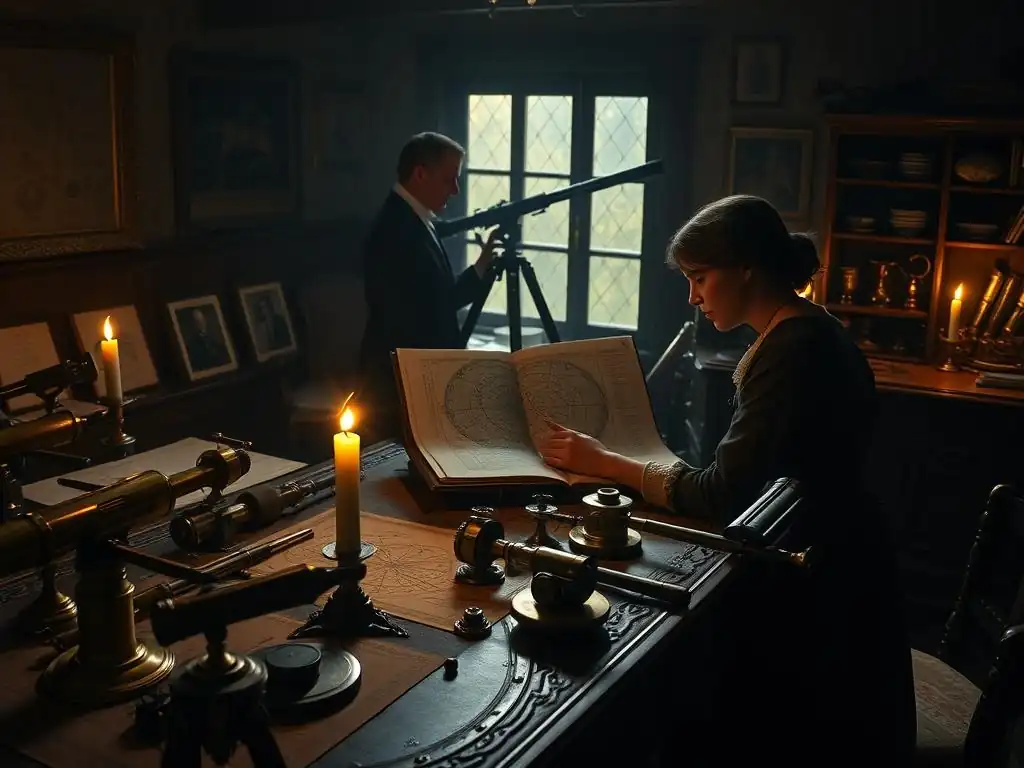
Welcome to WomenInScienceHistory.com, where we illuminate the untold stories of remarkable women who shaped the scientific landscape! Ever wondered how a singer transformed into one of history's most influential astronomers? Dive in to discover the fascinating journey of Caroline Herschel, and unravel the secrets behind her early astronomical observations. Her story is a testament to perseverance and ingenuity, and it all begins here...
First Astronomical Observations and Initial Contributions
Caroline Herschel’s early astronomical observations marked the beginning of her independent contributions to the field, moving beyond her initial role as her brother William’s assistant. Her meticulous nature and tireless dedication quickly became evident as she embarked on systematic sky surveys. Beginning in 1783, she started using her own small reflecting telescope, which William had constructed for her, to search for comets and previously uncataloged nebulae. This focused approach allowed her to scan sections of the night sky with unparalleled thoroughness.
Her diligence paid off significantly in August 1783 when Caroline Herschel’s early astronomical observations led to her first major independent discovery: the nebula Messier 110 (NGC 205), a satellite galaxy of the Andromeda Galaxy. This was a remarkable achievement, followed by her groundbreaking discovery of her first comet on August 1, 1786. This made her the first woman to discover a comet, a feat she would repeat seven more times, solidifying her reputation as a formidable comet hunter and a pioneer in observational astronomy.
The Mathematics Behind Caroline Herschel’s Astronomical Calculations
The success and precision of Caroline Herschel’s early astronomical observations were inextricably linked to her strong mathematical acumen. While William focused on the design and construction of increasingly powerful telescopes and broader theoretical concepts, Caroline meticulously handled the complex calculations necessary to process and interpret the vast amounts of observational data. She routinely spent hours reducing raw observations, applying necessary corrections for instrumental errors, and precisely determining the celestial coordinates of newly identified objects, a process that demanded advanced spherical trigonometry and logarithmic computations.
Caroline Herschel’s mathematical contributions were not limited to data reduction; she also played a crucial role in the verification and refinement of astronomical positions. For instance, upon discovering a new comet, she would undertake the laborious task of calculating its precise path and orbital elements. This mathematical rigor was vital for predicting future appearances of the comet and for allowing other astronomers to confirm her findings. Her numerical precision was indispensable for the accuracy of William’s monumental catalogs of stars and nebulae, ensuring the reliability of the Herschel observatory's contributions to the astronomical community.
- First Astronomical Observations and Initial Contributions
- The Mathematics Behind Caroline Herschel’s Astronomical Calculations
- What were Caroline Herschel's initial roles before becoming an astronomer, and how did they influence her later work?
- How did Caroline Herschel collaborate with her brother, William Herschel, in his astronomical endeavors?
- What were some of Caroline Herschel's most significant independent astronomical discoveries?
- What challenges did Caroline Herschel face as a woman in science during her time?
- How does "WomenInScienceHistory.com" aim to promote the legacy of women scientists like Caroline Herschel?
Frequently Asked Questions
What were Caroline Herschel's initial roles before becoming an astronomer, and how did they influence her later work?
Caroline Herschel initially worked as a domestic servant and then a singer. These roles, while seemingly unrelated, fostered her discipline and dedication, qualities essential for her astronomical pursuits.
How did Caroline Herschel collaborate with her brother, William Herschel, in his astronomical endeavors?
Caroline Herschel served as William's assistant, meticulously recording his observations and performing mathematical calculations. She also independently discovered comets and nebulae.
What were some of Caroline Herschel's most significant independent astronomical discoveries?
Caroline Herschel independently discovered eight comets and several nebulae and star clusters. She also compiled a comprehensive star catalog, significantly contributing to astronomical knowledge.
What challenges did Caroline Herschel face as a woman in science during her time?
Caroline Herschel faced significant challenges due to the prevailing societal biases against women in science. She often had to overcome lack of formal education and limited recognition for her work.
How does "WomenInScienceHistory.com" aim to promote the legacy of women scientists like Caroline Herschel?
"WomenInScienceHistory.com" aims to promote the legacy of women scientists by highlighting their contributions, discussing their groundbreaking work, and inspiring future generations. The site sheds light on their often overlooked narratives.
Final Reflection: Echoes of a Celestial Pioneer
Caroline Herschel's legacy resonates profoundly today, reminding us that groundbreaking discoveries often emerge from unexpected beginnings. Her journey, from a humble singer to a pioneering astronomer, underscores the power of perseverance and the boundless potential within each of us. The meticulous mathematics she employed to chart the cosmos, particularly her early astronomical observations, laid a foundation for our understanding of the universe that continues to inspire scientific exploration.
The impact of Caroline Herschel extends far beyond the scientific realm; it has profoundly shaped our understanding of women's roles in STEM. Her story serves as a potent reminder that brilliance knows no gender and that dedication can shatter societal barriers. I am nothing, I have done nothing; a mere hand, because I was a useful instrument.
This quote, while reflecting her characteristic humility, belies the monumental contributions she made, paving the way for future generations of female scientists to pursue their passions without limitation.
Let Caroline Herschel's unwavering spirit ignite your own curiosity and drive. Embrace the challenges that lie ahead, knowing that even the smallest steps, meticulously calculated and passionately pursued, can lead to extraordinary discoveries. Dare to question, dare to explore, and dare to leave your own indelible mark on the world, just as Caroline Herschel did among the stars.
Embrace the Universe: Chart Your Own Celestial Course!
Thank you for delving into the extraordinary story of Caroline Herschel and the mathematics of the cosmos. We hope you've found her journey inspiring and insightful. Now, it's your turn to connect with the wonders of the universe.
Here are a few ways to continue your exploration:
- Emulate Caroline's Curiosity: Download a free stargazing app and identify a constellation tonight! Discover the patterns and stories in the night sky.
- Explore: Research the contributions of other women in astronomy and mathematics, and share their stories with your friends.
- Contribute: Join a local astronomy club or online forum to connect with fellow stargazers and learn even more.
What will you discover when you look up at the night sky?